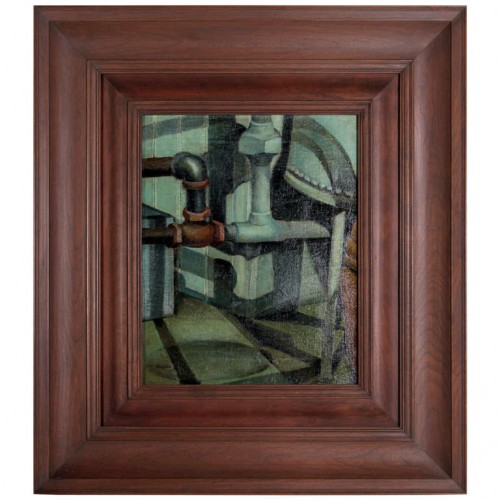
Otis Oldfield, Water Pipes and Shadows, Oil on Canvas c. 1920
OTIS OLDFIELD (1890-1969) USA
“Water pipes and shadows” c. 1920
Oil on canvas, walnut frame
Signed: Otis Oldfield (lower left)
For more information see: Otis Oldfield 1890-1990, Centennial retrospective exhibition (San Francisco, CA: Inkwell Publishing, 1990).
Painting: H: 16 1/8” x W: 13”
Framed: H: 28 ¼” x W: 25 1/8”
Price: $42,500
***The Metropolitan Museum of Art in New York owns a famous Gelatin silver print photograph by Morton Schamberg from 1916 entitled “God”. This image is akin to Duchamp’s “Fountain” and is an iconic Dadaist assemblage of plumbing pipes mounted on a miter box. The “Water Pipes and Shadows” painting by Otis Oldfield similarly brings a certain animation and personality to an under sink composition of mundane drain pipes in a sophisticated “Rayonist” or “Cubist” stylization. Otis Oldfield was born in Sacramento, California in 1890. He enrolled in the Best Art School in San Francisco in 1909 and continued his studies at the Academie Julian in Paris. Returning to the U.S., Oldfield settled briefly Sacramento before returning to San Francisco to accept a post as a teacher at the California School of Fine Art. Oldfield developed a bold modernist style, which caused some controversy among critics covering his exhibits. In 1936 Oldfield was one of a group of San Francisco artists chosen for a WPA project to paint murals in San Francisco’s Coit Tower. Following WW II, Oldfield taught at the California College of Arts and Crafts in Oakland. He died in San Francisco in 1969.
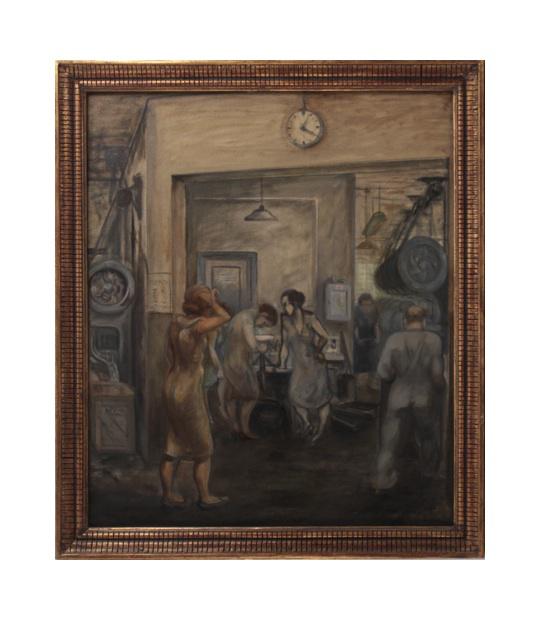
Arrigo Varettoni de Molin, “Cocktail Hour”, Oil on canvas 1937
ARRIGO VARETTONI DE MOLIN (1902-1985)
Cocktail Hour 1937
Oil on canvas
Signed: Arrigo V de Molin (on front of canvas), #4 Cocktail Hour, Arrigo Varettoni de Molin, 323 West 4th Street, 79 Horatio Street (paper label attached to back of frame)
Listed: Who’s Who in America, Series II, no. 11 (November 1, 1941) p. 6.
Exhibited: The Society of Independent Artists, 1939; Vendome Art Galleries, 1941
Painting reviewed: “Three Newcomers Enliven the Season’s Beginning” Roy Finch, The New York Herald Tribune (September 7, 1941).
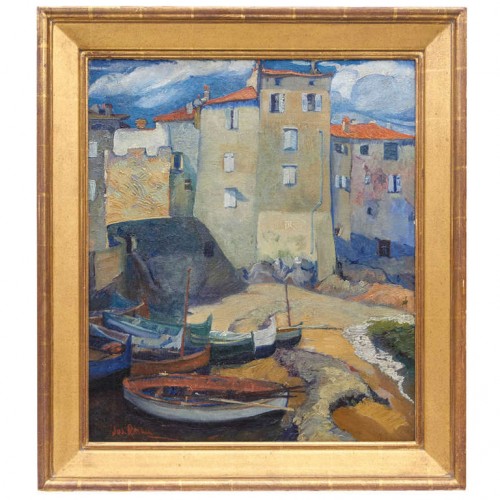
Joseph Raskin, Seaside scene, Oil on Canvas c. 1920 -1925
JOSEPH RASKIN (1897-1981) USA
Seaside scene c. 1920 -1925
Oil on canvas, gold leaf frame
Signed: Jos. Raskin (lower left)
For more information see: Who Was Who in American Art,
(Madison, Conn.: Sound View Press, 1985), p. 505
Canvas: 25 1/4” x 21 1/4”
Frame: 31 1/4” x 26 3/4”
Price: $35,000
Born in Nogaisk, Russia, Joseph Raskin made a name for himself as a painter in New York City, where he was also recognized as an etcher, teacher and writer. He studied at the National Academy of Design and, in 1921, received a fellowship from the Louis Comfort Tiffany Foundation. A member of the American Artists Congress, Raskin’s work was exhibited at the Schervee Gallery (Boston) in 1927, Tricker Gallery in 1939, the Schneider-Gabriel Gallery in 1941, Steinway Hall in 1942, and the American Artists Association in 1945. Raskin’s work may be found in several museum collections including the Carnegie Institute in Pittsburgh, the Pennsylvania Academy of Fine Arts in Philadelphia, the Virginia Museum of Fine Arts in Richmond, and the Corcoran Gallery of Art and National Academy of Design, both in Washington, D.C.
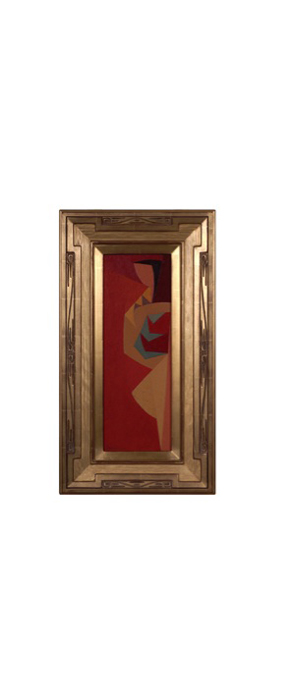
Karl Benjamin, “Geo-metricized figure”, Oil on canvas 1954
KARL BENJAMIN (1925-2012) USA
Geometricized figure 1954
Oil on canvas
Signed: Benjamin 54 (lower left)
For more information see: Dictionnaire des Peintres, Sculpteurs, Dessinateurs et Graveurs, Vol. 1 to 10, E. Bénézit (Paris: Librairie Gründ, 1976).
Canvas: H: 17″ x W: 6″
Framed: H: 24 1/2″ x W: 13 1/2″
Karl Benjamin was born in Chicago, IL in 1925. He received his BA from the University of Redlands, CA and his MFA at Claremont Graduate School, CA. Benjamin belonged to the Hard Edge group of West Coast painters led by John McLaughlin during the 1950s, 60s and early 70s. He was awarded the National Endowment for the Arts Grant for Visual Arts in both 1983 and 1989. His work has been featured in numerous museum exhibitions and is included in the public collections of the Los Angeles County Museum of Art; Museum of Contemporary Art, Los Angeles; Museum of Modern Art, Israel; Oakland Museum, Oakland, CA; San Francisco Museum of Modern Art, CA; Seattle Art Museum, WA; and the Whitney Museum of American Art, NY, among others. For many years, Benjamin taught painting at Pomona College and Claremont Graduate School, and currently is Professor Emeritus. He lived in Claremont, CA.




 @hd_jewels