Benin Bronze Head of King Oba, African, Nigeria 20th Century
More Information
Benin Bronze Head of King Oba, African, Nigeria 20th Century
NIGERIA
Benin Head of King Oba, c. early to mid-20th Century
Lost wax cast bronze with a rich brown and black patina with light desert sand patina in some of the recessed areas.
The art of Benin is the product of an urban royal court, and is meant to symbolize and to extol the power, mystique, grandeur, continuity, and endurance of the ruling dynasty and its governing institutions. From the 14th century until its fall in 1897, Benin was ruled by the Oba, a divine ruler at the head of the political system of titled chiefs. Under royal support, a number of craftsman’s guilds produced bronze, brass, and wood sculptures and embroidered cloth, all of which have become prized by museums and collectors.
These heads were typically placed on altars dedicated to each of the past Oba’s of Benin. The altars are semicircular mud platforms that have been packed hard and rubbed smooth and are located in open courtyards of the palace. The royal altars are the settings for one of the two most important rites of divine kingship in Benin, Ugie Erha Oba, when the Oba honors the spirit of his late father and performs sacrifices to the royal ancestors and to the earth in which they are buried. Acknowledging his role as his fathers’ successor, the chiefs pay homage to the king and greet him in order of seniority. The rite expresses the continuity of divine kingship, and the altar before which it takes place provides the means by which the connection between the living king and his predecessors was established and made.
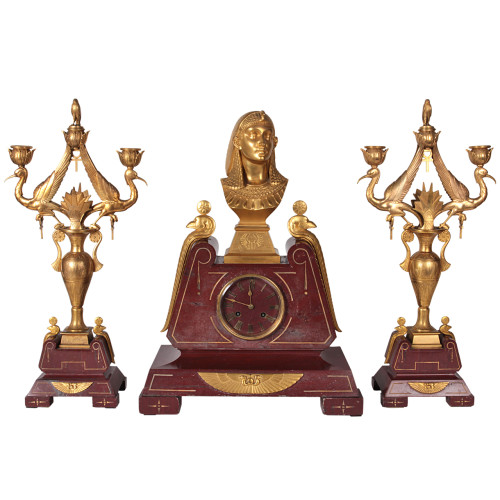
Paul-Auguste Gagné, French Egyptian Revival Gilt Bronze Garniture Set c. 1875
Paul-Auguste Gagné (Sculptor) France
Egyptian Revival garniture set, circa 1875
Gilt bronze and carved rouge marble mantle clock and candelabra in a high Egyptian Revival style
Marks: P.A. Gagne (elaborate incised scroll signature on the back of the portrait bust)
For more information on Gagné see: Dictionnaire des peintres, sculpteurs, dessinateurs et graveurs, vol. 4, E. Bénézit (Paris: Librairie Gründ, 1976) p. 579.
For other related Egyptian Revival garniture sets see: Egyptomania: Egypt in Western Art, 1730-1930 (Paris: Éditions de la Réunion des Musées Nationaux and Ottawa: National Gallery of Canada, 1994)
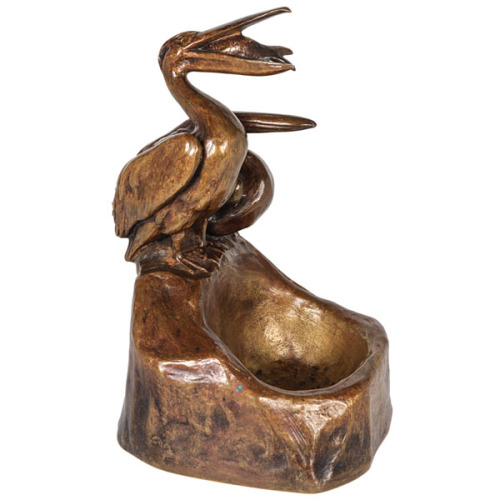
Friedrich Gornik Bronze “Pelican” Art Nouveau Vide Poche c.1910
Friedrich Gornik (1877-1943) Austria.
“Pelicans” vide poche c. 1910.
Bronze with a natural gold patina of two pelicans on a rock, one seated and the other eating fish.
Marks: F Gornik and monogram.
For more information on Friedrich Gornik see: Der Österreichische Werkbund, Astrid Gmeiner & Gottfried Pirhofer (Salzburg & Wien: Residenz Verlag,1985) p. 228; Österreichische Keramik des Jugendstils, Waltraud Neuwirth (Munich: Prestel-Verlag, 1974) p. 156.
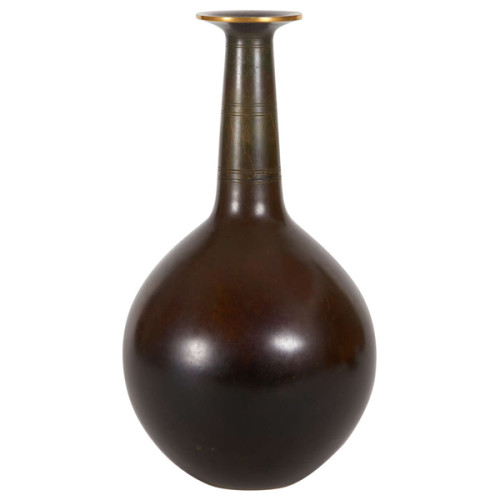
Just Andersen Denmark Art Deco Grand bronze vase c. 1935-40
JUST ANDERSEN (1884-1943) Denmark
Grand vase c. 1935-40
Rich deep brown patinated bronze, neck with three sets of four incised lines, with flaring rim and gilt edge
Marks: DENMARK, JUST (in a triangular cartouche), No. B 2055
For more information see: “Just Andersen: Manden og Vaerket” by Svend Rindholt in Samleren: Tidskrift for Kunst og Kunstindustri (Attende Aargang, 1941) pp. 171-194; Dansk Biografisk Leksikon. Første Bind (Copenhagen: Gyldendal, 1979) p. 199. The Design Encyclopedia. Mel Byars (New York: John Wiley & Sons, Inc., 1994) p. 23.
H: 13 1/2″ x Dia: 8″
Designer Just Andersen trained with Peter Hertz and Mogens Ballin, the premier silversmith in Copenhagen. He was also employed as a designer for Georg Jensen before he decided to open his own silver and metal studio in 1918. The elegant, simple forms and richly-patinated surfaces are highly characteristic of Andersen’s high level of design and superlative craftsmanship.




 @hd_jewels