Benin Bronze Head of King Oba, African, Nigeria 20th Century
More Information
Benin Bronze Head of King Oba, African, Nigeria 20th Century
NIGERIA
Benin Head of King Oba, c. early to mid-20th Century
Lost wax cast bronze with a rich brown and black patina with light desert sand patina in some of the recessed areas.
The art of Benin is the product of an urban royal court, and is meant to symbolize and to extol the power, mystique, grandeur, continuity, and endurance of the ruling dynasty and its governing institutions. From the 14th century until its fall in 1897, Benin was ruled by the Oba, a divine ruler at the head of the political system of titled chiefs. Under royal support, a number of craftsman’s guilds produced bronze, brass, and wood sculptures and embroidered cloth, all of which have become prized by museums and collectors.
These heads were typically placed on altars dedicated to each of the past Oba’s of Benin. The altars are semicircular mud platforms that have been packed hard and rubbed smooth and are located in open courtyards of the palace. The royal altars are the settings for one of the two most important rites of divine kingship in Benin, Ugie Erha Oba, when the Oba honors the spirit of his late father and performs sacrifices to the royal ancestors and to the earth in which they are buried. Acknowledging his role as his fathers’ successor, the chiefs pay homage to the king and greet him in order of seniority. The rite expresses the continuity of divine kingship, and the altar before which it takes place provides the means by which the connection between the living king and his predecessors was established and made.
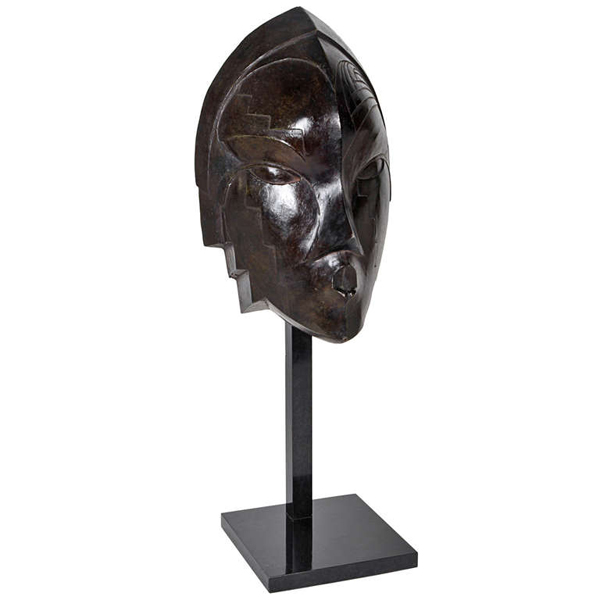
Andree Flamant-Ducany-Gide / Valsuani Foundry French Cubist bronze “African” mask sculpture 20th Century
ANDREE FLAMANT-DUCANY-GIDE (1882-1970) France
VALSUANI FONDEUR (1899-1981) Paris, France
Cubist mask sculpture 20th Century
Cast bronze with rich brown-black patina (possibly cast at a later date by the Valsuani Foundry)
Marks: G. Flamant, 2/8 C. Valsuani Cire Perdue (signed on chin)
H: 11” x W: 7” x D: 5 ½”;
On stand: H: 18 ½”
Price: $35,000
ANDREE FLAMANT-DUCANY-GIDE
Flamant-Gide was born in Nimes, France on January 2nd, 1892 and died on March 28th 1970. She was both a painter and sculptor and exhibited regularly at the Salon des Artists Francais beginning in 1923. She sculpted in an angular Cubist style influenced by African Art and was a fellow artist of Joseph Csaky, Gustave Miklos, Jacques Lipchitz and Henri Laurens who were considered the leading Art Deco sculptors in Paris during the 1920’s.
CUBISM
Cubism drew its influence from: Cezanne’s structural analysis in his oil landscapes, e.g. ‘La Montagne Sainte Victorie’ c.1887; Gauguin’s figurative landscapes, e.g. ‘Haymaking’ 1889; and African tribal Art such as Gabon masks. European artists were greatly influenced by African and Oceanic Art during the late 1890s and early 1900s. African sculpture, with its bold shapes and lines, had a great impact on the development of Cubism. Maurice de Vlaminck became a keen admirer and collector of African masks after seeing them in a Paris anthropological museum. He purchased similar masks and his excitement for these works displaying bold primitive expressions and simplistic design filtered through to Matisse, Derain, Gris and Picasso, who all became collectors as well. By the 1920s African art exhibitions were common in Paris and other cities throughout Europe.
Cubist sculpture brought the simplified shapes of Cubist painting together with the three-dimensional modeling medium of sculpture. The first Cubist sculpture, which could be properly deemed as such was made by Picasso in 1909 and was titled ‘Head of a Woman’. However Picasso did experiment with sculptural forms as early as 1907 when he found himself fascinated and deeply influenced by African masks. Cubist sculpture was mostly reminiscent of Analytical Cubism in its stripping away of illusionist details to reveal the fundamental form contained in each individual subject, be it human or still-life.
VALSUANI FOUNDRY
The Valsuani foundry was started by the brothers Claude and Attilio Valsuani who learned the foundry trade while employed at the Hebrard foundry. While working for Hebrard, Claude Valsuani showed great promise as a finisher and eventually worked his way up to become the Technical Director of the Hebrard foundry. In 1899 Claude Valsuani started his own foundry in Chatillon, casting mostly small works for various artists primarily using the lost wax technique of casting (cire perdue). In 1905 he moved his foundry to 74 Rue des Plantes in Paris. Among the famous sculptors who had the Valsuani foundry cast their works were: Renoir, Picasso, Despiau, Paul Troubetzkoy, Matisse, and Gaugin. Claude Valsuani died in 1923 in his native Italy but his son, Marcele then took over the foundry and continued the tradition of producing extremely fine bronzes until the 1970’s.
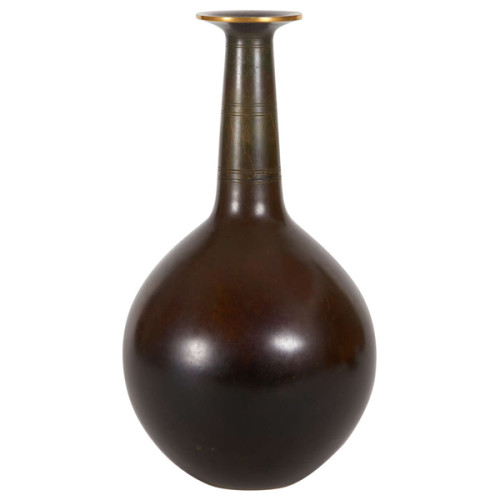
Just Andersen Denmark Art Deco Grand bronze vase c. 1935-40
JUST ANDERSEN (1884-1943) Denmark
Grand vase c. 1935-40
Rich deep brown patinated bronze, neck with three sets of four incised lines, with flaring rim and gilt edge
Marks: DENMARK, JUST (in a triangular cartouche), No. B 2055
For more information see: “Just Andersen: Manden og Vaerket” by Svend Rindholt in Samleren: Tidskrift for Kunst og Kunstindustri (Attende Aargang, 1941) pp. 171-194; Dansk Biografisk Leksikon. Første Bind (Copenhagen: Gyldendal, 1979) p. 199. The Design Encyclopedia. Mel Byars (New York: John Wiley & Sons, Inc., 1994) p. 23.
H: 13 1/2″ x Dia: 8″
Designer Just Andersen trained with Peter Hertz and Mogens Ballin, the premier silversmith in Copenhagen. He was also employed as a designer for Georg Jensen before he decided to open his own silver and metal studio in 1918. The elegant, simple forms and richly-patinated surfaces are highly characteristic of Andersen’s high level of design and superlative craftsmanship.
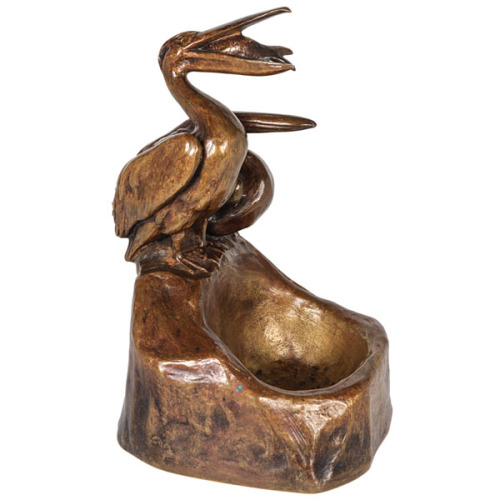
Friedrich Gornik Bronze “Pelican” Art Nouveau Vide Poche c.1910
Friedrich Gornik (1877-1943) Austria.
“Pelicans” vide poche c. 1910.
Bronze with a natural gold patina of two pelicans on a rock, one seated and the other eating fish.
Marks: F Gornik and monogram.
For more information on Friedrich Gornik see: Der Österreichische Werkbund, Astrid Gmeiner & Gottfried Pirhofer (Salzburg & Wien: Residenz Verlag,1985) p. 228; Österreichische Keramik des Jugendstils, Waltraud Neuwirth (Munich: Prestel-Verlag, 1974) p. 156.





 @hd_jewels