Product Description
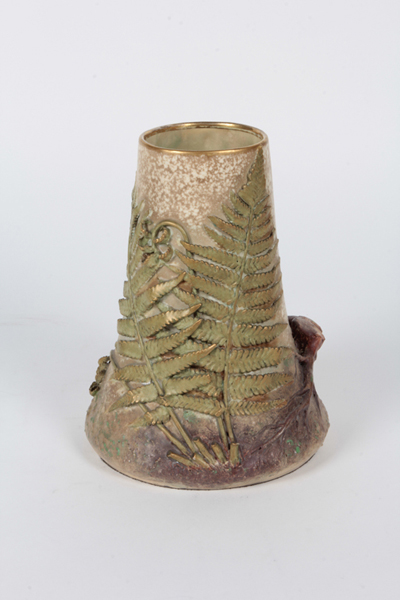
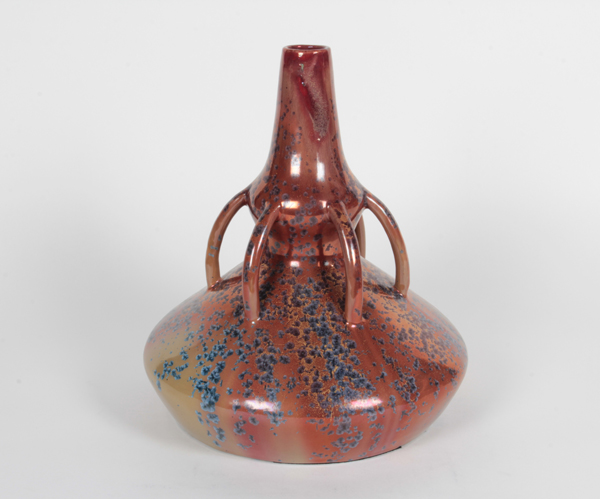
Amphora Art Pottery / Eduard Stellmacher Art Nouveau “Fern fronds” vase c. 1900

EDUARD STELLMACHER Turn-Teplitz, Austria
AMPHORA ART POTTERY Turn-Teplitz, Austria
“Fern fronds” vase c. 1900
Glazed earthenware with applied three-dimensional fern fronds
Marks: STELLMACHER TEPLITZ, Amphora mark, 1145, 7
For more information see: Deutsch Kunst und Dekoration, ( March 1901) pp. 346-349; Sammlung Bröhan: Kunsthandwerk, Glas, Holz, Keramik, Vol. 1 Band II (Berlin: Bröhan Museum, 1976), pp. 284-293.
H: 8″ x Dia: 6 1/4″
Amphora Art Pottery / Eduard Stellmacher Art Nouveau “Fern fronds” vase c. 1900
SEVARD France (active 1920’s/1930’s)
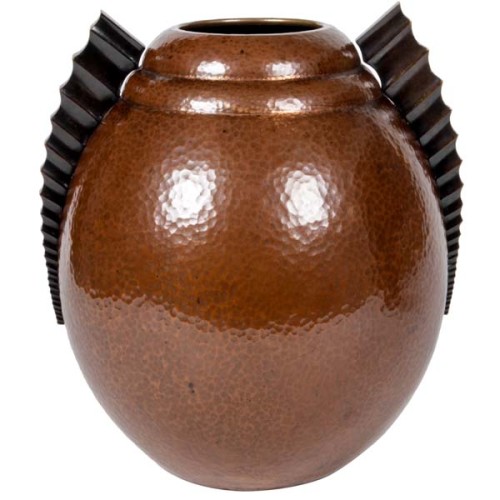
Dinanderie vase with fish fins c. 1925
Hand wrought and hand hammered copper with a rich chocolate-brown
patination and bronze fin-like handles, gilt detailing
Marks: Sevard (inscribed signature), “France”
H: 7 7/8” x W: 8 3/4”
GUSTAVO PEREZ Mexico
Stoneware vase 2000
Black, randomly positioned rectangles on a cream / sandy base with a pinned overlap detail
Signed: GP 2000-68
H: 9 1/4″ x D: 6 1/2″
Price: $5,500
Gustavo Pérez makes vessels that are simple, smooth and symmetrical. Their elegance is due to the precision of the incised lines and other markings on the pots. While using the same clay body—sand colored stoneware—throughout his work, the artist achieves a wide range of form and pattern and includes slowly undulating walls beneath the subtly incised surfaces.
Gustavo Pérez works are incessantly experimental. There have been parallel lines, calligraphic traces, geometric cuts into the surface, minimalist vessels, recollections of pre-Hispanic vases and references to other ancient cultures.
The ceramics of Gustavo Pérez are distinguished by eliminating superfluous details, by synthesis of his elements. During the past two decades he has created a visual language that seems closely aligned with music. Pure in form, with a significant structure, completely abstract and without specific associations, his language of line, the bending of forms, and the definition of the vessel mark his work as a distinctive voice. The form is not just a container or a receptacle; it is architecture.
CLÉMENT MASSIER (1845-1917) France
MASSIER ART POTTERY Golfe Juan, France
“Bamboo and flying crane” vase c. 1900
Earthenware tapering form with applied handles, hand painted with bamboo and flying cranes with gilt motives and details
Marks: Clement Massier Golfe Juan (block impressed letters)
For more information and other works by the Massier family see: Lost Paradise: Symbolist Europe (Montreal, Quebec: The Montreal Museum of Fine Arts, 1995) p. 176, cat. 269; Jugendstil Art Nouveau, Floral and Functional Forms, Siegfried Wichmann (New York/Boston: Graphic Society/Little, Brown & Co., 1984) p. 45; Art Nouveau Belgium France. Exh. cat. Yvonne Brunhammer et al. (Houston, TX: Institute for the the Arts, Rice University, 1976); La Céramique Art Nouveau, Edgar Pélichet, Michèle Duperrex (Paris: La Bibliothèque des Arts, 1976) p. 89
H: 14 1/8” x D: 9 5/8”
Tsuchida Yasuhiko (b. 1969) Osaka, Japan/ Italy
Art glass mosaic technique vase 1999
Overall matte finish art glass vase with an elaborate mosaic technique inset with red rectangular patchwork sections and blue murrina jewels all on a chocolate brown body with a black glass foot
Marks: Tsuchida Yasuhiko 99, 77
For more information see: Tsuchida Yasuhiko, exh. cat., Franco Schiavon (Murano, Italy: Palazzo del Vetro, 2000).
Provenance: Pauly & Co. Venice
H: 4 3/4″ x Dia: 5 1/8″
Price: $5,450
Yasuhiko Tsuchida was born in Osaka, Japan in 1969. In 1988, soon after graduating TSUJI Culinary Institute, he left Japan to explore food and art in Paris. Since 1992, he has lived in Venice, Italy. Tsuchida has been making glass work in Murano Island since 1995, and next year assumed the office of art director at Schiavone Glass Co. Ltd. In 1996 he presented a glass sculpture entitled “Bamboo Collection” with Japanese motif of bamboo. The work was highly acclaimed, which gave him a chance to start to hold solo exhibitions around the world. In 2000, Tsuchida became a member of the board of directors at Venetian Glass Institute, and a chief director there in 2003. In 2004, he won Honorary Technique Prize in Düsseldorf, Germany, and in 2008, received Award of Contribution to Cultural Promotion from Grosseto city, Toscana. In the same year, he represented Japan at International Open Exhibition of Sculpture, and won the Grand-Prix. In 2010, Tsuchida was invited to the Issei Miyake “IM10” Project Competition, and held a solo exhibition at Lorusso Gallery, Andria, Italy. Tsuchida continues to exhibit in many solo shows around the world.