Product Description
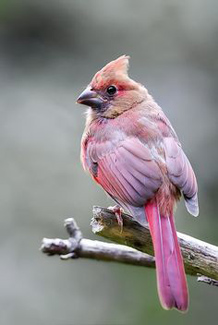
Asprey & Co., Important Cardinal Sculpture gem set with natural rubies, 18K gold and amethyst quartz, signed, 1980

ASPREY & CO. LTD. (founded 1781) London, UK
Important Natural Ruby Gem Set 18K Gold Cardinal Bird Sculpture 1980
Finely chased and chiseled 18K yellow and white gold realistically rendered sculpture of a Cardinal bird set with
85+ carats (approx.) of natural gem quality oval and round cut Burmese rubies (GIA certificate) further heightened with enamel eyes and blackened gold face plumage details, the 18K gold and natural ruby cardinal sets atop a natural Amethyst crystal “mountain rock” with a tooled and gilt (script mark) on the leather under-pad.
Marks: A & Co. (in a quatrefoil), Crown mark, 750 (gold standard mark) Lion’s head (London assay mark) “F” date mark for 1980, tooled and gilt Asprey (script mark) on the leather under-pad
Provenance: Privately commissioned by the Sultan of Brunei’s younger brother, Prince Jefri Bolkiah who also later became the owner of Asprey & Co in the 1995. This rare sculptural 18K gold and natural ruby Cardinal was handmade by the finest jewelers and work masters in the workshop of the London Asprey & Co. located above the flagship store at 167 New Bond Street.
H: 3 ¾” x L: 5 3/4” x W: 1 ½”(Cardinal only)
H: 6” x W: 6 ¾” x D: 5 ¾” (with Cardinal atop natural Amethyst crystal rock)
As one might guess, a large part of the animal symbolism of the cardinal comes from the brilliant red color of the males. In fact, its name is derived from the royal red vestments worn by Catholic cardinals. This shock of red, especially against the stark backdrop of winter snow, is a magnificent sight. The male cardinal reminds us passion, warmth and vibrancy is available to us – even under the cloak of Winter’s grey clouds. Interestingly, the more bold and bright his color is, the more successful the cardinal will be at prolonging his lineage. Dull colored male cardinals are less likely to mate successfully than bright colored ones. True to the fire of his color, the crimson cardinal has got some major spunk. He will aggressively defend his territory, and fight attackers with ferocity. Indeed, they have been known to fight ghost males (their reflections) in mirrors for hours on end. Both male and female give us glorious songs. Along with peeps and pips and warbles, the tuned ear can also hear “cheer, cheer, cheer!” Very appropriate to the animal symbolism of cardinals, because they are a delight to both eyes and ears. The cardinal makes a fantastic animal totem. It reminds us to hold ourselves with pride, not ego pride but rather the cardinal asks us to stand a little taller, be a bit more regal and step into our natural confidence as if we were born to lead with grace and nobility. Those who attract the cardinal as their totem are naturally energetic, love life, and happily help others where and when they can!
Asprey & Co., Important Cardinal Sculpture gem set with natural rubies, 18K gold and amethyst quartz, signed, 1980
TIM LIDDY
“Who Can Beat Nixon” (1970) Presidential Sweepstakes 2006
Oil and enamel on copper, plywood back
Signed in script: Tim Liddy “circa 1970” 2006, red circular ring
Provenance: William Shearburn Gallery (St. Louis, MO)
H: 11 ¾” x W: 9” x D: 2”
With his recent paintings, Liddy has both reasserted the construct of hyperrealist painting and developed a thoroughly unique advancement of that mode by extending the cultural reality of the indexed original. Based on the illustrated box lids of vintage board games, Liddy has recontextualized a subject, which evokes the underlying rules of life. Painted on copper or steel in the precise dimensions of the original, the metal is then manipulated to demonstrate the exact rips and tears from years of usage and includes trompe-l’oeil renditions of the scotch tape that might be holding the cardboard box together, the assorted stains, or the various graffiti of time. Liddy leaves no possibility of ambivalence, these works speak to a concurrent understanding of their original object identity and to themselves as works of art engaged in historical and psychological dialogue.
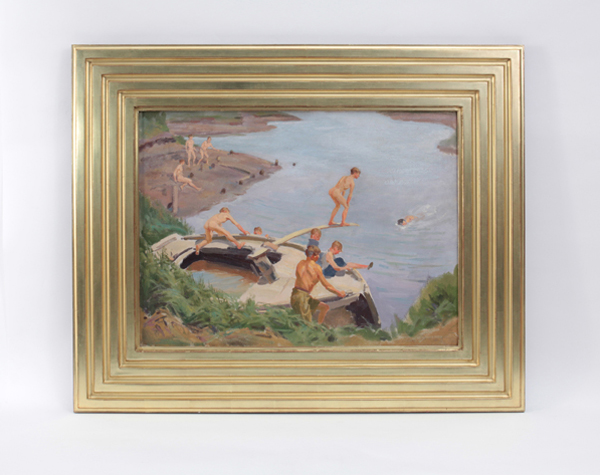
EDMUND F. WARD (b. 1892 – 1991) USA
“The Swimming Hole” c. 1930
Oil on canvas
Marks: signed Edm. F. Ward (lower right); partial labels verso:Westchester Arts and Crafts Guild; 4 Edmund F. Ward
For more information on the artist see: Who Was Who in American Art,Peter Hastings Falk, ed. (Madison, Conn.: Sound View Press, 1985), p. 658.
Canvas H: 18” x W: 24”
Framed H: 27 9/16” x W: 33 9/16”
Price: $14,000
Ward studied at the Arts Student’s League with Edward Dufner, George Bridgeman, and Thomas Fogarty. He was an illustrator for several national magazines and books. In 1925, Ward exhibited an award winning work at the Art Institute of Chicago. He is perhaps best known for his WPA mural in the Federal Building, White Plains, New York.
HUBERT SCHMALIX (1952-) Austria
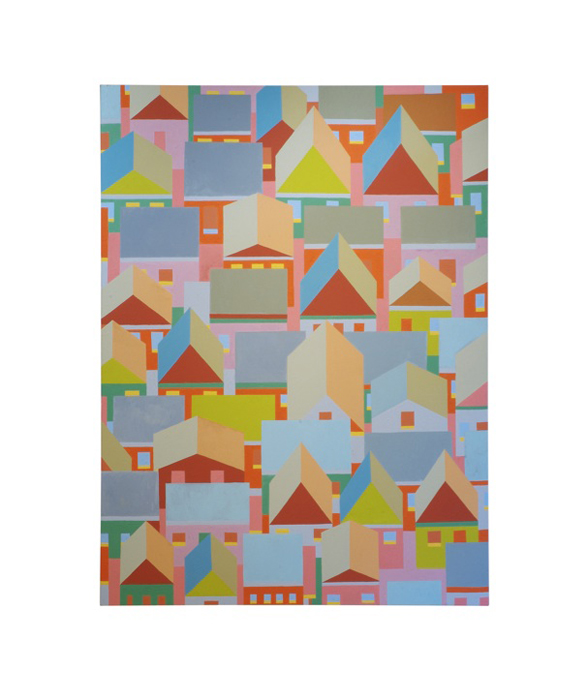
Mount Washington 2005/06
Oil on canvas
Signed and dated on back: Schmalix 05 06
Provenance: Hubert Schmalix Vienna
For related works by Hubert Schmalix see: Hubert Schmalix, Lóránd Hegyi exhibition catalog (Museum moderner Kunst Stiftung Ludwig Wien) November 19, 1994 – January 1995.
H: 69” x W: 51”
Hubert Schmalix was born in Graz, Austria, on December 17, 1952 and studied at the Vienna Art Academy from 1971 to 1976. By 1979 Schmalix was showing work at the forward-looking exhibition ‘Europa 79 – Kunst der 80er Jahre’ in Stuttgart. In 1983 the London Tate Gallery invited Schmalix to present work at ‘New Art’, an important survey of contemporary art. Schmalix has become well-known world-wide as an exponent of ‘New Art’, working with a retrospective glance at both classical art history and modern art. Schmalix focuses on the world of things and the human figure. Although the expressive gesture was the dominant feature of his 1980s work, it yielded early in the 1990s to stringent tectonic composition. In 1984 Hubert Schmalix went to the Philippines and on to the US, moving to Los Angeles in 1987. In 1986-87 Schmalix taught at the Academy for the Decorative and Applied Arts in Vienna and from 1997 he has been a professor at the Vienna Art Academy. Schmalix is a visiting professor at the University of California Los Angeles (UCLA). In 1993 his work was featured at the Venice Biennale and in 1998 he was awarded the Fine Art Prize of the City of Vienna. Schmalix has done several large fresco cycles in Salzburg and his work has been shown extensively at numerous international solo and group shows and most recently at Art Basel 2006.