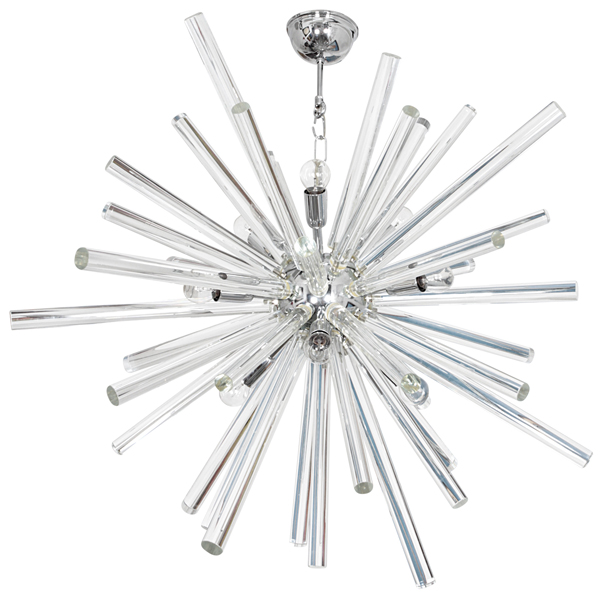
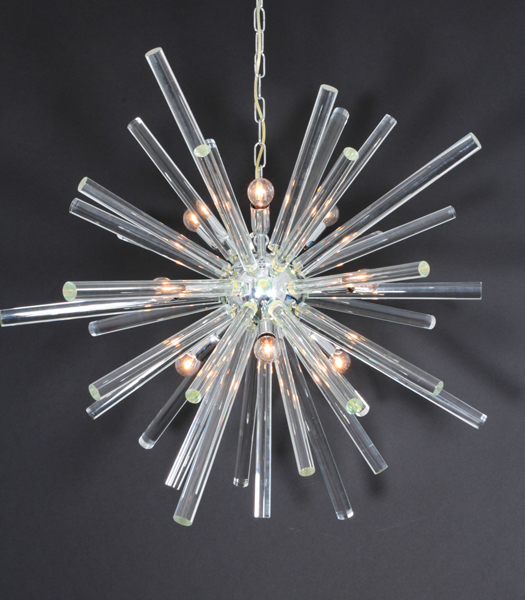
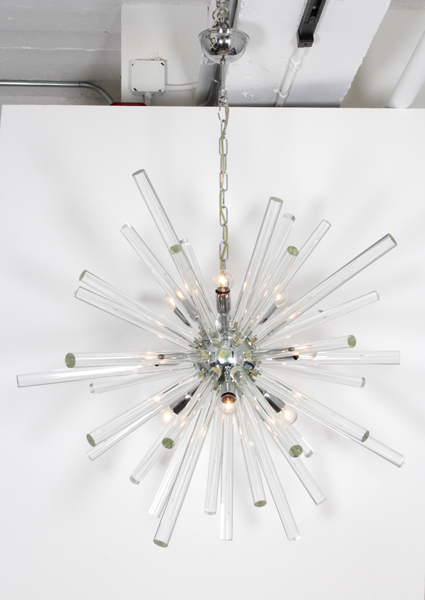
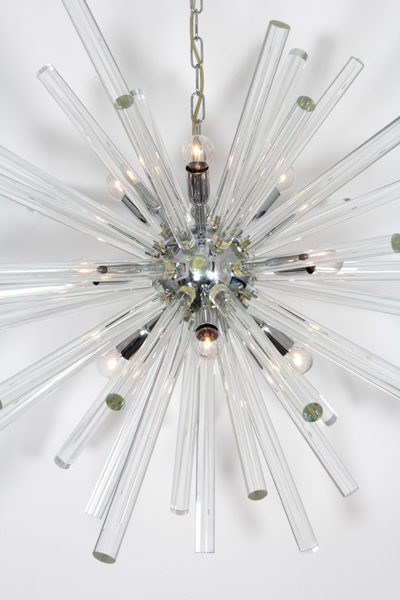
Bakalowits & Söhne Spectacular "Starburst" chandelier c. 1970's
More Information
Bakalowits & Söhne Spectacular “Starburst” chandelier c. 1970’s
BAKALOWITS & SÖHNE (founded 1845 in Vienna)
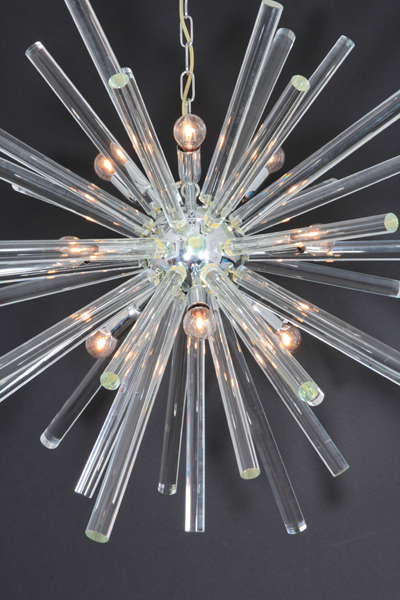
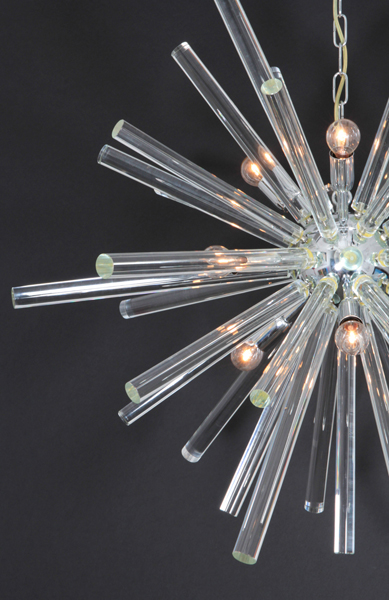
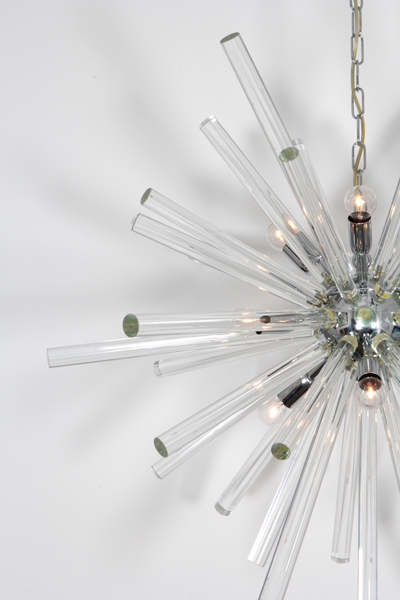
“Starburst” chandelier c.1970’s
Crystal rods of varying lengths with nine lights,
chromium-plated metal ceiling cap and spherical chandelier parts.
Ceiling to drop length: 46 1/2″ x overall diameter: 33 1/2″
Price: $24,000
The Bakalowits Company was founded in Vienna, Austria in 1845 by Elias Bakalowits. After his son Ludwig joined the company, E. Bakalowits & Sons grew and became one of the foremost crystal chandelier manufacturers in the Austro-Hungarian Empire. In 1892 Ludwig Bakalowits received the order to manufacture the chandeliers for the Neue Hofburg Palace in Vienna for Emperor Franz Joseph I and was appointed Imperial and Royal Purveyor to the Court.
The company’s reputation for excellence grew outside Europe, and by 1885 the company was exporting its products to America and Asia. In 1900, Bakalowits & Sons displayed their crystal chandeliers at the World Exposition in Paris. Other exhibitions in St. Petersburg, London, Geneva and Turin followed and attracted more clients from around the world. In 1928, the company obtained patents for its crystal chandeliers. In 1955 Bakalowits was entrusted with the manufacture of new lighting fixtures for some of the Viennese buildings that had suffered damage during the Second World War. These included the Parliament, the State Opera House, the National theatre, City Hall, St. Stephan’s Cathedral, and others.
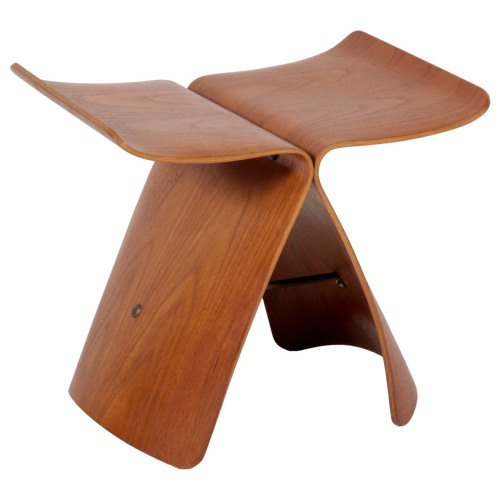
Sori Yanagi / Tendo Co. Ltd. / Japanese Crafts “Butterfly” Stool c.1956
Sori Yanagi (1915-2012), Japan
Tendo Co. Ltd., Japan
Butterfly stool, 1956.
Bleached rosewood veneer on plywood with brass.
H: 15” x W: 16 ½” x D: 12”
Price: $4,900
This model can be found in the collections of the Museum of Modern Art and the Metropolitan Museum in New York.
The Japanese designer Sori Yanagi is best known for his 1956 Butterfly Stool. It is both elegant and utterly simple: two curved pieces of molded plywood are held together through compression and tension by a single brass rod. The stool’s graceful shape recalls a butterfly’s wings, and has also been compared to the form of torii, the traditional Shinto shrine gates. He loved traditional Japanese crafts and was dedicated to the modernist principles of simplicity, practicality and tactility that are associated with Alvar Aalto, Charles and Ray Eames, and Le Corbusier.”
Yanagi, who studied architecture and art at Tokyo’s Academy of Fine Art, was inspired by the work of Le Corbusier and by the designer Charlotte Perriand, with whom he worked in the early 1940s, while she was in Tokyo as the arts and crafts adviser to the Japanese Board of Trade. But perhaps the most indelible influence on Yanagi was that of his father, Soetsu Yanagi, who led the “mingei” movement, which celebrated Japanese folk craft and the beauty of everyday objects, and who founded the Nihon Mingeikan (or Japanese Folk Crafts Museum) in Tokyo. Yanagi fils, who was named director of the museum in 1977, succinctly described his design aesthetic in a 2002 interview in The Japan Times: “I try to create things that we human beings feel are useful in our daily lives. During the process, beauty is born naturally.” Throughout his life, Sori Yanagi was inspired by what he called “anonymous design” — he cited the Jeep and a baseball glove as two examples — and he in turn inspired younger designers, like Naoto Fukasawa, Tom Dixon and Jasper Morrison.




 @hd_jewels