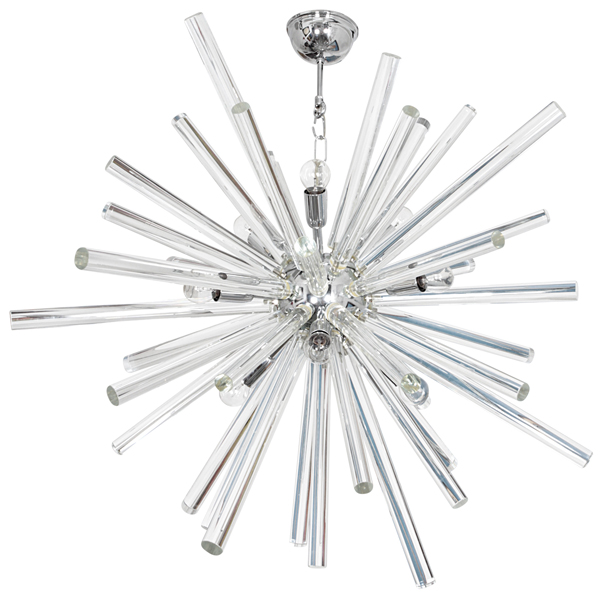
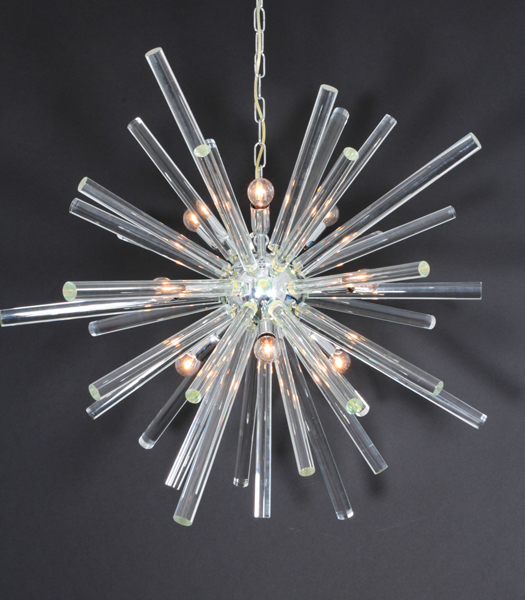
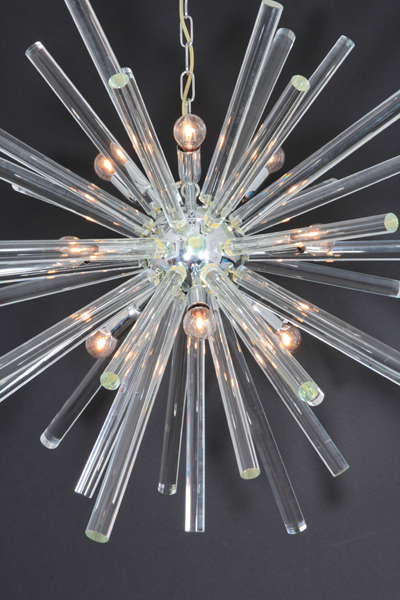
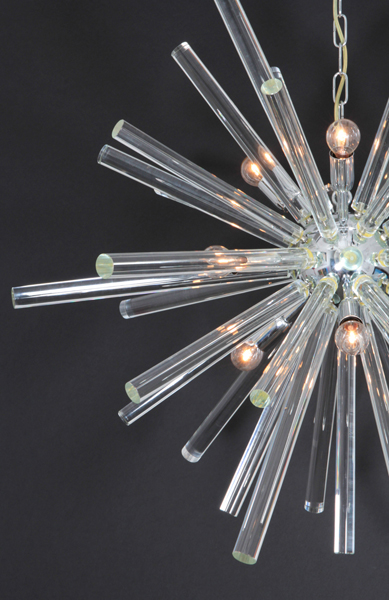
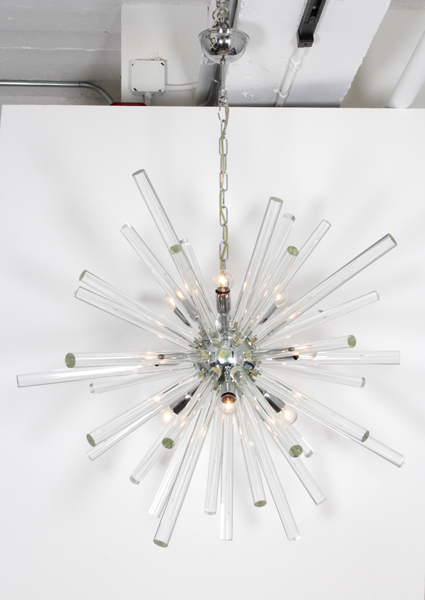
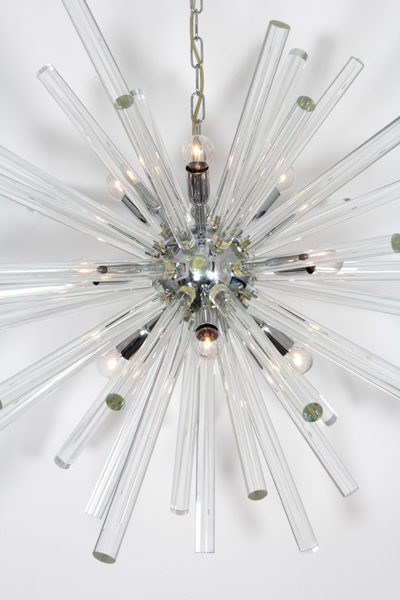
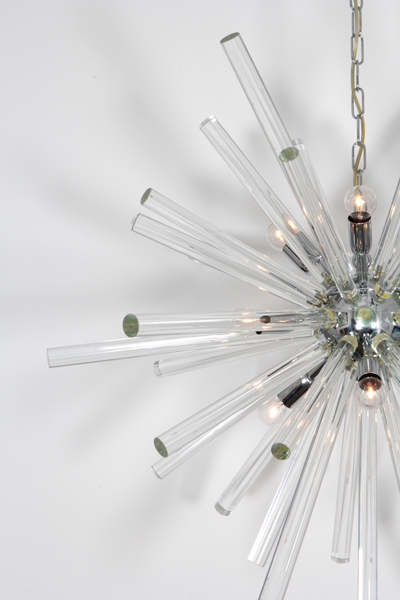
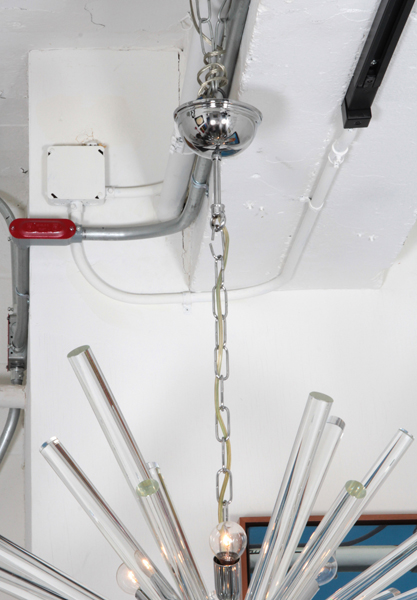
Bakalowits & Söhne Spectacular “Starburst” chandelier c. 1970’s
BAKALOWITS & SÖHNE (founded 1845 in Vienna)
“Starburst” chandelier c.1970’s
Crystal rods of varying lengths with nine lights,
chromium-plated metal ceiling cap and spherical chandelier parts.
Ceiling to drop length: 46 1/2″ x overall diameter: 33 1/2″
Price: $24,000
The Bakalowits Company was founded in Vienna, Austria in 1845 by Elias Bakalowits. After his son Ludwig joined the company, E. Bakalowits & Sons grew and became one of the foremost crystal chandelier manufacturers in the Austro-Hungarian Empire. In 1892 Ludwig Bakalowits received the order to manufacture the chandeliers for the Neue Hofburg Palace in Vienna for Emperor Franz Joseph I and was appointed Imperial and Royal Purveyor to the Court.
The company’s reputation for excellence grew outside Europe, and by 1885 the company was exporting its products to America and Asia. In 1900, Bakalowits & Sons displayed their crystal chandeliers at the World Exposition in Paris. Other exhibitions in St. Petersburg, London, Geneva and Turin followed and attracted more clients from around the world. In 1928, the company obtained patents for its crystal chandeliers. In 1955 Bakalowits was entrusted with the manufacture of new lighting fixtures for some of the Viennese buildings that had suffered damage during the Second World War. These included the Parliament, the State Opera House, the National theatre, City Hall, St. Stephan’s Cathedral, and others.
Related Products
-
Fernando and Humberto Campana, Zig Zag Screen 2001
Humberto Campana (1953 – ) Brazil
Fernando Campana (1961 – ) BrazilZig Zag Screen, 2001
Circular iron frame with electrostatic silver painted surface, translucent PVC hose stretched in a web pattern.
Illustrated: Campanas, Humberto and Fernando Campana (Sao Paulo: Bookmark 2003) p. 240; Mood River, February 3 – June 26, 2002, exh. cat. Jeffrey Kipnis and Annetta Massie (Ohio: Wexner Center, 2002)
H: 78” x D: 69”
Price: $11,500
-
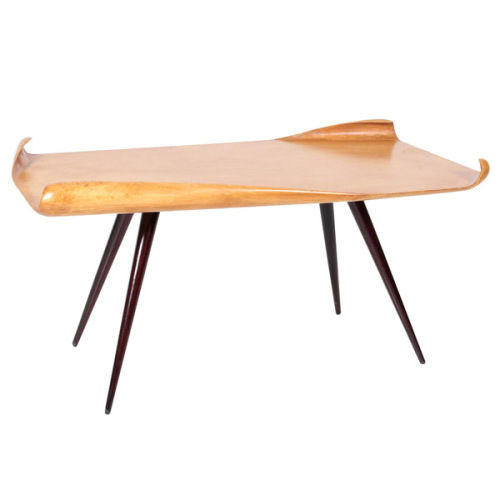
Aldo Tura / Italian Post-War Coffee table with furled edges c. 1950
ALDO TURA Italy
Coffee table with furled edges c. 1950
Vellum-covered birch with mahogany lacquered cherry legs
Illustrated: Mid-Century Modern, Furniture of the 1950s, Cara Greenberg
(New York: Harmony Books, 1984) p. 160.H: 18 1/2” x D: 21” x 37”
Price: $14,500
-
Nigel Coates, Rare, Early and Iconic Genie stool 1988
NIGEL COATES (b. 1949) England
BRANSON COATES ARCHITECTURE London“Genie” stool 1988
Carved and sandblasted solid ash seat on twisted mild steel legs
Marks: NIGEL COATES GENIE STOOL
Illustrated: 1000 chairs, Charlotte & Peter Fiell (Cologne: Taschen Verlag, 1997), p. 615.H: 26: x D: 13 1/2″
Price: $9,500
British architect and designer. He studied at Nottingham University and the Architectural Association, London, where he graduated in 1974 and subsequently taught until 1989. In 1983 he formed the group NATO (Narrative Architecture Today) with a group of former students and began to practice independently; two years later he went into partnership with Doug Branson (b 1951). Coates became known for his fluid and lively graphic style and the overt theatricality of his designs. His proposals for the redevelopment of London, involving sophisticated allegories of popular culture, were shown in two exhibitions: ArkAlbion (1984), with drawings of new development areas such as County Hall and the Isle of Dogs, and Ecstacity (1992), with computer simulations and video clips. In the renovation (1980) of his own flat in London he juxtaposed the original, ornate late 19th-century interior with ‘found’ furniture and decorative objects. The publication of this project brought Coates to the attention of Japanese clients who were seeking fashionable Western designers, and he carried out several projects in Japan that became increasingly theatrical: in Tokyo the Metropole Restaurant (1985) evokes a European café, while the Parco Café Bongo (1986) juxtaposes classical English furniture with an imitation aeroplane wing mounted on the ceiling; and the Arca di Noè (1988), Sapporo, is an eclectic mixture of classical motifs and a concrete boat. Coates’s radical approach was dissipated in later British works, such as a series of London shops: one for Katharine Hamnett in Sloane Street (1988) has a shop front formed of aquaria, and one for Jigsaw in Knightsbridge (1992) has its shop front formed of a two-storey copper column in the shape of a phallus. In 1992 he began designing an extension to the Geffrye Museum, London.
Coates was an influential teacher at the Architectural Association from 78- 86, and has lectured extensively abroad. In 1995 he was appointed Professor of Architectural Design at the Royal College of Art and now divides his time equally between the college and his office. Nigel Coates furniture is represented in the Modern Furniture Collection of the Victoria & Albert Museum, London.“I go for architecture that overlays and enhances. By blending observation and wit with reason, I want my work to generate a sense of the unexpected, and the seemingly spontaneous.”
-
Ilias Lalaounis, Greece, “Shell” clip earrings in highly textured 18k gold, signed, c.1970’s