Product Description
Barrey, Paris, Art Deco “Wheat” clip brooch in 18k gold with fine details of a sheath of wheat, marked, c. 1938

Barrey, Paris, Art Deco “Wheat” clip brooch in 18k gold with fine details of a sheath of wheat, marked, c. 1938
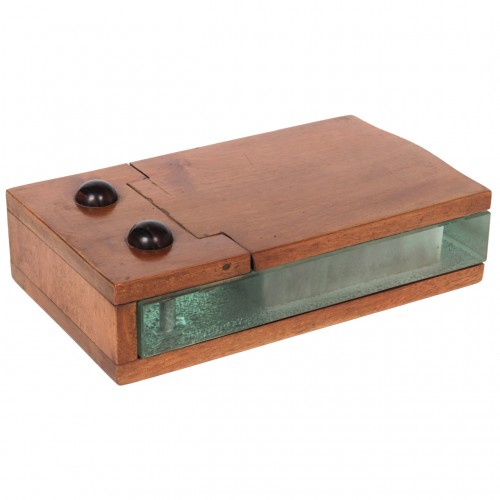
ALEXANDRE NOLL (1890-1970) France
Covered box c. 1930
Mahogany with ebony peg details and 1 ¼ inch thick Saint-Gobain glass.
Marks: ANoll
Provenance: Private Collection New York, Galerie de Beyrie Paris, Odile Noll (A. Noll’s daughter), Alexandre Noll Estate
For more information see: Alexandre Noll, Olivier Jean-Elie, Pierre Passebon (Paris:Edition du Regard, 1999); Alexandre Noll: Les Matres de L’ Art Decoratif Contemporain, Collection dirigée par R. Moutard-Uldry edited by (Geneve: Pierre Cailler, 1954); Le Mobilier du Xxe Siécle: Dictionnaire des
Créateurs, Pierre Kjellberg (Paris: Les Éditons de l’Amateur, 1994) p. 455-456.
H: 2 1/2″ x D: 5 3/8″ x W: 8″
HULDA ROTIER FISCHER (1893 – 1982) Milwaukee, WI
Three-resting giraffes sculpture 1936
Handbuilt earthenware sculpture with a golden light brown glaze.
Marks: Hulda Rotier Fischer 36 (hand incised)
H: 6 1/2″ x W: 7″ x D: 5 1/2″
Price: $2,300
Hulda Rotier Fisched studied at the Milwaukee Normal School and was a student of Robert von Neumann Sr. In 1921 she also studied with Carl Holty. She worked as an Art Instructor at Shorewood Opportunity School for 30 years. Rotier Fischer was a Member of the Milwaukee Art institute.
She is the recipient of many Milwaukeee Journal Awards.
INGEGERD TORHAMN (1898-1994) Sweden
Modernist rug c. 1930
Hand-knotted wool
Signed: it (Ingegerd Torhamn) lower left
Exhibited: Stockholm Exhibition 1930, Stockholmsutställningen 1930, Villa 42; V.I.P. in Swedish Design, Kalmar Konstmuseum 1996.
Illustrated: Katalog Över Bostadsavdelningen: Stockholms Utställningen 1930 (illustrated in situ) Stockholm Exhibition1930 (Stockholm: Tryckt Hos Bröderna Lagerström, Boktryckare, 1930) p. 149
Drawing illustrated: V.I.P. in Swedish Design: Axel Larsso, Ingegerd Torhamn, Inga Linden & Paula Sokolow, Arkiv for Svensk Formgivning, Kalmar Konstmuseum
For more information see: Svenska Textilier 1930, Stockholm 1930, Nils G. Wollin, plate nr. 50
Dimensions: 7’2” square
One of the ten rugs of her designs (including this rug as part of the music room) exhibited at the important Stockholm Exhibition of 1930 is now in the permanent collection of the Nationalmuseum in Stockholm.
PEDRO DE LEMOS (1882-1945) Bay Area, California
Clydesdale horse sculpture c. 1930
Hand modeled orange glazed terra cotta.
Marks: De Lemos Palo Alto (sticker on the bottom), various pencil notations on the foot bottom
H: 9 1/8″ x D: 3 1/2″ x W: 9 1/2″
Pedro Joseph de Lemos (25 May 1882 Austin, Nevada – 5 December 1945) was an American painter, printmaker, architect, illustrator, writer, lecturer and museum director. He started his art career in the Bay Area. He studied under Arthur Frank Mathews at the Mark Hopkins Institute of Art in 1900, later was a student of George Bridgman at the Art Students League in New York and of Arthur Wesley Dow at Columbia University Teachers College. The influence of traditional Japanese woodcuts is clearly seen in his work.
Pedro’s father Francisco, a cobbler, emigrated from the Azores in 1872, and settled in Oakland, California where Pedro was educated. Pedro and his brothers Frank and John all followed careers in art. Pedro was employed by Pacific Press Publishing Company between 1900 and 1906, afterwards starting the Lemos Illustrating Company with his brothers in 1907. Later this became known as the Lemos Brothers Art and Photography Studio, which offered art classes in copper, leather and landscaping as well as the traditional media of drypoint, etching and illustrating.
Lemos worked from a studio overlooking Lake Merritt and taught art at the University of California, Berkeley, working at the same time as illustrator and designer and giving classes in decorative design and etching at the San Francisco Institute of Art, where he had earlier studied when it was the Mark Hopkins Institute. He helped found the California Society of Etchers and an aqua print of his was acclaimed at the 1915 Panama-Pacific International Exposition, for which he helped organise the California print exhibition. He filled the position of Professor of Design at Stanford University and became director of the Stanford University Museum of Art in 1919. Besides being the first president of the Carmel Art Association, he was an affiliate member of several art organisations such as the California Society of Etchers, the California Print Makers, the Palo Alto Art Association, the Chicago Society of Etchers and the Bohemian Club. In 1943 he was elected a Fellow of the Royal Society of Arts in London.