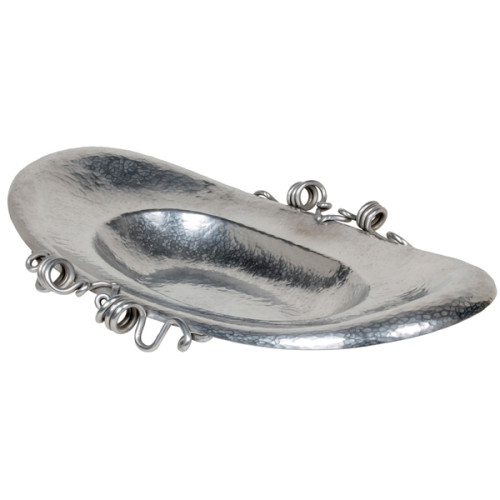
Cellini-Craft / American Art Deco Grand handcrafted “Argental” Center piece / bowl c. 1934
CELLINI-CRAFT Evanston, Ill
Grand “Argental” center piece bowl c. 1934
Hand wrought and hand hammered aluminum in a curvacious ovoid form with applied curlique handles.
Marks: ARGENTAL, XXX, HANDWROUGHT
H: 3 1/4″ x D: 13 3/4″ x L: 21″
CELLINI CRAFT was founded by Walter Gerlach & Hans Gregg in 1914.
The company created jewelry and tableware and was noted for their use of aluminum alloy “Argental.” In 1957 Cellini Craft was purchased by Julius Randahl. In 1965 the patterns and rights to “Argental” were sold to Reed & Barton.
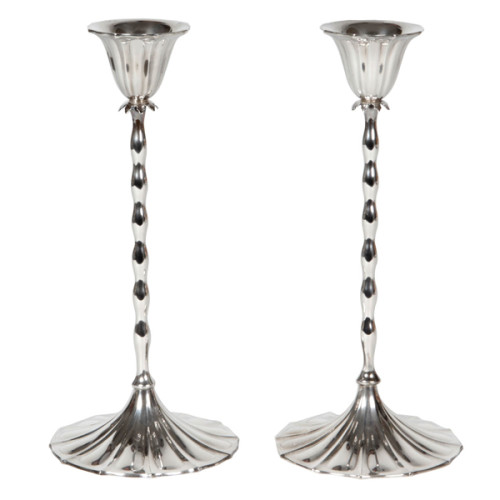
American Art Deco Reed & Barton Sterling candlesticks 1928
REED & BARTON (active 1824 – present) Taunton, MA
Candlesticks 1928
Sterling silver with Hoffmann-like fluted base and bobêches with undulating stem and palm leaf like terminating detail.
Marks: eagle R (in a shield) lion, Sterling, 1000, cement reinforced, eagle (date mark for 1928).
Model illustrated: Vanity Fair (Dec. 1928, Vol. 31), p. 120., Reed & Barton Vintage Catalog, p. 10, plate number 1000.
For more information on Reed & Barton see: Encyclopedia of American Silver Manufacturers, Dorothy T. Rainwater (West Chester, PA: Schiffer Publishing Ltd., 1986), p. 156-160.
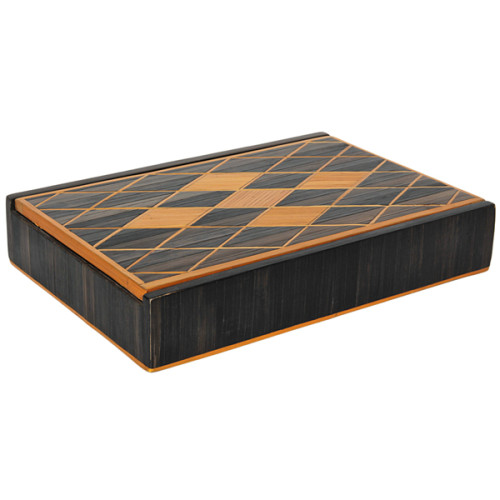
Andre Arbus (attr.) French Art Deco Straw Marquetry Box c. 1940
ANDRÉ ARBUS (attr.) (1903-1969) France
Straw marquetry box c. 1940
Natural gold and ebony stained straw inlaid in a design of a window pane diamond pattern on the hinged lid, original suede cloth/paper interior, wood frame
For more information see: André Arbus: architecture-décorateur des années 40, Yvonne Brunhammer (Paris: l’Editions NORMA, 1996).
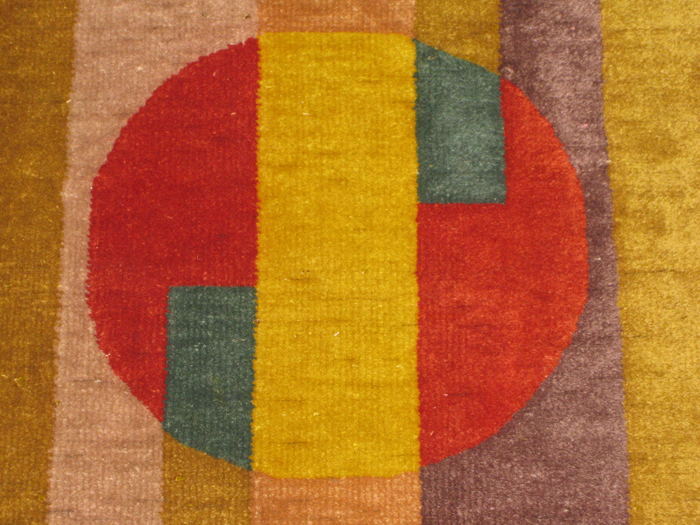
Walter Nichols Chinese Art Deco rug with circle motif c. 1935
Walter Nichols Chinese Art Deco rug c. 1935
WALTER NICHOLS China
Chinese Art Deco rug c. 1935
Walter Abner Burns Nichols was one of the most colorful of the American adventurer/entrepreneurs in 1920s China. The Nichols name has come to be used almost synonymously with the ‘Chinese deco’ rugs manufactured in Tientsin, China in the 1920s and 1930s. Nichols did not originate the Chinese deco style, but he did a great deal to popularize it and to maintain its high standards of manufacture.
Nichols began in his youth as a first-class wool grader who went to Tientsin around 1920 to work for the Elbrook family of wool merchants. Nichols started his own business a couple of years later. In a brochure he produced in the late ’20s, with the assistance of Pande-Cameron, he announced: “In 1924 W.A.B. Nichols of Tientsin, North China, introduced the Super Chinese Rug which has become world famous. It is known in every market as the most durable and beautiful product of the modern Chinese weavers art and adorns the homes of people all over the earth.”




 @hd_jewels