Product Description
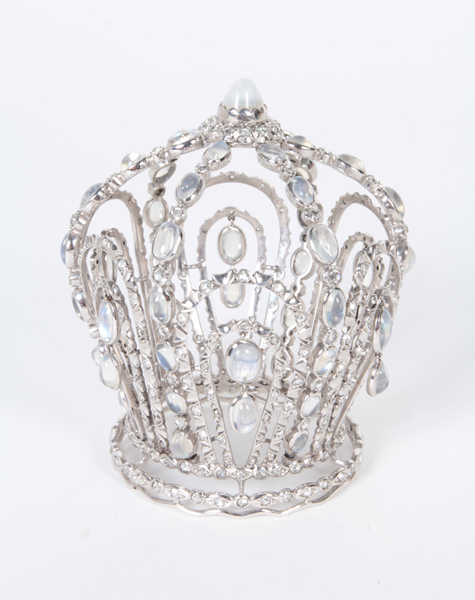
Bismarck Family Crown – House of Koch, Chignon crown, Moonstones and diamonds set in an elaborate platinum mount, original leather box, c. 1900

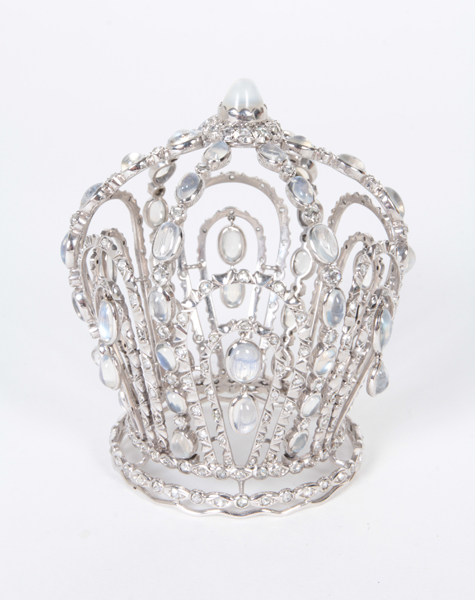
BISMARCK FAMILY CROWN
HOUSE OF KOCH Germany
Chignon crown c. 1900
Moonstones and diamonds set in an elaborate platinum mount, original leather box
The renowned “House of Koch” made this remarkable bejeweled chignon for the Bismarck family of Lauenburg, Germany. It is an early example of exquisite work in platinum and is set with cabochon moonstones and rose cut diamonds. The jewelry firm, known as the “House of Koch” was founded by Robert and Louis Koch in 1879 in Frankfurt, Germany with a branch in Baden-Baden. By 1883, the jewelers had earned the coveted title of Jeweler of the Court of Frankfurt and crafted jewels for many European Royal families. In fact, their jewels were famous across Europe, and their fashionable styles were worn in the courts of several European royals including the King of Italy and the Czar of Russia. By the time Robert Bosch had assumed control of the firm in 1938, the Koch family was forced to “Aryanize” their jewelry house. It was common during the late nineteenth Century for prestigious families to retool old antique heirloom pieces to bring them up to contemporary fashion standards and since this chignon has characteristics of both the 18th and the 19th Century jewelry, it was likely made from older pieces owned by the Bismarck family. The company closed doors in 1987 and jewels from the great time of the House of Koch are very much sought after in today’s antique jewelry market.
Bismarck Family Crown – House of Koch, Chignon crown, Moonstones and diamonds set in an elaborate platinum mount, original leather box, c. 1900
TIM LIDDY (b. 1963) Missouri
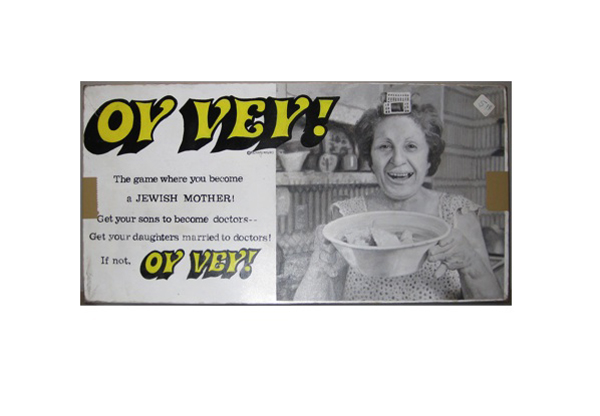
“Lie Cheat and Steal” (1971) The Game of Political Power 2006
Oil and enamel on copper, plywood back
Signed in script: Tim Liddy “circa 1971” 2006, red circular ring
Provenance: William Shearburn Gallery (St. Louis, MO)
H: 12” x W: 9” x D: 2”
With his recent paintings, Liddy has both reasserted the construct of hyperrealist painting and developed a thoroughly unique advancement of that mode by extending the cultural reality of the indexed original. Based on the illustrated box lids of vintage board games, Liddy has recontextualized a subject, which evokes the underlying rules of life. Painted on copper or steel in the precise dimensions of the original, the metal is then manipulated to demonstrate the exact rips and tears from years of usage and includes trompe-l’oeil renditions of the scotch tape that might be holding the cardboard box together, the assorted stains, or the various graffiti of time. Liddy leaves no possibility of ambivalence, these works speak to a concurrent understanding of their original object identity and to themselves as works of art engaged in historical and psychological dialogue.
REINHOLD KLAUS (1881-1963) Vienna, Austria
CARL GEYLING ATELIER (founded 1841) Vienna, Austria
Man with tophat and flowers c. 1930
Window of stained and hand-painted leaded glass
Provenance: Estate of Carl Geyling (1814-1880), Vienna
H: 17 3/4″ x W: 14 1/2″
Reinhold Klaus studied from 1898-1902 with Alfred Roller at the Kaiserlich-Königliche Kunstgewerbeschule in Vienna. In 1914 Klaus married into the Carl Geyling family and became extensively involved with with stained glass painting. As early as 1918 Klaus worked on a stained glass window for the Siegestempel am Bisamberg in Vienna. In 1934 he became a professor of stained glass painting at the Kunstgewerbeschule, as well as creative director of the C. Geylings Erben glass painting company. Reinhold Klaus, a member of the Künstlerhaus since 1924 received many prizes and honors. He worked on commissions for the St. Veits cathedral in Prague, the St. Stephan cathedral in Vienna and many others.
EDMUND F. WARD (b. 1892 – 1991) USA
“The Swimming Hole” c. 1930
Oil on canvas
Marks: signed Edm. F. Ward (lower right); partial labels verso:Westchester Arts and Crafts Guild; 4 Edmund F. Ward
For more information on the artist see: Who Was Who in American Art,Peter Hastings Falk, ed. (Madison, Conn.: Sound View Press, 1985), p. 658.
Canvas H: 18” x W: 24”
Framed H: 27 9/16” x W: 33 9/16”
Price: $14,000
Ward studied at the Arts Student’s League with Edward Dufner, George Bridgeman, and Thomas Fogarty. He was an illustrator for several national magazines and books. In 1925, Ward exhibited an award winning work at the Art Institute of Chicago. He is perhaps best known for his WPA mural in the Federal Building, White Plains, New York.