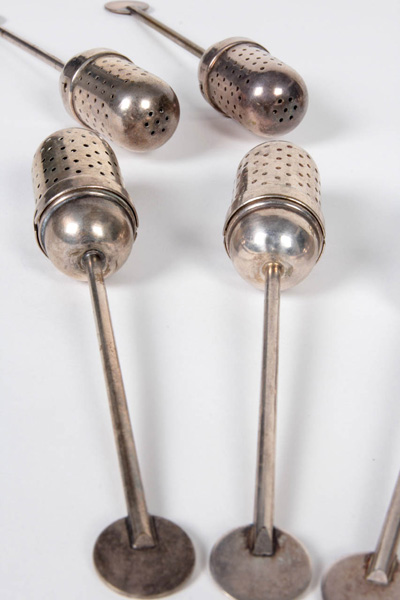
Christian Dell / Bauhaus “Tee-Ei” Tea infusers (Rare set of eight) 1924
More Information
Christian Dell / Bauhaus “Tee-Ei” Tea infusers (Rare set of eight) 1924
CHRISTIAN DELL (1893-1974) Germany
BAUHAUS (1919-1933) Germany
“Tee-Ei” (tea ball) 1924 (rare set of 8)
Silvered brass.
***These are all in fine original, untouched condition.
Illustrated: Christian Dell: Silberschmied und Leuchtengestalter im 20. Jahrhundert, Beate Alice Hofmann, Museum Hanau (Hanau: Heller Druck,1996) illus. 15, p.56; Modernist Design 1880-1940, Alastair Duncan, The Norwest Collection (Woodbridge, Suffolk: The Antique Collectors’ Club, 1998), p. 173; Decorative Arts 1850-1950, Judy Rudoe, (London: British Museum Press, 1991) cover, p. 276; Die Metall Werkstatt am Bauhaus, (Berlin: Bauhaus-Archiv, Museum für Gestaltung, 1992) pp. 140-141 Silver of a New Era, (Rotterdam: Museum Boymans-van Beuningen, 1992) p. 157; cat. no. 140.
Length: 5 1/4″
Price: $9,600
Christian Dell, metal artist and industrial designer, played a formative role in shaping the Bauhaus style. Dell was the master of the metal workshop at the Bauhaus, 1922-25, in Weimar, working closely with László Moholy-Nagy.
Born the son of a locksmith in Offenbach in 1893, he had a great impact as a teacher on the curriculum of the Weimar metal workshop. He had done an apprenticeship as a silversmith in Hanau before and had also attended the drawing academy, followed by a stay at the Weimar School of Applied Art. Henry van de Velde, director of this institution, coined Christian Dell’s early works with his organic-flowing use of forms, a feature that can also be observed on Dell’s later works.
Metal workshop at the Bauhaus in Weimar:
From 1922, the former goldsmith, silversmith and coppersmith workshops of the Weimar phase became a laboratory for design where metal vessels and lamps were made. This is also where the designs for industry, as well as metal furniture, were ultimately created. In 1922, the silversmith Christian Dell took over as master of works. Following Itten’s departure in 1923, the workshop developed in a new direction with the Hungarian Constructivist László Moholy-Nagy. Instead of individual pieces, prototypes were now made for mass production. In order to manufacture the individual models, a production line was established.
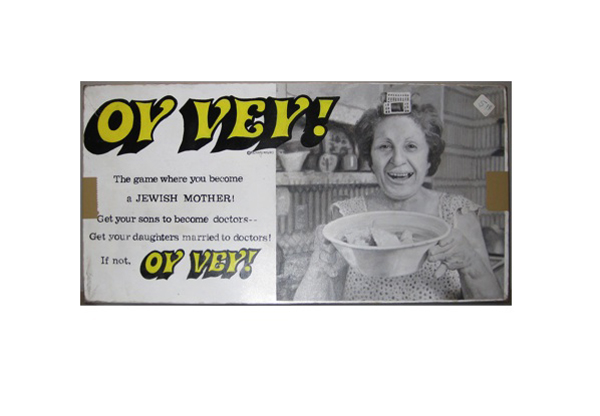
Tim Liddy Oy Vey (1979) The game where you become a JEWISH MOTHER! Get your sons to become doctors—Get your daughters married to doctors! If not, OY VEY! 2008 Oil and enamel on copper, plywood back
TIM LIDDY
“Oy Vey” (1979) The game where you become a JEWISH MOTHER! Get your sons to become doctors—Get your daughters married to doctors! If not, OY VEY! 2008
Oil and enamel on copper, plywood back
Signed in script: Tim Liddy, red circular ring, “circa 1979”, 2008
Provenance: William Shearburn Gallery, St. Louis, MO
H: 10 ¼” x W: 20 ½” x D: 1 ¾”
With his recent paintings, Liddy has both reasserted the construct of hyperrealist painting and developed a thoroughly unique advancement of that mode by extending the cultural reality of the indexed original. Based on the illustrated box lids of vintage board games, Liddy has recontextualized a subject, which evokes the underlying rules of life. Painted on copper or steel in the precise dimensions of the original, the metal is then manipulated to demonstrate the exact rips and tears from years of usage and includes trompe-l’oeil renditions of the scotch tape that might be holding the cardboard box together, the assorted stains, or the various graffiti of time. Liddy leaves no possibility of ambivalence, these works speak to a concurrent understanding of their original object identity and to themselves as works of art engaged in historical and psychological dialogue.
Aram Gesar has been published internationally and has exhibited his photographic work in New York, San Francisco, Zurich and Geneva since 1977. As a producer, art director and photographer, Gesar created advertising campaigns for major corporations in the U.S. and Europe focusing on the fields of travel, banking, financial services, aerospace and motion pictures. He also created and produced documentaries on travel, aviation and yachting for national cable networks and the home video markets and television commercials and corporate programs for various U.S. and European corporations.
Gesar is currently one of the leading international experts on travel and air transport, and the founder and CEO of The Pyramid Media Group, which includes several magazines, newsletters, web sites, books, eBooks and other publications integrating a spectrum of business, travel and aviation content.
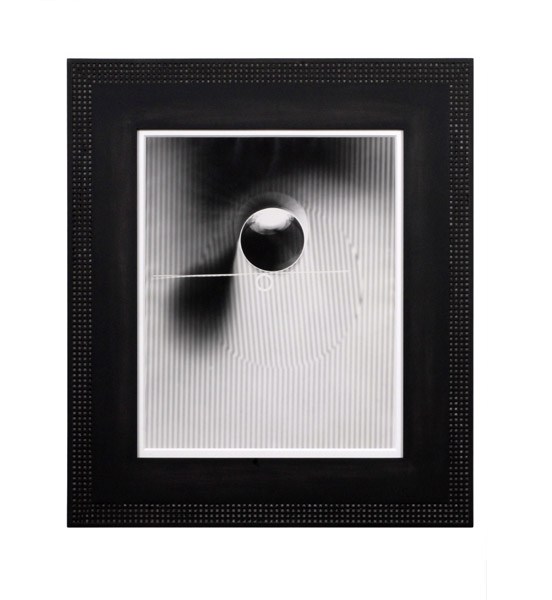
György Kepes, Abstraction, Gelatin silver print, 1942
GYÖRGY KEPES (1906-2001) Hungary/USA
Abstraction 1942
Silver gelatin print
Signed: 9 (in a circle, on back); Gyorgy Kepes 1942 (in ink on back)
György Kepes was a Hungarian-born painter, designer, educator and art theorist. After emigrating to the U.S. in 1937, he taught design at the New Bauhaus (later the School of Design, then Institute of Design, then Illinois Institute of Design or IIT) in Chicago. In 1947 He founded the Center for Advanced Visual Studies at the Massachusetts Institute of Technology (MIT) where he taught until his retirement in 1974.







 @hd_jewels
Reviews
There are no reviews yet, would you like to submit yours?