Black Starr & Frost American Art Nouveau Sterling Mounted Jewelry Box c.1900 SOLD
More Information
Black Starr & Frost American Art Nouveau Sterling Mounted Jewelry Box c.1900
BLACK STARR & FROST New York, NY
Art Nouveau Sterling and Mahogany Jewelry Box c.1900
Mahogany jewelry box with thick sterling silver decorative graphic mountings in an elaborate Art Nouveau whiplash design, original key
Marks: Eagle mark (Company logo) BLACK STARR & FROST, Sterling
For more information see: American Jewelry Manufacturers, Dorothy T. Rainwater (West Chester, Penn.: Schiffer, 1988)
H: 4 1/2″ x W: 10 1/2″ x D: 7″
SOLD
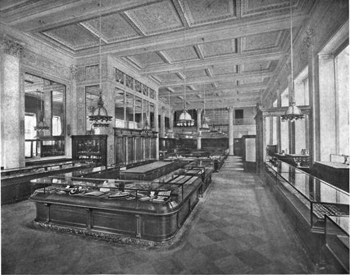
One of America’s oldest fine jewelers, Black, Starr and Frost traces its roots to 1810. In that year, Erastus Barton and Frederick Marquand opened Marquand and Barton near New York’s Maiden Lane. The firm added and lost partners numerous times and it also frequently moved locations in accordance with the addresses of its prestigious clientele. Its merchandise was eclectic and greatly varied including, lamps, jewelry, paintings, porcelain, and artistic objects. In 1876, the firm changed its name from Black, Ball, and Co. to Black, Starr, and Frost, and moved to 251 Fifth Avenue. Its inventory became focused on jewelry and silver objects, some imported from Europe, some produced in-house. For many decades, the renowned jewelry house, Black, Starr, and Frost was considered one of the great American jewelers. In 1876, it was invited to exhibit at the Centennial Exposition in Philadelphia along with renowned firms like Tiffany & Company, Whiting, and Gorham. In 1939, the firm was one of five American jewelers invited to exhibit at the New York’s World’s Fair. In 1929, it merged with Gorham to become Black, Starr, Frost – Gorham.
Aram Gesar has been published internationally and has exhibited his photographic work in New York, San Francisco, Zurich and Geneva since 1977. As a producer, art director and photographer, Gesar created advertising campaigns for major corporations in the U.S. and Europe focusing on the fields of travel, banking, financial services, aerospace and motion pictures. He also created and produced documentaries on travel, aviation and yachting for national cable networks and the home video markets and television commercials and corporate programs for various U.S. and European corporations.
Gesar is currently one of the leading international experts on travel and air transport, and the founder and CEO of The Pyramid Media Group, which includes several magazines, newsletters, web sites, books, eBooks and other publications integrating a spectrum of business, travel and aviation content.
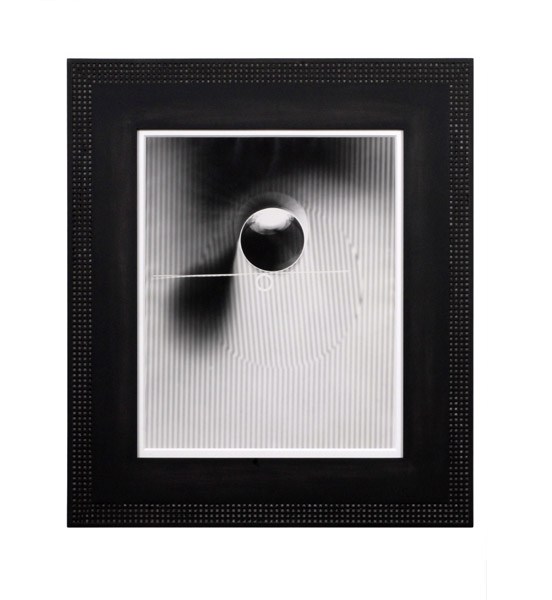
György Kepes, Abstraction, Gelatin silver print, 1942
GYÖRGY KEPES (1906-2001) Hungary/USA
Abstraction 1942
Silver gelatin print
Signed: 9 (in a circle, on back); Gyorgy Kepes 1942 (in ink on back)
György Kepes was a Hungarian-born painter, designer, educator and art theorist. After emigrating to the U.S. in 1937, he taught design at the New Bauhaus (later the School of Design, then Institute of Design, then Illinois Institute of Design or IIT) in Chicago. In 1947 He founded the Center for Advanced Visual Studies at the Massachusetts Institute of Technology (MIT) where he taught until his retirement in 1974.






 @hd_jewels