Black Starr & Frost American Art Nouveau Sterling Mounted Jewelry Box c.1900 SOLD
More Information
Black Starr & Frost American Art Nouveau Sterling Mounted Jewelry Box c.1900
BLACK STARR & FROST New York, NY
Art Nouveau Sterling and Mahogany Jewelry Box c.1900
Mahogany jewelry box with thick sterling silver decorative graphic mountings in an elaborate Art Nouveau whiplash design, original key
Marks: Eagle mark (Company logo) BLACK STARR & FROST, Sterling
For more information see: American Jewelry Manufacturers, Dorothy T. Rainwater (West Chester, Penn.: Schiffer, 1988)
H: 4 1/2″ x W: 10 1/2″ x D: 7″
SOLD
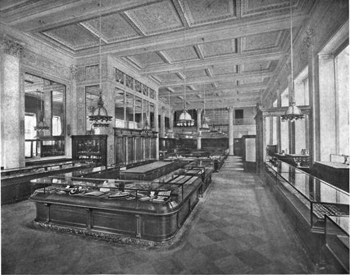
One of America’s oldest fine jewelers, Black, Starr and Frost traces its roots to 1810. In that year, Erastus Barton and Frederick Marquand opened Marquand and Barton near New York’s Maiden Lane. The firm added and lost partners numerous times and it also frequently moved locations in accordance with the addresses of its prestigious clientele. Its merchandise was eclectic and greatly varied including, lamps, jewelry, paintings, porcelain, and artistic objects. In 1876, the firm changed its name from Black, Ball, and Co. to Black, Starr, and Frost, and moved to 251 Fifth Avenue. Its inventory became focused on jewelry and silver objects, some imported from Europe, some produced in-house. For many decades, the renowned jewelry house, Black, Starr, and Frost was considered one of the great American jewelers. In 1876, it was invited to exhibit at the Centennial Exposition in Philadelphia along with renowned firms like Tiffany & Company, Whiting, and Gorham. In 1939, the firm was one of five American jewelers invited to exhibit at the New York’s World’s Fair. In 1929, it merged with Gorham to become Black, Starr, Frost – Gorham.
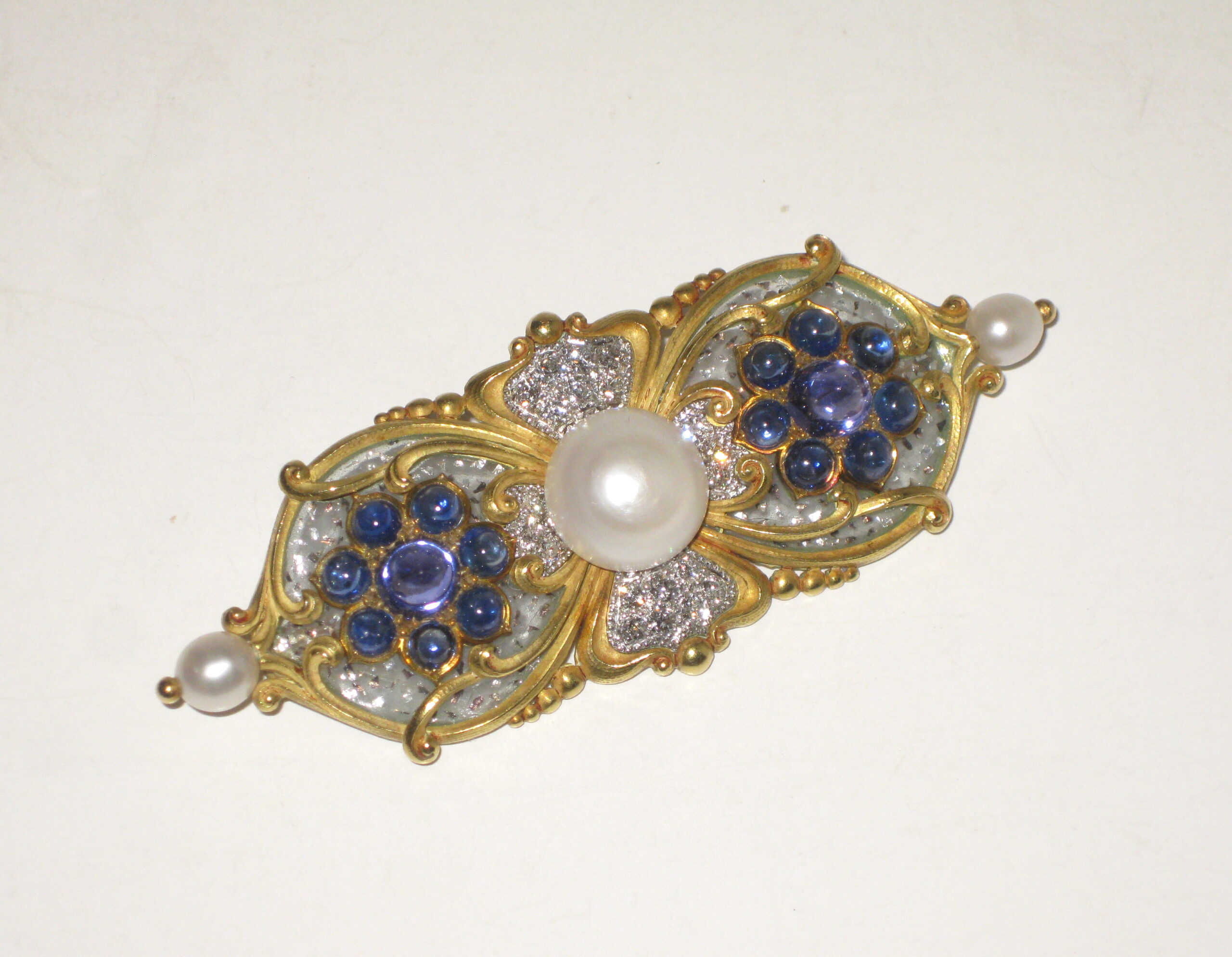
Marcus & Co. Art Nouveau brooch, “Tibula” shaped 18k yellow gold brooch set with three natural pearls, the natural center button pearl approx. 10 mm in diameter (G.I.A. certificate, 3 natural freshwater pearls, weight 24.90 grams, measurement range from 5.46 to 12.26mm), 16 sugarloaf cabochon sapphires, the two large and high dome middle sapphires with a purple hue, 20 pave set round diamonds all surrounded with clear plique-a-jour further trapped with platinum flakes, signed c. 1897





 @hd_jewels