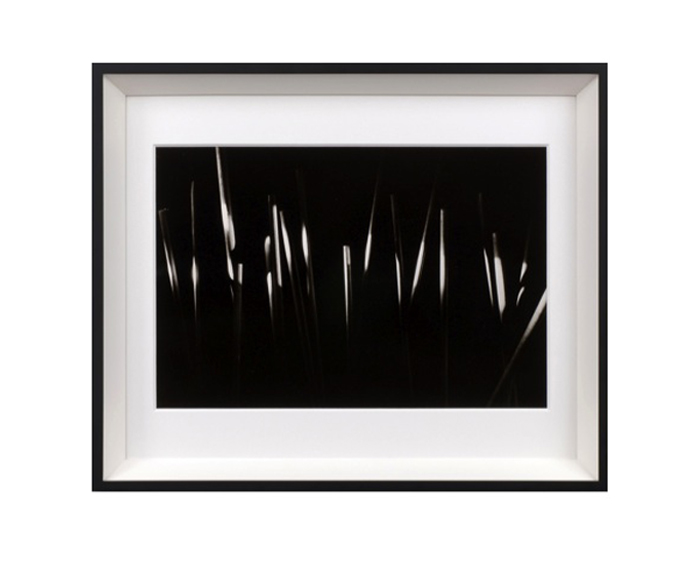
Illustrated: New Bauhaus, 50 Jahre: Bauhausnachfolge in Chicago (Berlin: Bauhaus-Archiv and Argon Verlag GmbH: 1987), p. 177
H: 18 5/8” x 22 ½” (framed)
Nathan Lerner’s long career was inextricably bound up in the history of visual culture in Chicago. Born in 1913 to immigrants from Ukraine, he began studying painting at the Art Institute of Chicago at the age of 16, taking up the camera to perfect his compositional skills. At 22 he began doing a kind of photojournalism, developing his well-known series on ”Maxwell Street,” an immigrant neighborhood hit hard by the Depression, and also photographing the southern Illinois mining area. In 1936 when the New Bauhaus was established in Chicago by Lazlo Moholy-Nagy, Lerner became one of its first scholarship students and turned increasingly to photographic experimentation. He began making semi-abstract, strongly Constructivist images involving luminous projections, solarization, photograms and other methods, and his interest in manipulating light led him to invent the first ”light box.” In 1939 he became the assistant of Gyorgy Kepes, head of the school’s light workshop; together, they wrote ”The Creative Use of Light” (1941). With Charles Niedringhaus in 1942 he developed a machine for forming plywood that was used in making most of the school’s furniture. After working as a civilian light expert for the Navy in New York during World War II, Lerner returned to the school, now called the Institute of Design, and was named education director after Moholy-Nagy’s death in 1946. He left in 1949, opening a design office that became nationally known for its furniture, building systems and glass and plastic containers (including bottles for Revlon and Neutrogena and the Honeybear honey container). In 1968 Lerner married Kiyoko Asia, a classical pianist from Japan, and over the next two decades made numerous trips to Japan, where he took his first color photographs, as well as Mexico. He had his first solo exhibition of photography in 1973 and thereafter exhibited regularly in galleries and museums in the United States, Europe and Japan. His work is included in photography and design collections around the world. (Roberta Smith, New York Times, February 15, 1997).
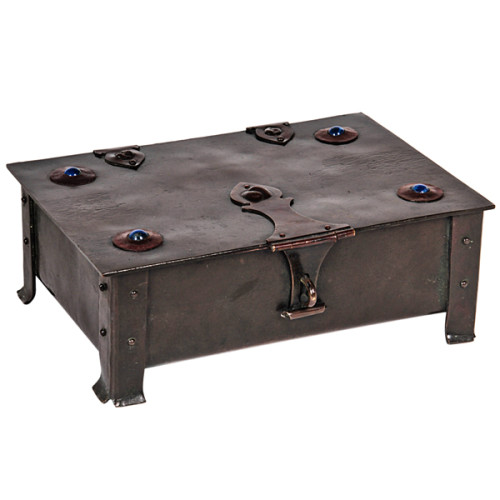
Albert Edward Jones British Arts & Crafts Copper and Lapis Lazuli Box c.1905
Albert Edward Jones (1879-1954) Birmingham, UK
British Arts & Crafts Movement
Footed box with hinged lid and hasp 1905
Hand wrought and patinated copper with riveted strap work and hasp, inset with 4 cabochons of lapis lazuli, brown leather and wood interior.
This box is a particularly handsome example of British arts & crafts metalwork by the famous designer / craftsman A.E. Jones. It retains its original deep, rich chocolate brown patina with the contrasting cobalt blue large round bezel-set cabochons of lapis lazuli.
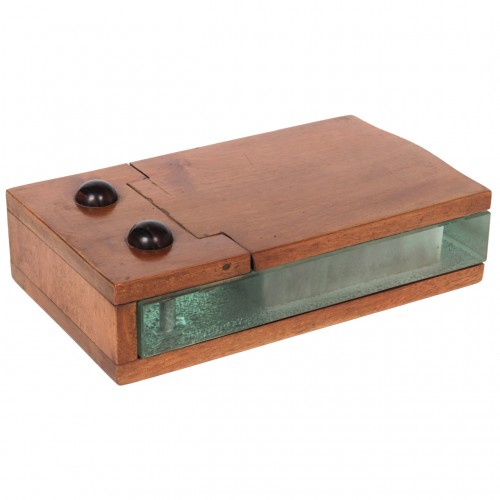
Alexandre Noll rare and early Art Deco mahogany and glass box c. 1930
ALEXANDRE NOLL (1890-1970) France
Covered box c. 1930
Mahogany with ebony peg details and 1 ¼ inch thick Saint-Gobain glass.
Marks: ANoll
Provenance: Private Collection New York, Galerie de Beyrie Paris, Odile Noll (A. Noll’s daughter), Alexandre Noll Estate
For more information see: Alexandre Noll, Olivier Jean-Elie, Pierre Passebon (Paris:Edition du Regard, 1999); Alexandre Noll: Les Matres de L’ Art Decoratif Contemporain, Collection dirigée par R. Moutard-Uldry edited by (Geneve: Pierre Cailler, 1954); Le Mobilier du Xxe Siécle: Dictionnaire des
Créateurs, Pierre Kjellberg (Paris: Les Éditons de l’Amateur, 1994) p. 455-456.
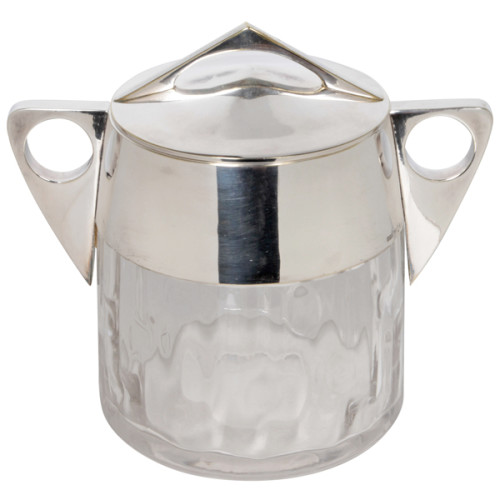
Gisela Falke von Lilienstein / Berndorfer Metallwarenfabrik Vienna Secession covered box c. 1902
GISELA VON FALKE (b. 1874) Austria
SCHOOL OF KOLO MOSER Austria
BERNDORFER METALLWARENFABRIK Berndorf, Austria
E. BAKALOWITS & SÖHNE Vienna, Austria [retailer]
Covered box c. 1902
Silver plate mounts and cover, blown “meteor” glass.
Marks: BEPWF 1481, maker’s touch marks
For more information on Berndorfer Metallwarenfabrik see: Blühender Jugendstil – Österreich (Art Nouveau in Blossom – Austria), Firmen und Marken (Companies and Marks), Waltraud Neuwirth, II (Vienna: Selbstverlag Neuwirth, 1991), p. 221; Metallkunst, Kunst vom Jugendstil zur Moderne (1889-1939), Karl H. Bröhan (Berlin: Bröhan Museum, 1990) pp. 20-44.


 @hd_jewels