Product Description
Cartier (attr.) “Bombe” cocktail ring set with a emerald-cut aquamarine (approx. 6 carats TW) 26 round-cut and 18 baguette diamonds, two triangle-cut diamonds all in an elaborate platinum mounting, marked, c.1950

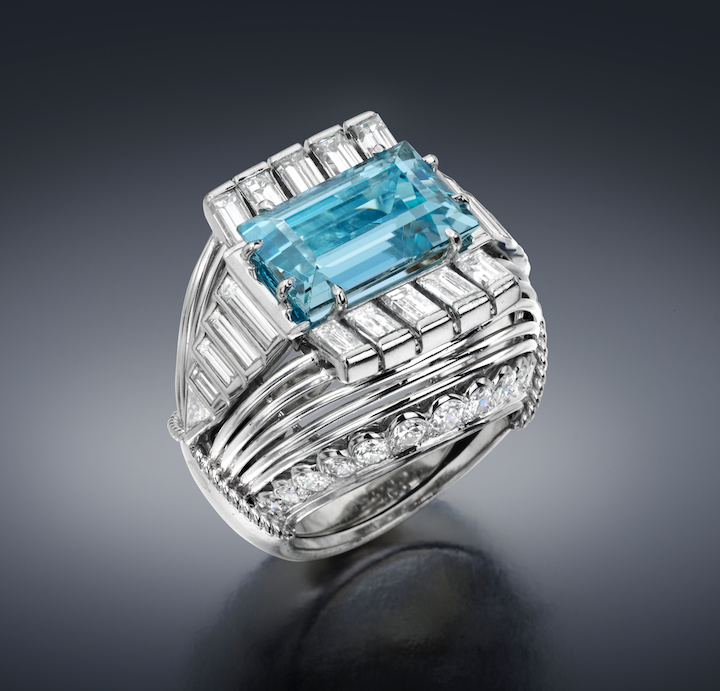
Cartier (attr.) “Bombe” cocktail ring set with a emerald-cut aquamarine (approx. 6 carats TW) 26 round-cut and 18 baguette diamonds, two triangle-cut diamonds all in an elaborate platinum mounting, marked, c.1950

JAIPUR, MUGHAL INDIA
Enameled and gem set gold Cup and Saucer c. mid-19th Century
High carat yellow gold (22-24 carat) cup and saucer set with a fine emerald, ruby and diamonds, the cup with a high foot with rounded sides and handle formed of two snakes intersecting at three points and biting the rim. The exterior is decorated with red, green, blue and white enamels with roundels containing combatant animals on a ground of floral sprays, the saucer with gently rounded sides decorated with lobed cartouches containing warriors combating tigers and birds, the underside with a series of oval panels containing peacocks and hummingbirds.
Provenance: a gift from a European diplomat in the 1930’s-40’s, and thence by descent.
Saucer: Dia: 5 1/4;
Cup: H: 2 3/4″ (with handle) x Dia: 2 5/8″
Similar animal decoration can be found in an epaulette attributed to Rajesthan, probably Jaipur, in the Khalili Collection (Pedro Moura Carvalho, Gems and Jewels of Mughal India, London, 2010, p. 225, no. 120. A related cup and saucer with similar animal depictions was sold at Christie’s (Islamic Art, Indian Miniatures, Rugs and Carpets, London, 21st October 1993, lot 350.
W.C. HANDY ed. (1973-1958) USA
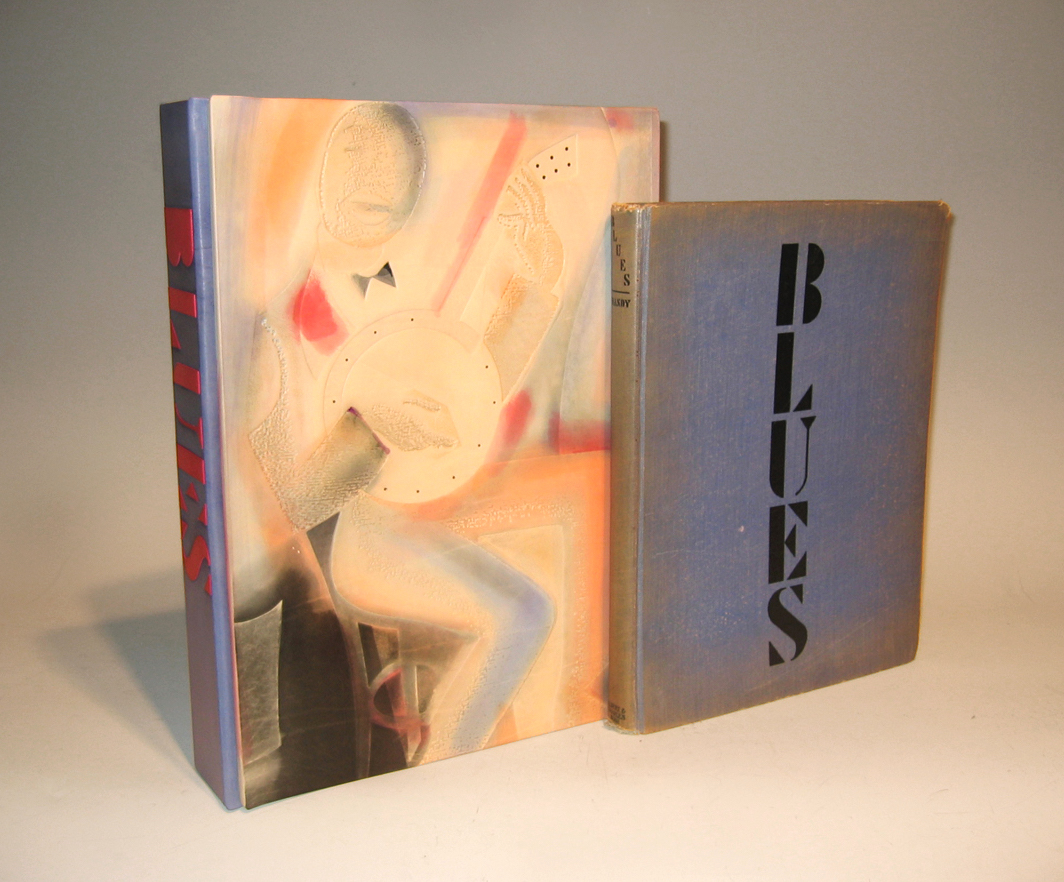
“Blues – An Anthology” 1926
180pp. bound in blue cloth with original dust jacket. Very scarce work, considered the most famous blues collection in history, it includes historical notes, tunes and arrangements, notes for each song, a bibliography, and a chart of guitar chords.
With an introduction and notes by Abbe Niles
Illustrations by Miguel Covarrubias
Published by Albert & Charles Boni, New York
Dimensions:
Book: H: 11 ¾” x W: 9 1/8” x D: 1”
Custom leather box 2008: H: 13 13/16” x W: 10 3/8” x D: 2 7/16”
Custom silk slipcase: H: 15” x W: 11 1/8” x D: 3 3/8”
William Christopher Handy was a composer, musician and a music publisher. He was sometimes called the “Father of the Blues” and was credited with helping popularize blues music. Handy was a seminal figure in the development of American songwriting. His compositions assimilated folk tunes, blues, spirituals, minstrel songs, and elements of European music and forged a new sound in American popular commercial music. Born in Florence, Alabama, Handy began arranging music when in grade school. By the turn of the century, he had toured or was touring with a number of minstrel acts and bands. He became a leading bandleader in Memphis, Tennessee, and eventually wrote such classics as “The Memphis Blues” (1912), “The St. Louis Blues” (1914), and “Beale Street Blues” (1916). In addition to his songwriting, Handy also founded an important and influential music publishing concern, the Pace and Handy Music Company, in 1913. Finally, Handy’s books and writings, such as his autobiography, Father of the Blues (1941), and Blues: An Anthology (1926), comprise an important contribution to American culture. In 1979, New York City joined the list of institutions and municipalities to honor Handy by naming a stretch of West 52nd Street in Manhattan “W.C. Handy Place.”
OHLSSON & RICE (founded 1941) Los Angeles, CA
Tether Race Red car Model No. 88
Gas powered tether car racer 1950
Steel and various metals with the car and trailer details painted red, rubber tires and cork details
The license plate reads: California, 19-50, 61U421
H: 5″ x L” 13 1/2″ x D: 7 1/2″
Price: $3,000
In 1941 Irv Ohlsson teamed up with Harry Rice, and the firm of Ohlsson & Rice was founded producing model race cars and propellers. No other engines at the time combined the reliability, ease of maintenance, simplicity of operation and unlimited life of the Ohlsson & Rice engines. The Second World War put a temporary hold on their success, however, as all manufacturing facilities were turned over to military production. By the time the war shut down their production, they had produced about 75,000 engines.
As soon as the war was over, Ohlsson & Rice got back into production. Even with a shortage of needed materials and machines somewhat worn out by 3-shift a day wartime production use, they jumped back into a market that had a seemingly endless demand for their products. Modelers were hungry to get back into flying, and O & R took advantage of the market by buying the machinery needed to meet the huge demand.
Ohllson & Rice die cast tether cars were first manufactured in 1946. The early model cars had solid rear brake drums. open air front grill, 10 air vent slots in the seat, windshield, manual fuel pump, external hand brake lever, 4 nerf bars or radius rods, and plated front axle. The cars were fitted with a .23 or .29 Ohlsson and Rice engine. The easiest way to tell their plane engines from the car engines was the exhaust port. The cars have a straight cut exhaust and the planes had an angled cut port. However they are interchangeable except to be estetically correct. Basic colors included white, black, red , blue and yellow. The .29 engine were available in either spark ignition models or with a glow plug. In the early days Ohlsson and Rice had trouble with their engines and discovered a lot of the problems were due to inferior fuel sources. To rectify this they started to manufacture their own Nitro Glow fuel. This seemed to cure their engine problems. The later models in the fifties went to a closed front grill , 1 air vent slot in seat, hollow brake drums, no windshield and a smaller .049 engine. The last of the midget racers were made in 1959.