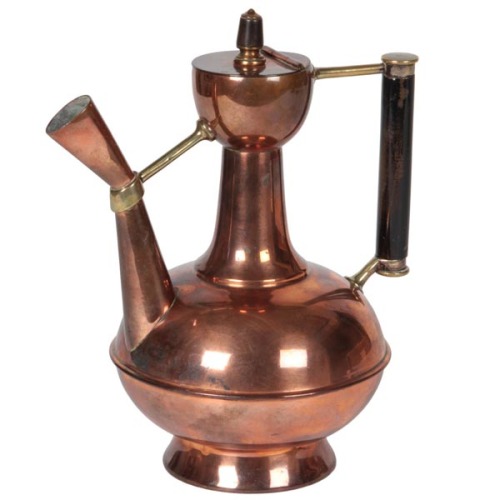
Christopher Dresser / Benham & Froud Aesthetic Movement Kettle c. 1885
More Information
Christopher Dresser / Benham & Froud Aesthetic Movement Kettle c. 1885
CHRISTOPHER DRESSER (1834-1904) UK
BENHAM & FROUD London, England
Kettle c. 1885
Copper, brass, wood handle and finial
Marks: maker’s cipher
Illustrated: Minor Masters of the XIXth Century: Christopher Dresser, Industrial Designer, by N. Pevsner, (Architectural Review, 1937), p. 184, illus. 1; Truth, Beauty, Power: Dr. Christopher Dresser 1834-1904, exhib. cat. Historical Design, Inc. (New York, 1998) p. 67.
Christopher Dresser / Benham & Froud Rare Aesthetic Movement Copper coffee pot 1888
CHRISTOPHER DRESSER (1834-1904) UK
BENHAM & FROUD London, England
Coffee pot 1888
Copper, brass, wood handle and finial
***One of only two known models of this Dresser / Benham & Froud coffee pot.
Marks: maker’s cipher, Reg. no. 114566 for 1888
Only other model known illustrated: Christopher Dresser, by Widar Halén (Oxford: Phaidon, 1990), illus. 192, p. 170 (variant model); Truth, Beauty, Power: Dr. Christopher Dresser 1834-1904, exhib. cat. Historical Design, Inc. (New York, 1998) p. 66.
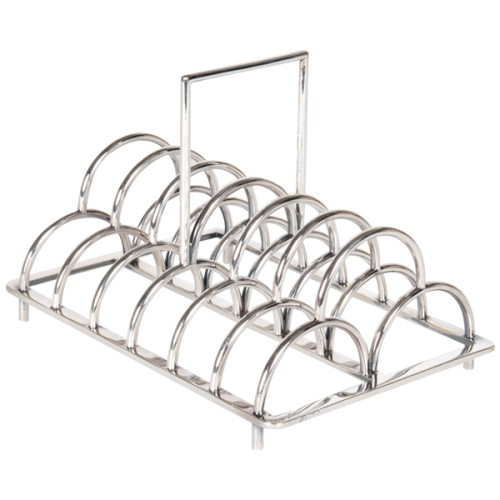
Christopher Dresser / James Dixon & Sons “Triple Arch” square handle toast rack c.1881
CHRISTOPHER DRESSER (1834-1904) UK
JAMES DIXON & SONS Sheffield, England
“Triple Arch” square handle toast rack c.1881
Silver-plate
Marks: JD&S (stamped), Chr. Dresser (facsimile signature), EP, #67, diamond or clover touchmark
Illustrated: 1885 Dixon catalogue, p. 95
For more information see: Truth, Beauty, Power: Dr. Christopher Dresser 1834-1904, exhib. cat. Historical Design, Inc. (New York, 1998); Charles Handley-Read, “High Victorian Design: An Illustrated Commentary” in ‘Design 1860-1960’ sixth conference report of the Victorian Society (London, 1968); Victorian and Edwardian Decorative Art: The Handley-Read Collection, ed. Simon Jervis (London: Diploma Galleries,1972); Christopher Dresser: pottery, glass, metalwork, (London: The Fine Arts Society Ltd., 1972); Isabelle Anscombe & Charlotte Gere, Arts & Crafts in Britain and America (New York: Rizzoli International Publications, Inc., 1978); Truth, Beauty and Design, Victorian, Edwardian and later Decorative Art (London: Fischer Fine Art Limited),; A Thing of Beauty: Art Nouveau, Art Deco, Arts & Crafts Movement and Aesthetic Movement Objects in Atlanta Collections (Atlanta, GA: The High Museum of Art, 1980), cat. no. M2; Widar Halén, Christopher Dresser (Oxford: Phaidon, 1990),; Judy Rudoe, Decorative Arts 1850-1950: A Catalogue of the British Museum Collection (London: Trustees of the British Museum, 1991),; Gerda Breuer, Von Morris bis Mackintosh – Reformbewegung zwischen Kunstgewerbe und Sozialutopie, Arts and Crafts (Darmstadt: Institut Mathildenhöhe, 1994/95); “The Silver Designs of Dr. Christopher Dresser,” Shirley Bury, Apollo (December, 1962);




 @hd_jewels