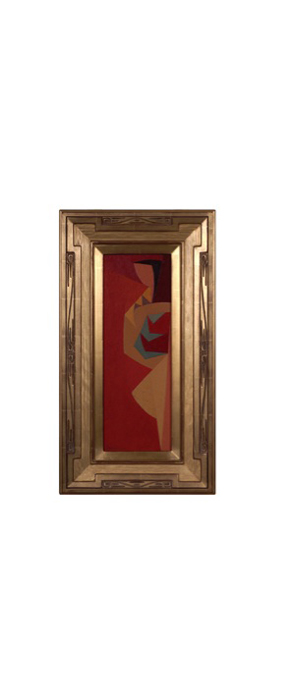
Karl Benjamin, “Geo-metricized figure”, Oil on canvas 1954
KARL BENJAMIN (1925-2012) USA
Geometricized figure 1954
Oil on canvas
Signed: Benjamin 54 (lower left)
For more information see: Dictionnaire des Peintres, Sculpteurs, Dessinateurs et Graveurs, Vol. 1 to 10, E. Bénézit (Paris: Librairie Gründ, 1976).
Canvas: H: 17″ x W: 6″
Framed: H: 24 1/2″ x W: 13 1/2″
Karl Benjamin was born in Chicago, IL in 1925. He received his BA from the University of Redlands, CA and his MFA at Claremont Graduate School, CA. Benjamin belonged to the Hard Edge group of West Coast painters led by John McLaughlin during the 1950s, 60s and early 70s. He was awarded the National Endowment for the Arts Grant for Visual Arts in both 1983 and 1989. His work has been featured in numerous museum exhibitions and is included in the public collections of the Los Angeles County Museum of Art; Museum of Contemporary Art, Los Angeles; Museum of Modern Art, Israel; Oakland Museum, Oakland, CA; San Francisco Museum of Modern Art, CA; Seattle Art Museum, WA; and the Whitney Museum of American Art, NY, among others. For many years, Benjamin taught painting at Pomona College and Claremont Graduate School, and currently is Professor Emeritus. He lived in Claremont, CA.
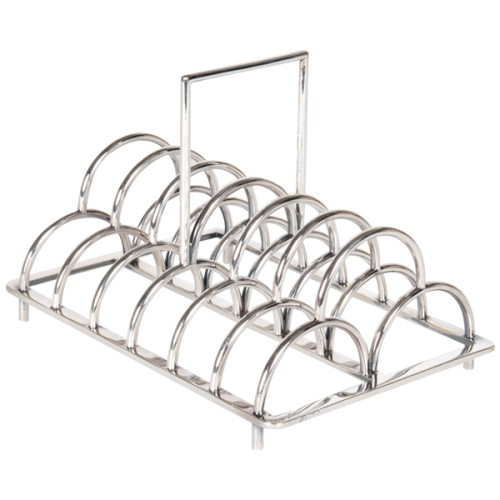
Christopher Dresser / James Dixon & Sons “Triple Arch” square handle toast rack c.1881
CHRISTOPHER DRESSER (1834-1904) UK
JAMES DIXON & SONS Sheffield, England
“Triple Arch” square handle toast rack c.1881
Silver-plate
Marks: JD&S (stamped), Chr. Dresser (facsimile signature), EP, #67, diamond or clover touchmark
Illustrated: 1885 Dixon catalogue, p. 95
For more information see: Truth, Beauty, Power: Dr. Christopher Dresser 1834-1904, exhib. cat. Historical Design, Inc. (New York, 1998); Charles Handley-Read, “High Victorian Design: An Illustrated Commentary” in ‘Design 1860-1960’ sixth conference report of the Victorian Society (London, 1968); Victorian and Edwardian Decorative Art: The Handley-Read Collection, ed. Simon Jervis (London: Diploma Galleries,1972); Christopher Dresser: pottery, glass, metalwork, (London: The Fine Arts Society Ltd., 1972); Isabelle Anscombe & Charlotte Gere, Arts & Crafts in Britain and America (New York: Rizzoli International Publications, Inc., 1978); Truth, Beauty and Design, Victorian, Edwardian and later Decorative Art (London: Fischer Fine Art Limited),; A Thing of Beauty: Art Nouveau, Art Deco, Arts & Crafts Movement and Aesthetic Movement Objects in Atlanta Collections (Atlanta, GA: The High Museum of Art, 1980), cat. no. M2; Widar Halén, Christopher Dresser (Oxford: Phaidon, 1990),; Judy Rudoe, Decorative Arts 1850-1950: A Catalogue of the British Museum Collection (London: Trustees of the British Museum, 1991),; Gerda Breuer, Von Morris bis Mackintosh – Reformbewegung zwischen Kunstgewerbe und Sozialutopie, Arts and Crafts (Darmstadt: Institut Mathildenhöhe, 1994/95); “The Silver Designs of Dr. Christopher Dresser,” Shirley Bury, Apollo (December, 1962);
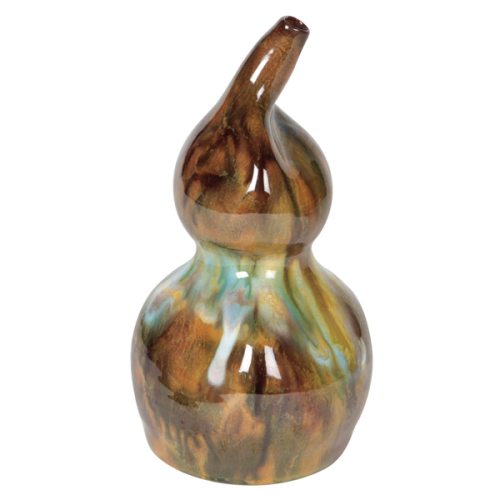
Christopher Dresser / Linthorpe Art Pottery Rare Aesthetic Movement “Gourd” Vase 1879-1882
CHRISTOPHER DRESSER (1834-1904) UK
LINTHORPE ART POTTERY, Middlesbrough
HENRY TOOTH Artistic Manager Linthorpe (1842-1918) UK
“Gourd Vase” 1879-1882
Glazed Earthenware
***Extremely rare Dresser / Linthorpe model.
Marked: LINTHORPE, Chr. Dresser (facsimile signature) HT, no. 326
Illustrated: Christopher Dresser: Truth, Beauty, Power exh. cat. (New York: Historical Design, 1998) p.75; illustrated in two drawings for gourd vases in Dresser’s 1881 design and account book under heading “Aug. 29, 1881. Sent to J. Harrison Esq. 41 Designs for Linthorpe.”
H: 7 3/4″
The contrasts in Dresser’s designs for different materials showed how his approach to design was also shaped by the properties and nature of a material. In 1879 Dresser was appointed art director at the newly established Linthorpe pottery, near Middlesbrough. Founded by John Harrison, a local businessman, the pottery’s aim was to use local clay to provide jobs for local men. Dresser’s design for the moulds for the pottery were inspired by a wide range of cultures from Japan, Peru, Mexico, Morocco and Ancient British forms. These very striking pieces, with the metal oxides in the complex and innovative glazes providing the only decoration. All of his designs were impressed with a facsimile signature. When Linthorpe closed in 1889, its moulds were acquired by a rival, Ault Pottery in Derbyshire. In 1893, Dresser signed a contract with Ault for new designs specifying that each pot should be marked with his facsimile signature.





 @hd_jewels