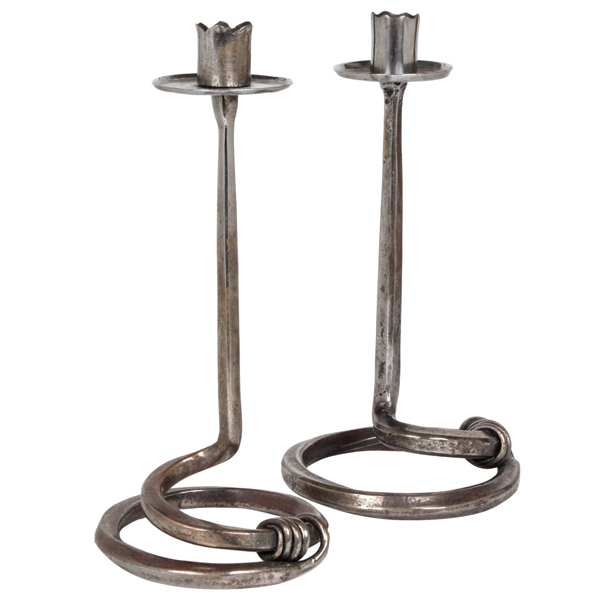
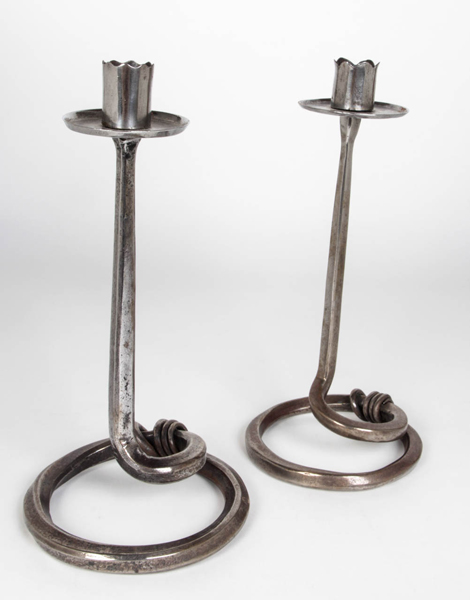
Edward Spencer/Artificers' Guild (attr.) British Arts & Crafts wrought iron candlesticks c. 1910
More Information
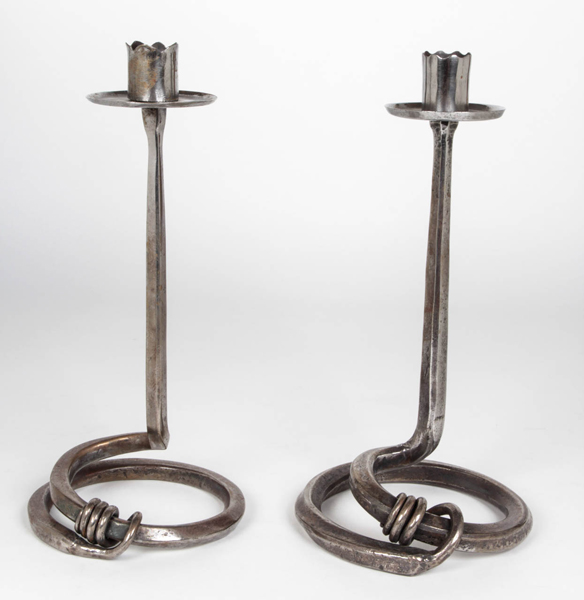
Edward Spencer/Artificers’ Guild (attr.) British Arts & Crafts wrought iron candlesticks c. 1910
Edward Spencer attr. (1872-1938) UK
Artificer’s Guild (1901-42) UK
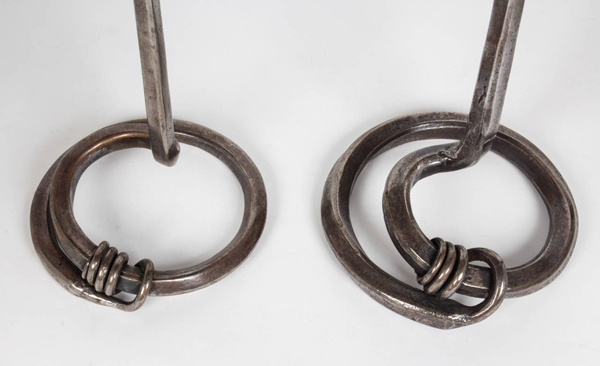
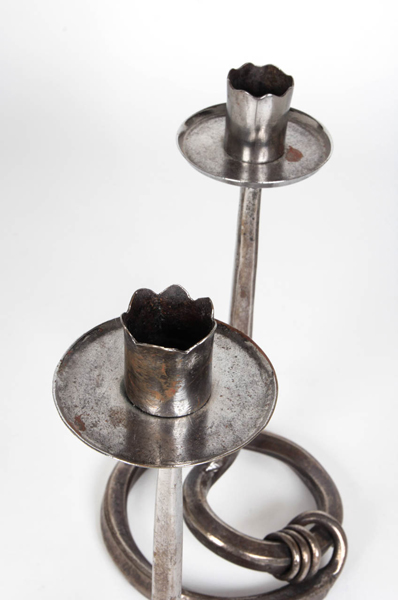
Pair of candlesticks circa 1910.
Handwrought iron with a squared central support terminating in a attenuated vine like wrap.
H: 10 1/2″ x Dia: 5 1/2″
The Artificers’ Guild Ltd was founded in 1901 by the metalwork and enameler Nelson Dawson (1859-1942). It was one of the few guilds inspired by the Arts and Crafts movement to enjoy real commercial success, and remained in operation until 1938. It was bought out in 1903 by the Birmingham entrepreneur Montague Fordham and established on a more commercial footing, producing domestic metalwork, church plate and furnishings, presentation plate and jewelry.
Fordham promoted Edward Spencer (1873-1938), previously Dawson’s principal designer, to be Director of the Guild’s workshop in Hammersmith. The Guild also had a showroom originally located just off Regent Street. Spencer died in 1938, shortly after the firm was wound up. During its existence, the Guild operated as a substantial business, employing over 40 staff at its peak, including a large number of skilled craftsmen, many of whom would have been trained in the Guild’s workshop. Although unacknowledged for much of the 20th century, the Guild is now recognized as an important producer of high quality metalwork and jewelry during this period.
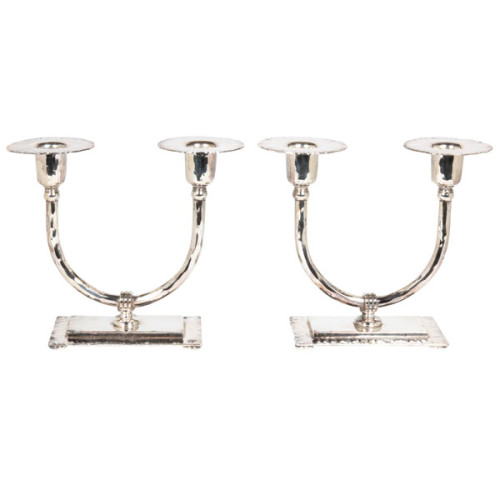
Roycroft / American Arts & Crafts Pair of Candlesticks c. 1915
ROYCROFT COPPER SHOP East Aurora, N.Y.
Pair of candlesticks c. 1915.
Hand wrought and textured copper, silver-plated.
Marks: impressed R, in orb with cross, ROYCROFT
For more information see: The American Arts & Crafts Movement in Western New York 1900-1928, Bruce A. Austin (Rochester Institute of Technology, 1992); Arts & Crafts Movement in New York State 1890’s – 1920’s, Coy Ludwig (Hamilton, N.Y.: Gallery Association of New York, 1983).
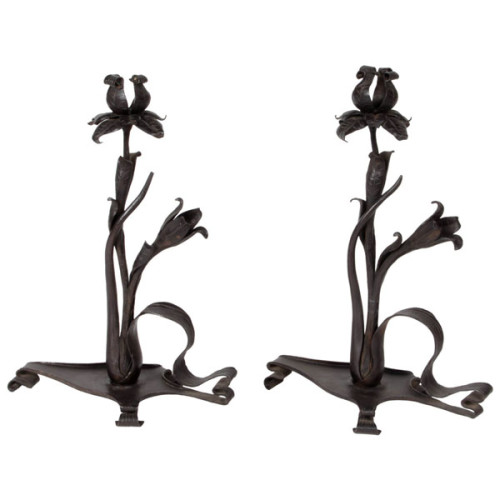
Otto Eckmann (attr.) Pair Of Hand Wrought Iron Floral Candlesticks c. 1900
OTTO ECKMANN attr. (1865-1902) Germany
Pair of candlesticks c. 1900
Hand-wrought iron with floral and foliage design
H: 12 ¼” x W: 8 ¼”
Price: $7,475
Otto Eckmann (19 November 1865 – 11 June 1902) was a German painter and graphic artist. He was a prominent member of the “floral” branch of Jugendstil. Otto Eckmann was born in Hamburg, Germany in 1865. He studied at the Kunstgewerbeschule in Hamburg and Nuernberg and at the academy in Munich. In 1894, Eckmann gave up painting (and auctioned off his works) in order to concentrate on applied design. He began producing graphic work for the magazines Pan in 1895 and Jugend in 1896. He also designed book covers for the publishers Cotta, Diederichs, Scherl and Seemann, as well as the logo for the publishing house S. Fischer Verlag. In 1897 he taught ornamental painting at the Unterrichtsanstalt des Königlichen Kunstgewerbemuseums in Berlin. In 1899, he designed the logo for the magazine Die Woche. From 1900 to 1902, Eckmann did graphic work for the Allgemeine Elektrizitätsgesellschaft (AEG). During this time, he designed the fonts Eckmann (in 1900) and Fette Eckmann (in 1902), probably the most common Jugendstil fonts still in use today.
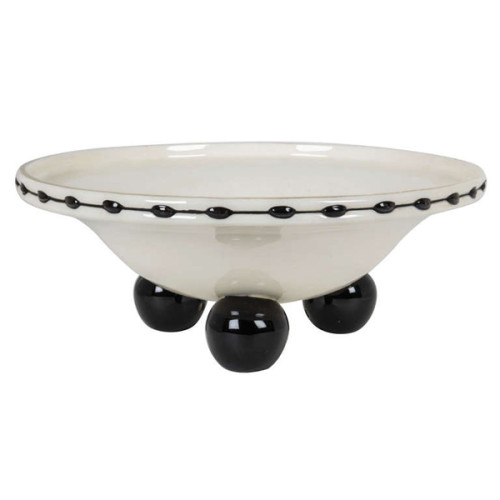
Julius Dressler / Art Pottery Black and White Footed bowl c. 1910
JULIUS DRESSLER Biela, Czech Republic
JULIUS DRESSLER BIELA (1888-1945) Czech Republic
Bowl 1910
Black and white glazed earthenware with three ball feet
Marks: JDB, 7764 (underglaze)
H: 4 7/8” x D base: 10 7/8”
Price: $3,750
Julius Dressler was a noted Bohemian ceramics manufacturing company that operated from the late 19th century until the end of World War II. Founded by Julius Dressler in the 1880s in Biela, Bohemia, the company produced high-quality decorative faience, Maiolica and porcelain ware. Dressler gained international renown for the ceramics it produced in the early 1900s in the Art Nouveau style, also known as “Jugendstil” or “Secessionist” ware.


 @hd_jewels