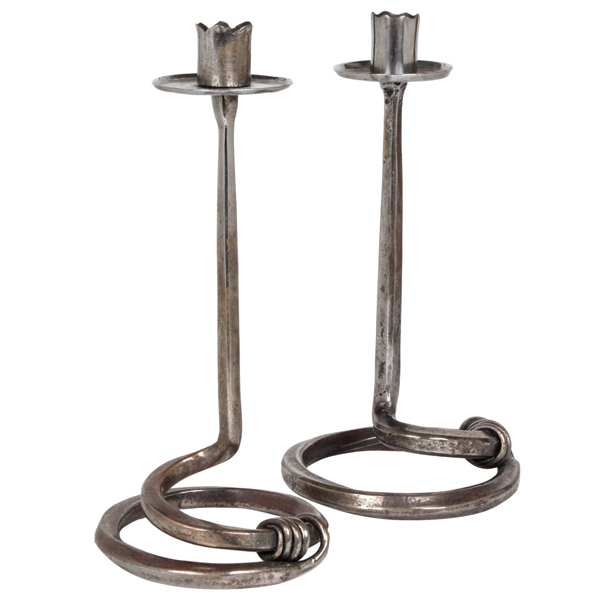
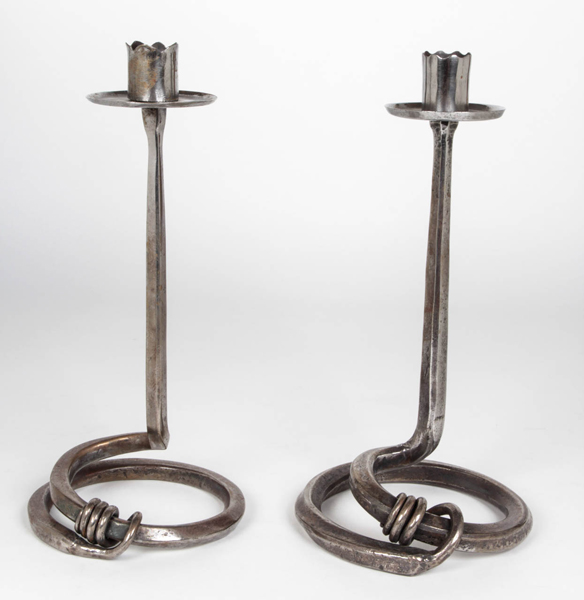
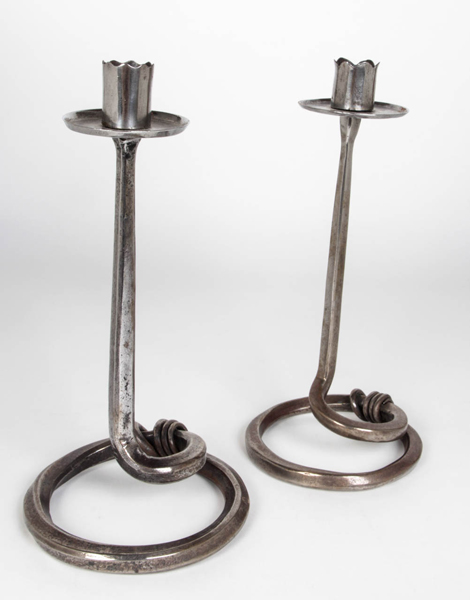
Edward Spencer/Artificers' Guild (attr.) British Arts & Crafts wrought iron candlesticks c. 1910
More Information
Edward Spencer/Artificers’ Guild (attr.) British Arts & Crafts wrought iron candlesticks c. 1910
Edward Spencer attr. (1872-1938) UK
Artificer’s Guild (1901-42) UK
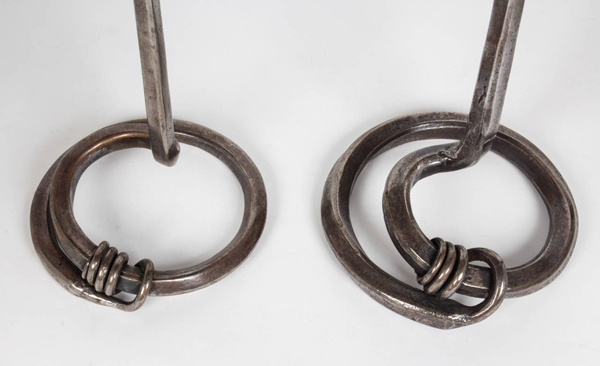
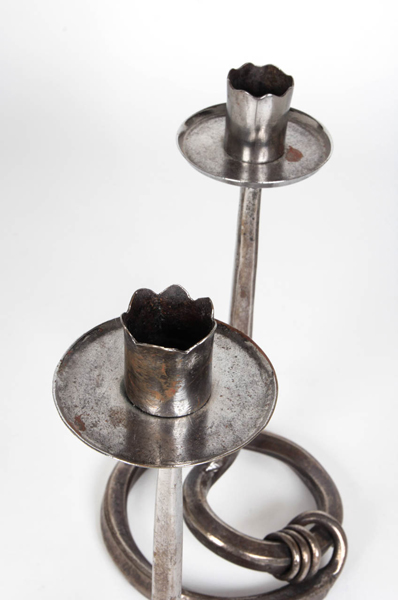
Pair of candlesticks circa 1910.
Handwrought iron with a squared central support terminating in a attenuated vine like wrap.
H: 10 1/2″ x Dia: 5 1/2″
The Artificers’ Guild Ltd was founded in 1901 by the metalwork and enameler Nelson Dawson (1859-1942). It was one of the few guilds inspired by the Arts and Crafts movement to enjoy real commercial success, and remained in operation until 1938. It was bought out in 1903 by the Birmingham entrepreneur Montague Fordham and established on a more commercial footing, producing domestic metalwork, church plate and furnishings, presentation plate and jewelry.
Fordham promoted Edward Spencer (1873-1938), previously Dawson’s principal designer, to be Director of the Guild’s workshop in Hammersmith. The Guild also had a showroom originally located just off Regent Street. Spencer died in 1938, shortly after the firm was wound up. During its existence, the Guild operated as a substantial business, employing over 40 staff at its peak, including a large number of skilled craftsmen, many of whom would have been trained in the Guild’s workshop. Although unacknowledged for much of the 20th century, the Guild is now recognized as an important producer of high quality metalwork and jewelry during this period.
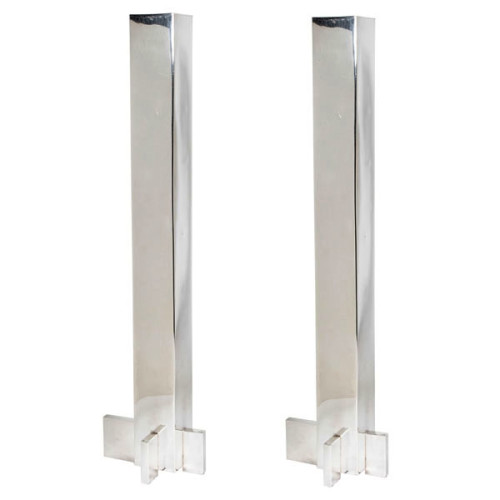
Antonio Pineda Important Sterling Architectural Candlesticks c.1955-60
ANTONIO PIÑEDA (1919-2009) Taxco, Mexico
Important Architectural Candlesticks c.1955-60
Handwrought sterling silver in exaggerated tall rectangular forms with various size rectangular geometric elements attached as the base supports, 100 troy ounces total weight
Marks: Antonio Taxco (crown mark), 925, Mexican Eagle silver standard mark, Mexican circular mark, Hecho en Mexico
Provenance: Antonio Pineda, 1990
***According to Antonio Pineda, these are one pair of only three pair made!
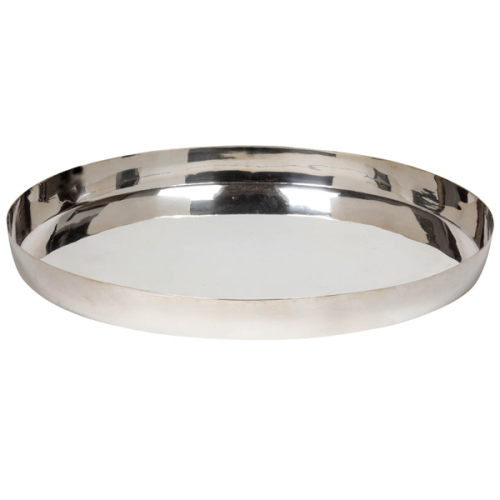
Josef Hoffmann / Wiener Werkstätte / Vienna Secession Oval serving tray c. 1910
JOSEF HOFFMANN (1870-1956) Austria
WIENER WERKSTÄTTE (1903-1932) Vienna
Oval serving tray c. 1910
Silver plated alpaca
Marks: JH monogram, WIENER/WERK/STATTE, MADE IN AUSTRIA (impressed); L 478 a 1 (inscribed)
Illustrated: Wiener Werkstätte: Die Schutzmarken, The Registered Trade Marks, Waltraud Neuwirth (Wien: Selbstverlag Dr. Waltraud Neuwirth, 1985), p. 221; Wiener Werkstätte, 1903-1932, Gabriele Fahr-Becker (Köln: Benedikt Taschen Verlag GmbH, 1995), p. 161.
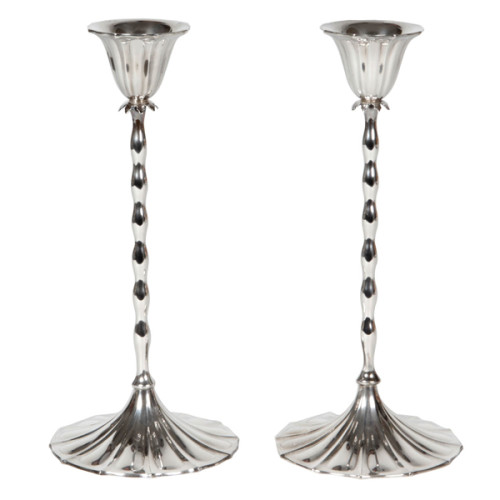
American Art Deco Reed & Barton Sterling candlesticks 1928
REED & BARTON (active 1824 – present) Taunton, MA
Candlesticks 1928
Sterling silver with Hoffmann-like fluted base and bobêches with undulating stem and palm leaf like terminating detail.
Marks: eagle R (in a shield) lion, Sterling, 1000, cement reinforced, eagle (date mark for 1928).
Model illustrated: Vanity Fair (Dec. 1928, Vol. 31), p. 120., Reed & Barton Vintage Catalog, p. 10, plate number 1000.
For more information on Reed & Barton see: Encyclopedia of American Silver Manufacturers, Dorothy T. Rainwater (West Chester, PA: Schiffer Publishing Ltd., 1986), p. 156-160.


 @hd_jewels