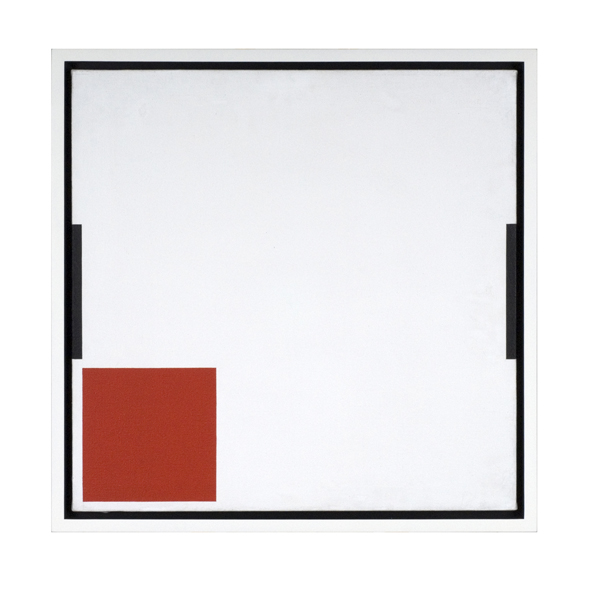
***24 layers of paint were applied to the surface and the painting is 24 inches high and wide. Erik Saxon was born in San Francisco in 1941 and now resides in New York City. He received both his Bachelor and Master of Arts from Berkeley (The University of California). Originally from San Francisco but based in NYC since 1968, Saxon was a core member of the Radical Painting Group active in NYC during the 1970s and 1980s. The RPG stressed a return to the core concerns of painting, focusing primarily on the monochrome. The group included Erik Saxon, Phil Sims, Merrill Wagner, Dale Henry, Doug Sanderson, Susanna Tanger, Anders Knutsson, Marcia Hafif, Jerry Zeniuk, Frederic Matys Thursz. In 1973 Saxon began making abstract work based on the grid format, initially using watercolor on paper and then industrial paint on raw canvas. The same year he began exploring the idea of monochromatic canvases – a series of acrylic drawings consisting of white and off-white squares arranged into groups of three to five panels – but tabled the idea a year later to focus his attention on paintings organized around a nine square grid structure. For the past thirty years, Saxon has worked with the monochrome and it’s relationship to its surroundings–the wall, the floor, its location within the exhibition space, and the viewer. In addition to his studio work, Saxon is a writer and has had his essays published in Artforum, Art in America, Appearances and other respectable art magazines. Radical Painting denotes an abstract art tendency in Europe and North America, which was in existence in the 1980s and 1990s and has to be seen in the light of Postmodernism. The term Radical Painting was used in the context of an exhibition at the Williams College Museum of Art in Williamstown (MA) in 1984 for the first time. It describes a self-referential art, which addresses topics of its immanent characteristics – especially color, but also image carriers, surface and structure. The Radical Painting artists and their monochrome painting are in the tradition of Post Painterly Abstraction of the 1950s and 1960s and shows notions of Minimal Art. The roots of radical art can also be found in the stylistic ambitions of Constructivism, Suprematism and Art Concret. In terms of style, radical painting is characterized by mostly monochrome works that focus on color effects, shading and material properties, entirely doing without external motifs. Radical Painting enables the observer to sensually experience the picture with its independently perceived color and light values, uniquely achieved by the painting technique, subtle coating methods or change of flows. Among the main artists of Radical Painting are Phil Sims, Marcia Hafif, Günter Umberg and Joseph Marioni; others radical artist are Jerry Zenuik, Andreas Exner, Frederic Matys Thursz, Rudolf De Crignis, Christiane Fuchs, Ingo Meller, Eric Saxon, Peter Tollens, Dieter Villinger, Ulrich Wellmann, Olivier Mosset and Winston Roeth.
Saxon’s works can be found in the following selected Public and Private Collections: artothek, Kolnisches Stadt Museum, Cologne, Germany. Bank of America, San Francisco. Fogg Museum, Havard University , Boston, MA Goteborg Museum of Art, Sweden Lita Hornik, New York IBM, San Jose, CA Wynn Kramarsky, New York Herbert Minkel, New York Mondriaanhuis, Museum voor Constructieve en Concrete Kunst, Amersfoort, Neatherlands. Morris and Helen Belkin Art Gallery, The University of British Columbia, Vancover,B.C., Canada Museo Cantonale d’Arte of Lugano , Switzerland Museum fur Kommunikation, Frankfurt, Germany Museum of Modern Art, Belgrade MOMA, Museum of Modern Art , New York . Gift of Wynn Kramarsky National Gallery of Art, Washington , D.C. UCLA Hammer Museum, Los Angeles , CA University of Kentucky Art Museum, Lexington, KY Yale University Art Gallery, New Haven, CT
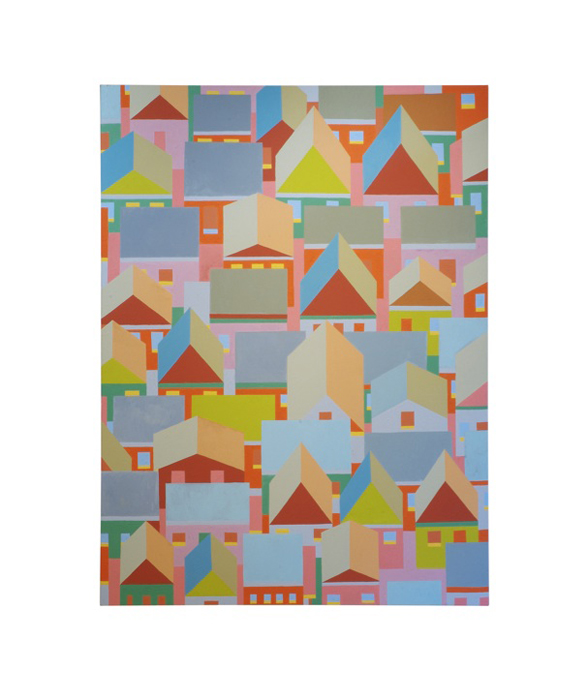
Hubert Schmalix “Mount Washington” Oil on Canvas 2005/2006
HUBERT SCHMALIX (1952-) Austria
Mount Washington 2005/06
Oil on canvas
Signed and dated on back: Schmalix 05 06
Provenance: Hubert Schmalix Vienna
For related works by Hubert Schmalix see: Hubert Schmalix, Lóránd Hegyi exhibition catalog (Museum moderner Kunst Stiftung Ludwig Wien) November 19, 1994 – January 1995.
H: 69” x W: 51”
Hubert Schmalix was born in Graz, Austria, on December 17, 1952 and studied at the Vienna Art Academy from 1971 to 1976. By 1979 Schmalix was showing work at the forward-looking exhibition ‘Europa 79 – Kunst der 80er Jahre’ in Stuttgart. In 1983 the London Tate Gallery invited Schmalix to present work at ‘New Art’, an important survey of contemporary art. Schmalix has become well-known world-wide as an exponent of ‘New Art’, working with a retrospective glance at both classical art history and modern art. Schmalix focuses on the world of things and the human figure. Although the expressive gesture was the dominant feature of his 1980s work, it yielded early in the 1990s to stringent tectonic composition. In 1984 Hubert Schmalix went to the Philippines and on to the US, moving to Los Angeles in 1987. In 1986-87 Schmalix taught at the Academy for the Decorative and Applied Arts in Vienna and from 1997 he has been a professor at the Vienna Art Academy. Schmalix is a visiting professor at the University of California Los Angeles (UCLA). In 1993 his work was featured at the Venice Biennale and in 1998 he was awarded the Fine Art Prize of the City of Vienna. Schmalix has done several large fresco cycles in Salzburg and his work has been shown extensively at numerous international solo and group shows and most recently at Art Basel 2006.
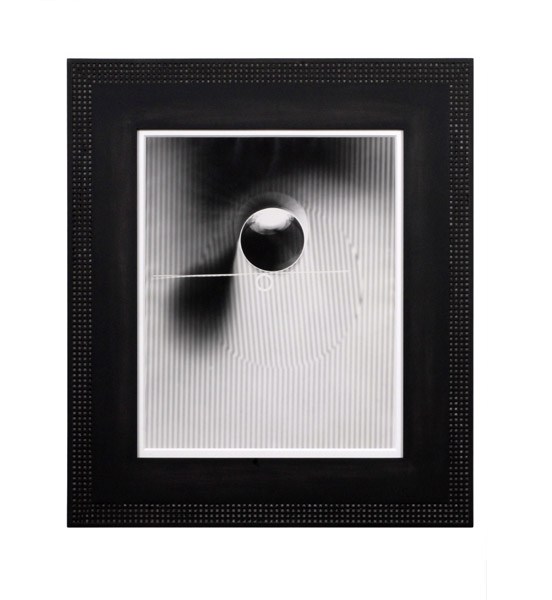
György Kepes, Abstraction, Gelatin silver print, 1942
GYÖRGY KEPES (1906-2001) Hungary/USA
Abstraction 1942
Silver gelatin print
Signed: 9 (in a circle, on back); Gyorgy Kepes 1942 (in ink on back)
György Kepes was a Hungarian-born painter, designer, educator and art theorist. After emigrating to the U.S. in 1937, he taught design at the New Bauhaus (later the School of Design, then Institute of Design, then Illinois Institute of Design or IIT) in Chicago. In 1947 He founded the Center for Advanced Visual Studies at the Massachusetts Institute of Technology (MIT) where he taught until his retirement in 1974.
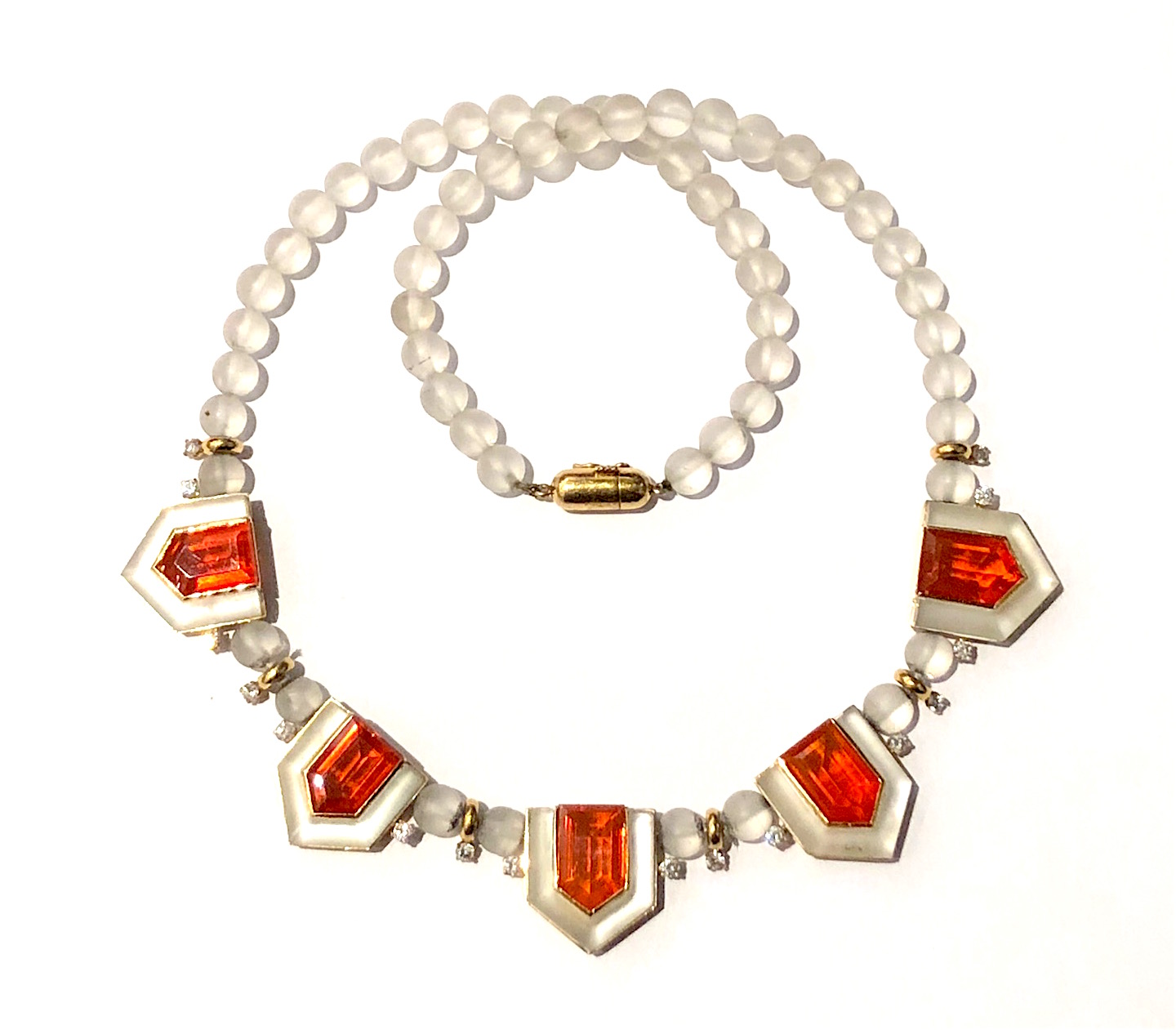
Art Deco “Fire Opal” necklace, frosted rock crystal round beads and four sided custom rock crystal bezels set in 18K yellow gold with 16 round–cut accent diamonds featuring five large natural fire opals (G.I.A certificate, dimension of each fire opal, 13.00 x 8.15 x 6.20mm for a TW of approx. 17.50 carats), c. 1940’s
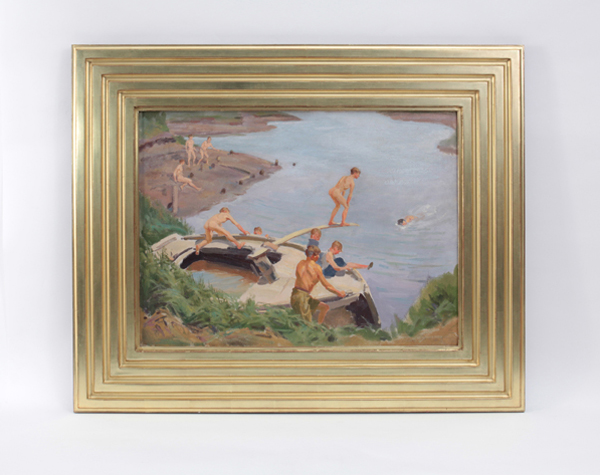
Edmund F. Ward “The Swimming Hole” Oil on canvas c. 1930
EDMUND F. WARD (b. 1892 – 1991) USA
“The Swimming Hole” c. 1930
Oil on canvas
Marks: signed Edm. F. Ward (lower right); partial labels verso:Westchester Arts and Crafts Guild; 4 Edmund F. Ward
For more information on the artist see: Who Was Who in American Art,Peter Hastings Falk, ed. (Madison, Conn.: Sound View Press, 1985), p. 658.
Canvas H: 18” x W: 24”
Framed H: 27 9/16” x W: 33 9/16”
Price: $14,000
Ward studied at the Arts Student’s League with Edward Dufner, George Bridgeman, and Thomas Fogarty. He was an illustrator for several national magazines and books. In 1925, Ward exhibited an award winning work at the Art Institute of Chicago. He is perhaps best known for his WPA mural in the Federal Building, White Plains, New York.



 @hd_jewels