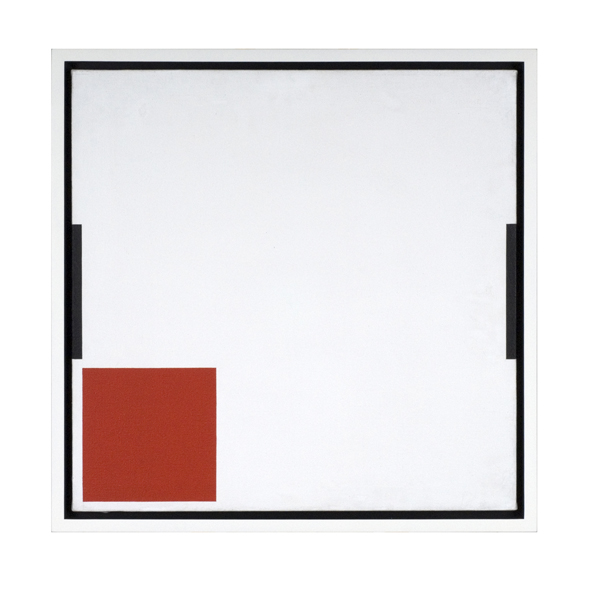
***24 layers of paint were applied to the surface and the painting is 24 inches high and wide. Erik Saxon was born in San Francisco in 1941 and now resides in New York City. He received both his Bachelor and Master of Arts from Berkeley (The University of California). Originally from San Francisco but based in NYC since 1968, Saxon was a core member of the Radical Painting Group active in NYC during the 1970s and 1980s. The RPG stressed a return to the core concerns of painting, focusing primarily on the monochrome. The group included Erik Saxon, Phil Sims, Merrill Wagner, Dale Henry, Doug Sanderson, Susanna Tanger, Anders Knutsson, Marcia Hafif, Jerry Zeniuk, Frederic Matys Thursz. In 1973 Saxon began making abstract work based on the grid format, initially using watercolor on paper and then industrial paint on raw canvas. The same year he began exploring the idea of monochromatic canvases – a series of acrylic drawings consisting of white and off-white squares arranged into groups of three to five panels – but tabled the idea a year later to focus his attention on paintings organized around a nine square grid structure. For the past thirty years, Saxon has worked with the monochrome and it’s relationship to its surroundings–the wall, the floor, its location within the exhibition space, and the viewer. In addition to his studio work, Saxon is a writer and has had his essays published in Artforum, Art in America, Appearances and other respectable art magazines. Radical Painting denotes an abstract art tendency in Europe and North America, which was in existence in the 1980s and 1990s and has to be seen in the light of Postmodernism. The term Radical Painting was used in the context of an exhibition at the Williams College Museum of Art in Williamstown (MA) in 1984 for the first time. It describes a self-referential art, which addresses topics of its immanent characteristics – especially color, but also image carriers, surface and structure. The Radical Painting artists and their monochrome painting are in the tradition of Post Painterly Abstraction of the 1950s and 1960s and shows notions of Minimal Art. The roots of radical art can also be found in the stylistic ambitions of Constructivism, Suprematism and Art Concret. In terms of style, radical painting is characterized by mostly monochrome works that focus on color effects, shading and material properties, entirely doing without external motifs. Radical Painting enables the observer to sensually experience the picture with its independently perceived color and light values, uniquely achieved by the painting technique, subtle coating methods or change of flows. Among the main artists of Radical Painting are Phil Sims, Marcia Hafif, Günter Umberg and Joseph Marioni; others radical artist are Jerry Zenuik, Andreas Exner, Frederic Matys Thursz, Rudolf De Crignis, Christiane Fuchs, Ingo Meller, Eric Saxon, Peter Tollens, Dieter Villinger, Ulrich Wellmann, Olivier Mosset and Winston Roeth.
Saxon’s works can be found in the following selected Public and Private Collections: artothek, Kolnisches Stadt Museum, Cologne, Germany. Bank of America, San Francisco. Fogg Museum, Havard University , Boston, MA Goteborg Museum of Art, Sweden Lita Hornik, New York IBM, San Jose, CA Wynn Kramarsky, New York Herbert Minkel, New York Mondriaanhuis, Museum voor Constructieve en Concrete Kunst, Amersfoort, Neatherlands. Morris and Helen Belkin Art Gallery, The University of British Columbia, Vancover,B.C., Canada Museo Cantonale d’Arte of Lugano , Switzerland Museum fur Kommunikation, Frankfurt, Germany Museum of Modern Art, Belgrade MOMA, Museum of Modern Art , New York . Gift of Wynn Kramarsky National Gallery of Art, Washington , D.C. UCLA Hammer Museum, Los Angeles , CA University of Kentucky Art Museum, Lexington, KY Yale University Art Gallery, New Haven, CT
Aram Gesar has been published internationally and has exhibited his photographic work in New York, San Francisco, Zurich and Geneva since 1977. As a producer, art director and photographer, Gesar created advertising campaigns for major corporations in the U.S. and Europe focusing on the fields of travel, banking, financial services, aerospace and motion pictures. He also created and produced documentaries on travel, aviation and yachting for national cable networks and the home video markets and television commercials and corporate programs for various U.S. and European corporations.
Gesar is currently one of the leading international experts on travel and air transport, and the founder and CEO of The Pyramid Media Group, which includes several magazines, newsletters, web sites, books, eBooks and other publications integrating a spectrum of business, travel and aviation content.
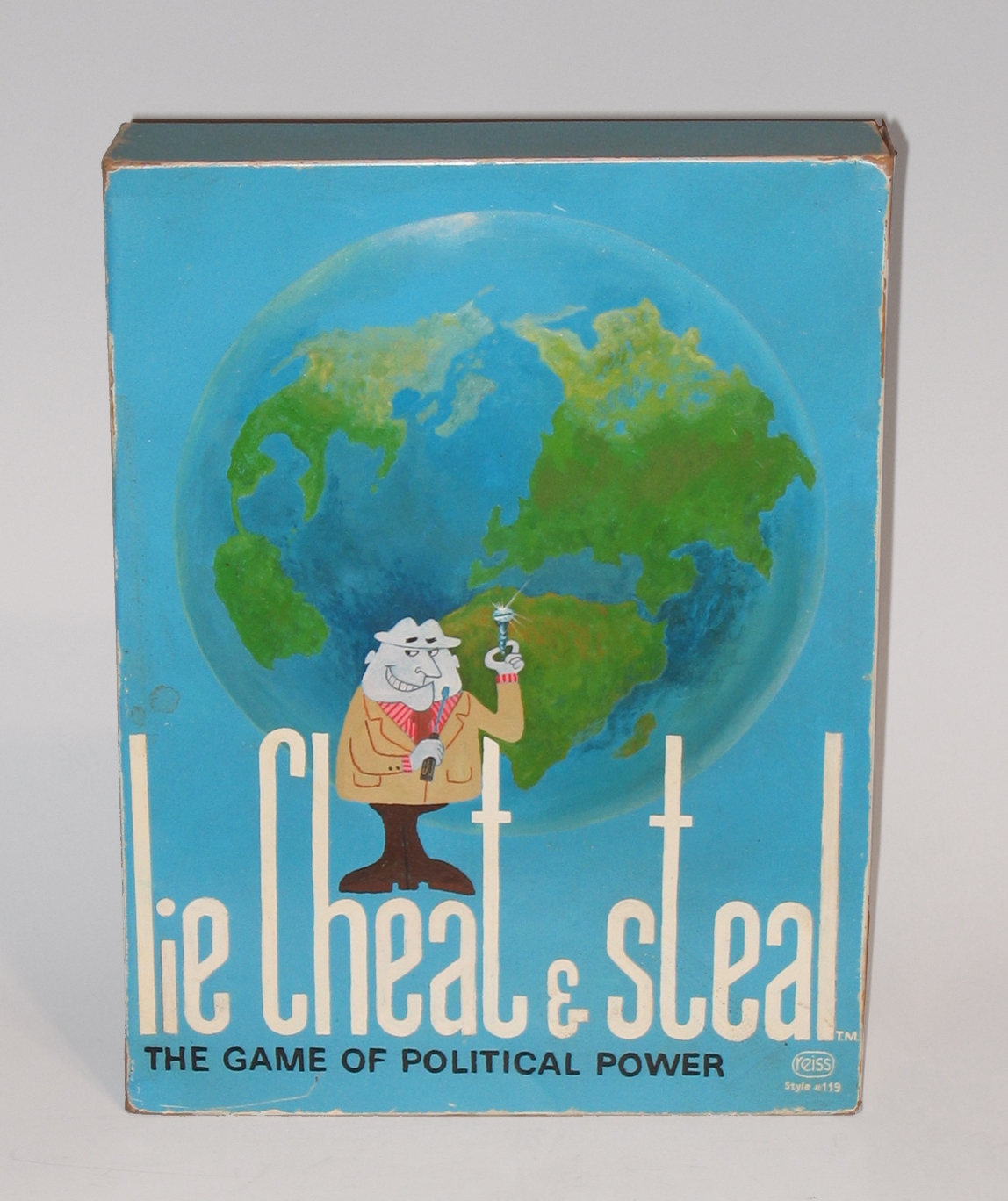
Tim Liddy, Lie Cheat and Steal (1971) The Game of Political Power Oil and enamel on copper, plywood back 2006
TIM LIDDY (b. 1963) Missouri
“Lie Cheat and Steal” (1971) The Game of Political Power 2006
Oil and enamel on copper, plywood back
Signed in script: Tim Liddy “circa 1971” 2006, red circular ring
Provenance: William Shearburn Gallery (St. Louis, MO)
H: 12” x W: 9” x D: 2”
With his recent paintings, Liddy has both reasserted the construct of hyperrealist painting and developed a thoroughly unique advancement of that mode by extending the cultural reality of the indexed original. Based on the illustrated box lids of vintage board games, Liddy has recontextualized a subject, which evokes the underlying rules of life. Painted on copper or steel in the precise dimensions of the original, the metal is then manipulated to demonstrate the exact rips and tears from years of usage and includes trompe-l’oeil renditions of the scotch tape that might be holding the cardboard box together, the assorted stains, or the various graffiti of time. Liddy leaves no possibility of ambivalence, these works speak to a concurrent understanding of their original object identity and to themselves as works of art engaged in historical and psychological dialogue.




 @hd_jewels