Product Description
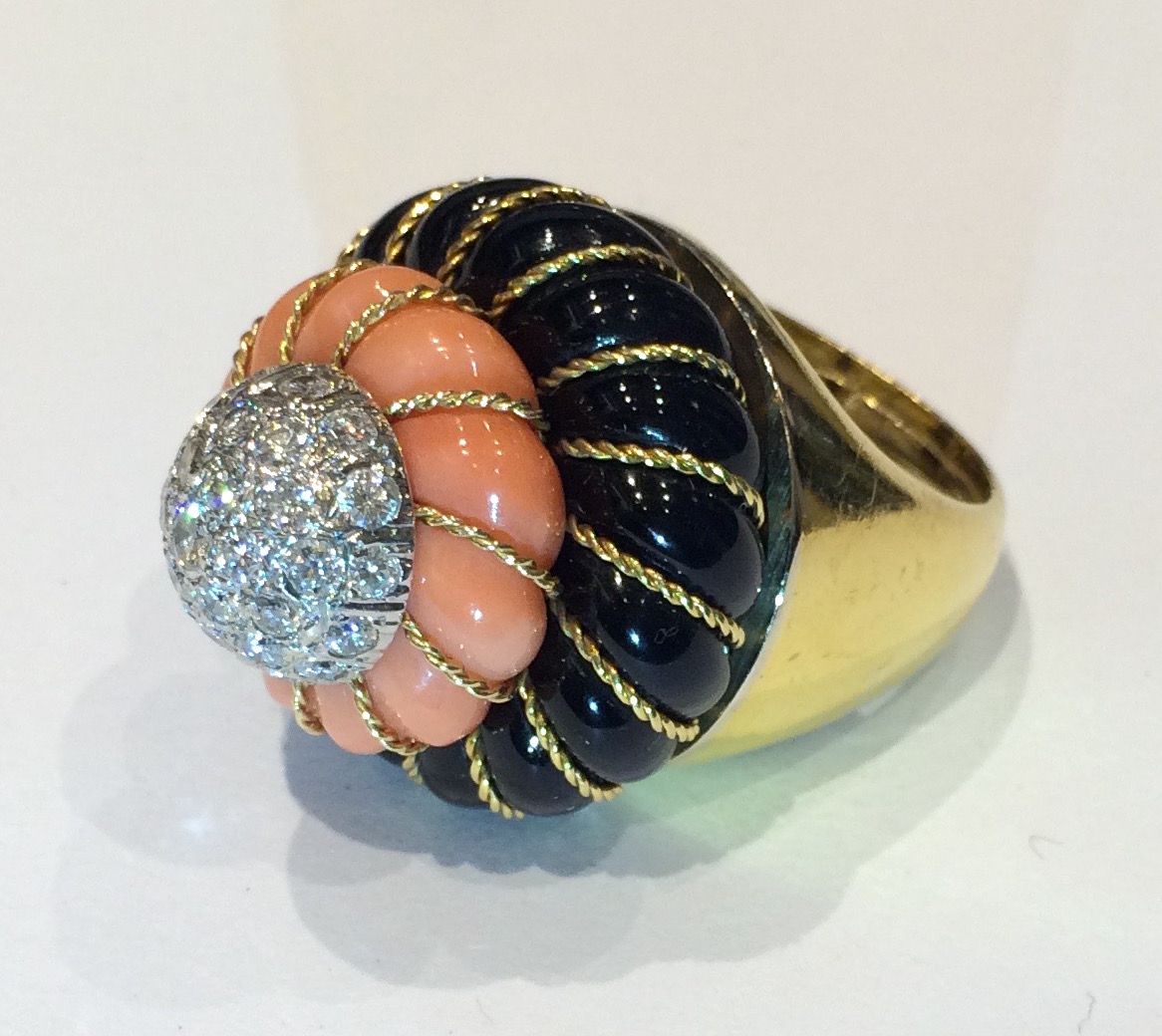
Ettore Sottsass / Cleto Munari Diagonal stripe and pyramid ring, 18K gold architectural with inset onyx stripes on a diagonal, inset with approx. 8 carats TW of pave diamonds, signed, c. 1985

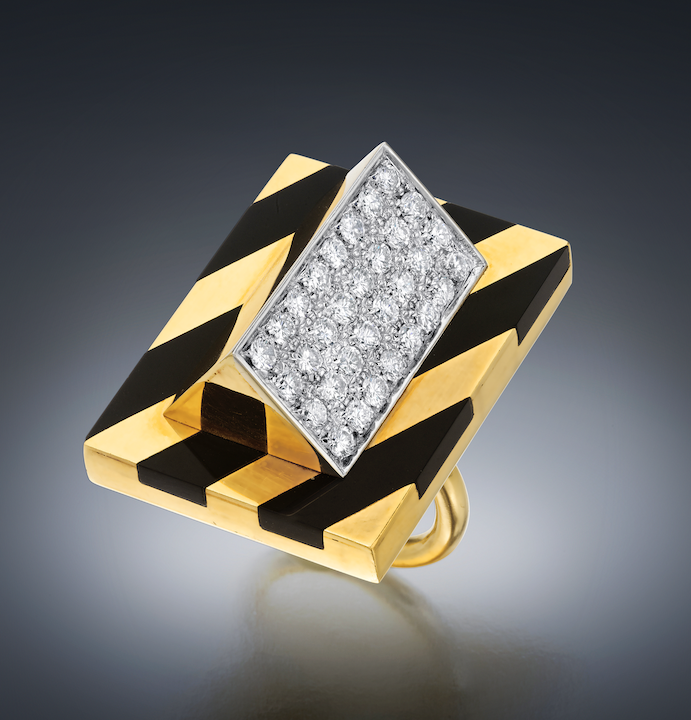
Ettore Sottsass / Cleto Munari ring illustrated in Jewelry By Architects: From the Collection of Cleto Munari by Barbara Radice (Rizzoli, 1988)
Ettore Sottsass / Cleto Munari Diagonal stripe and pyramid ring, 18K gold architectural with inset onyx stripes on a diagonal, inset with approx. 8 carats TW of pave diamonds, signed, c. 1985
GEORGE JAKOB HUNZINGER (1835-1898) Germany/ USA
Chair 1876
Yellow and blue painted elaborately turned wood, blue thread woven covered metal band mesh seat (original condition)
Marks: George Hunzinger Patent 1876
Illustrated: The Furniture of George Hunzinger, Invention and Innovation in Nineteenth-Century America, Barry R. Harwood (Brooklyn: Brooklyn Museum of Art, 1997) p.103.
H: 32″ x D: 17″ x W: 20″
GEORGE JAKOB HUNZINGER (1835-18989) USA
George Hunzinger emigrated in the 1850s from the Black Forest region of Germany where his family had worked as cabinetmakers since the 17th century. Settling in New York, he joined a community of 3,000 German furniture makers but soon distinguished himself as a maker of patent furniture and “fancy chairs”. Hunzinger’s innovative designs are often associated with the development of the Aesthetic Movement in America. By the 1870s, his chairs were sought after by many Americans as accent pieces for their parlors. The woven mesh or upholstery of these innovative chairs follows the original intention of the maker and the turned frame has an avant-garde, colorful and rather contemporary feeling painted in a combination of a rich ochre yellow and cobalt blue, a color combo that was highly prized for it’s eccentricity in Victorian America.
HENRI MATISSE (1869-1954) France
“Pasiphae” 1944
Limited edition No. 48/250.
Published by Martin Fabiani, Paris.
Dimensions:
Book: H: 13 3/16” x W: 10 3/8”
Custom leather box: H: 15 1/4” x W: 11 11/16” x D: 2 5/8”
Custom cloth slipcase: H: 16 1/8” x W: 12 3/16” x D: 3”
Signed by Matisse on the justification page.
Matisse’s Pasiphae is a singularly thrilling work and the plates were destroyed after the printing of this edition.
“A Contemporary retelling of the story of Parisphae and the Minoan bull was the impetus for one of Matisse’s most intensive printmaking experiences. Working with linoleum, a fairly easy material to use, Matisse cut many blocks of each image to achieve the perfect flow of line and relationship of forms. Intent on matching the spirit and ambience of the classical tale, Matisse took as his model ancient Greek playground vase painting”.