Guttierez Vega / South American Art Deco Sterling Modernist Coffee / Tea Set c. 1935
More Information
Guttierez Vega / South American Art Deco Sterling Modernist Coffee / Tea Set c. 1935
GUTTIEREZ VEGA (active 1930s) Bogotá, Columbia
Four-piece modernist coffee / tea set c. 1935
Radical form cone and triangular shaped four piece sterling silver with bold design exotic handles.
Marks: T.A.N. Sterling (Maker’s mark), serial number F925
Coffee pot H: 5″ x L: 10 1/2″
Teapot H: 4 3/8″ x L: 10 1/2″
Creamer H: 3″ x L: 8″
Sugar bowl H: 4 1/2″ x L: 7 3/4″
In the 1930s, Colombia began to embrace modern and Art Deco architecture. The new Liberal Party government tore down many older buildings to reject the conservative past. In their place, it constructed modern buildings with an international flavor and interiors and decorative arts were designed to complement these newly stylized buildings.
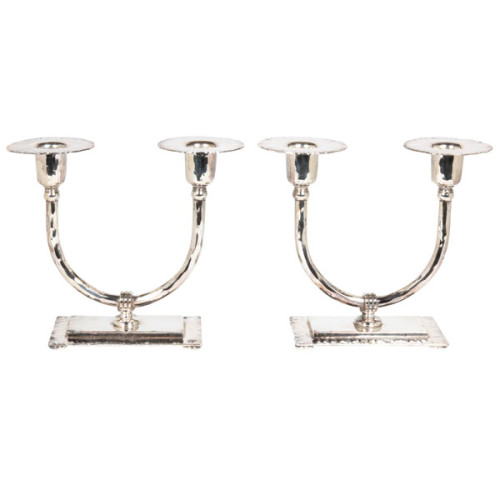
Roycroft / American Arts & Crafts Pair of Candlesticks c. 1915
ROYCROFT COPPER SHOP East Aurora, N.Y.
Pair of candlesticks c. 1915.
Hand wrought and textured copper, silver-plated.
Marks: impressed R, in orb with cross, ROYCROFT
For more information see: The American Arts & Crafts Movement in Western New York 1900-1928, Bruce A. Austin (Rochester Institute of Technology, 1992); Arts & Crafts Movement in New York State 1890’s – 1920’s, Coy Ludwig (Hamilton, N.Y.: Gallery Association of New York, 1983).
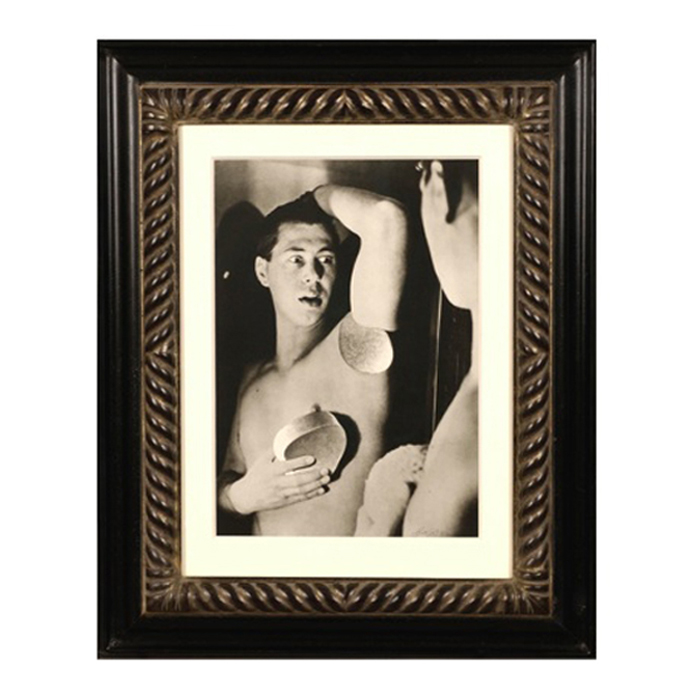
Herbert Bayer, Self Portrait, Gelatin silver print , 1932, printed later
HERBERT BAYER (1900-1985) Austria
Self portrait 1932 (printed later)
Silver gelatin print
Edition: 28/40
Signed: bayer 32 (in ink on bottom right corner)
Provenance: Kennedy Gallery, New York
H: 13 7/16” x W: 9 ½”
Framed size: H: 21 ½” x W: 17 ½”
Price: $16,000
Herbert Bayer (1900 – 1985) was an Austrian graphic designer, painter, photographer, and architect. Bayer apprenticed under the artist Georg Schmidthammer in Linz. Leaving the workshop to study at the Darmstadt Artists’ Colony, he became interested in Walter Gropius’s Bauhaus manifesto. After Bayer had studied for four years at the Bauhaus under such teachers as Wassily Kandinsky and László Moholy-Nagy, Gropius appointed Bayer director of printing and advertising. In the spirit of reductive minimalism, Bayer developed a crisp visual style and adopted use of all-lowercase, sans serif typefaces for most Bauhaus publications. Bayer is one of several typographers of the period including Kurt Schwitters and Jan Tschichold who experimented with the creation of a simplified more phonetic-based alphabet. Bayer designed the 1925 geometric sans-serif typeface, universal, now issued in digital form as Architype Bayer that bears comparison with the stylistically related typeface Architype Schwitters.
In 1928, Bayer left the Bauhaus to become art director of Vogue magazine’s Berlin office. He remained in Germany far later than most other progressives. In 1936 he designed a brochure for the Deutschland Ausstellung, an exhibition for tourists in Berlin during the 1936 Olympic Games. In 1938 he left Germany and settled in New York City where he had a long and distinguished career in nearly every aspect of the graphic arts. In 1946 Bayer relocated again. Hired by industrialist and visionary Walter Paepcke, Bayer moved to Aspen, Colorado as Paepcke promoted skiing as a popular sport. Bayer’s architectural work in the town included co-designing the Aspen Institute and restoring the Wheeler Opera House, but his production of promotional posters identified skiing with wit, excitement, and glamour. Bayer would remain associated with Aspen until the mid-1970s. Bayer gave the Denver Art Museum a collection of around 8,000 of his works. In 1959, he designed his “fonetik alfabet”, a phonetic alphabet, for English. It was sans-serif and without capital letters. He had special symbols for the endings -ed, -ory, -ing, and -ion, as well as the digraphs “ch”, “sh”, and “ng”. An underline indicated the doubling of a consonant in traditional orthography.
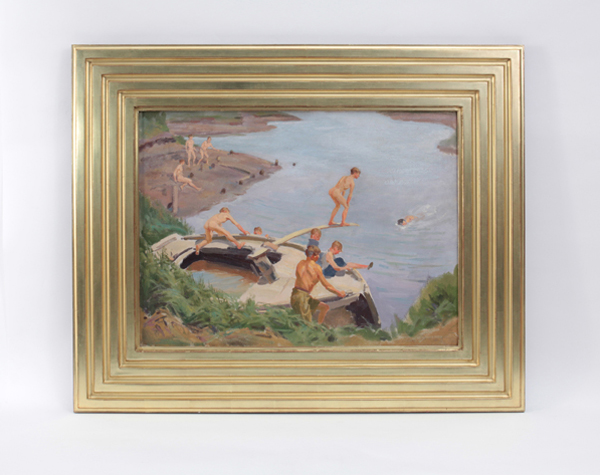
Edmund F. Ward “The Swimming Hole” Oil on canvas c. 1930
EDMUND F. WARD (b. 1892 – 1991) USA
“The Swimming Hole” c. 1930
Oil on canvas
Marks: signed Edm. F. Ward (lower right); partial labels verso:Westchester Arts and Crafts Guild; 4 Edmund F. Ward
For more information on the artist see: Who Was Who in American Art,Peter Hastings Falk, ed. (Madison, Conn.: Sound View Press, 1985), p. 658.
Canvas H: 18” x W: 24”
Framed H: 27 9/16” x W: 33 9/16”
Price: $14,000
Ward studied at the Arts Student’s League with Edward Dufner, George Bridgeman, and Thomas Fogarty. He was an illustrator for several national magazines and books. In 1925, Ward exhibited an award winning work at the Art Institute of Chicago. He is perhaps best known for his WPA mural in the Federal Building, White Plains, New York.





 @hd_jewels