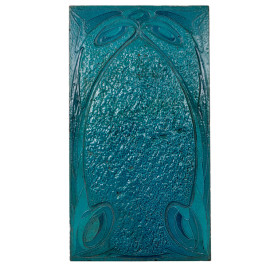
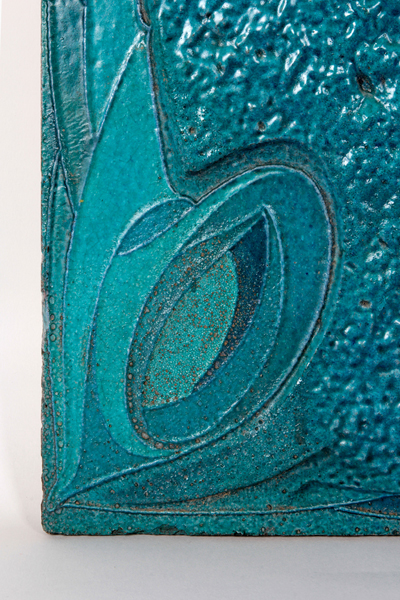
Hector Guimard for Maison Coilliot / Art Nouveau glazed lava tile 1898
More Information
Hector Guimard for Maison Coilliot / Art Nouveau glazed lava tile 1898
HECTOR GUIMARD (1867-1942) France
MAISON COILLIOT Lille, France
Tile c. 1898
Fired and glazed lava with abstract whiplash motifs in various tones of aqua blue on the obverse and a partial graphic on the reverse with polychrome floral and linear details.
Marks: 16 (on top of tile)
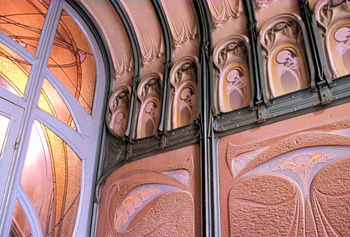
French architect Hector Guimard (1867-1942) realized the decorative possibilities of glazed lava, a substance made from mixing pulverized lava with clay when he built a villa for Louis Coillot, (1898-1900) a ceramics manufacturer in Lille who monopolized the distribution of the material. Guimard sided the entire facade of Maison Coilliot in lava stone.
***A related glazed lava tile from the Castel Henriette is in the Collection of the Musee d’Orsay.
The Maison Coilliot is an Art Nouveau house located on 14, rue de Fleurus in Lille, France. Louis Coilliot, a French ceramic entrepreneur, was fond of enameled lava and wanted to popularize the technique. To do so, Coilliot commissioned Hector Guimard, an architect he’d met at the 1897 fair La Céramique et tous les arts du feu, (“Ceramic Arts & Glass Making”), to apply the technique to his house’s façade. Coilliot’s factory and warehouse were located to the rear of his house, and therefore the façade held a double
purpose, both decorating the front of his home and advertising his business.
For more information see: Hector Guimard, 1867-1942: Architektur in Paris um 1900 (Munich: Museum Villa Stuck, 1975)
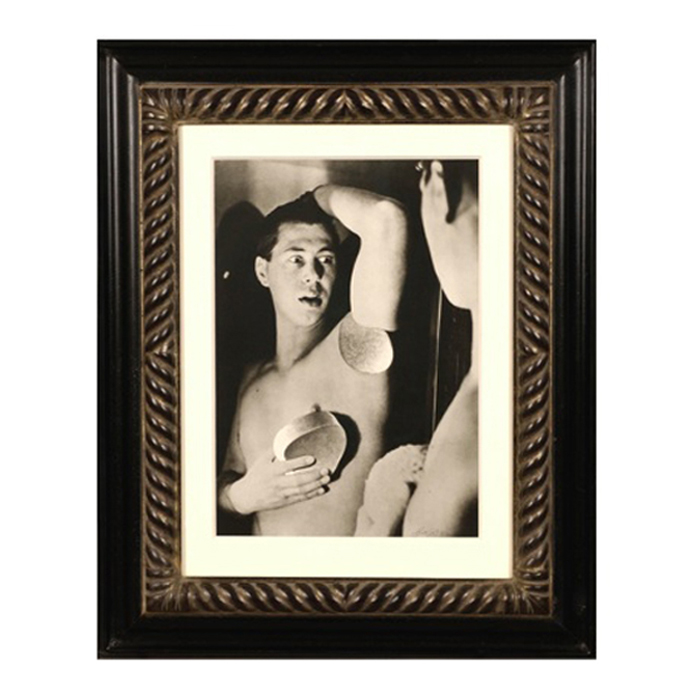
Herbert Bayer, Self Portrait, Gelatin silver print , 1932, printed later
HERBERT BAYER (1900-1985) Austria
Self portrait 1932 (printed later)
Silver gelatin print
Edition: 28/40
Signed: bayer 32 (in ink on bottom right corner)
Provenance: Kennedy Gallery, New York
H: 13 7/16” x W: 9 ½”
Framed size: H: 21 ½” x W: 17 ½”
Price: $16,000
Herbert Bayer (1900 – 1985) was an Austrian graphic designer, painter, photographer, and architect. Bayer apprenticed under the artist Georg Schmidthammer in Linz. Leaving the workshop to study at the Darmstadt Artists’ Colony, he became interested in Walter Gropius’s Bauhaus manifesto. After Bayer had studied for four years at the Bauhaus under such teachers as Wassily Kandinsky and László Moholy-Nagy, Gropius appointed Bayer director of printing and advertising. In the spirit of reductive minimalism, Bayer developed a crisp visual style and adopted use of all-lowercase, sans serif typefaces for most Bauhaus publications. Bayer is one of several typographers of the period including Kurt Schwitters and Jan Tschichold who experimented with the creation of a simplified more phonetic-based alphabet. Bayer designed the 1925 geometric sans-serif typeface, universal, now issued in digital form as Architype Bayer that bears comparison with the stylistically related typeface Architype Schwitters.
In 1928, Bayer left the Bauhaus to become art director of Vogue magazine’s Berlin office. He remained in Germany far later than most other progressives. In 1936 he designed a brochure for the Deutschland Ausstellung, an exhibition for tourists in Berlin during the 1936 Olympic Games. In 1938 he left Germany and settled in New York City where he had a long and distinguished career in nearly every aspect of the graphic arts. In 1946 Bayer relocated again. Hired by industrialist and visionary Walter Paepcke, Bayer moved to Aspen, Colorado as Paepcke promoted skiing as a popular sport. Bayer’s architectural work in the town included co-designing the Aspen Institute and restoring the Wheeler Opera House, but his production of promotional posters identified skiing with wit, excitement, and glamour. Bayer would remain associated with Aspen until the mid-1970s. Bayer gave the Denver Art Museum a collection of around 8,000 of his works. In 1959, he designed his “fonetik alfabet”, a phonetic alphabet, for English. It was sans-serif and without capital letters. He had special symbols for the endings -ed, -ory, -ing, and -ion, as well as the digraphs “ch”, “sh”, and “ng”. An underline indicated the doubling of a consonant in traditional orthography.
Aram Gesar has been published internationally and has exhibited his photographic work in New York, San Francisco, Zurich and Geneva since 1977. As a producer, art director and photographer, Gesar created advertising campaigns for major corporations in the U.S. and Europe focusing on the fields of travel, banking, financial services, aerospace and motion pictures. He also created and produced documentaries on travel, aviation and yachting for national cable networks and the home video markets and television commercials and corporate programs for various U.S. and European corporations.
Gesar is currently one of the leading international experts on travel and air transport, and the founder and CEO of The Pyramid Media Group, which includes several magazines, newsletters, web sites, books, eBooks and other publications integrating a spectrum of business, travel and aviation content.








 @hd_jewels