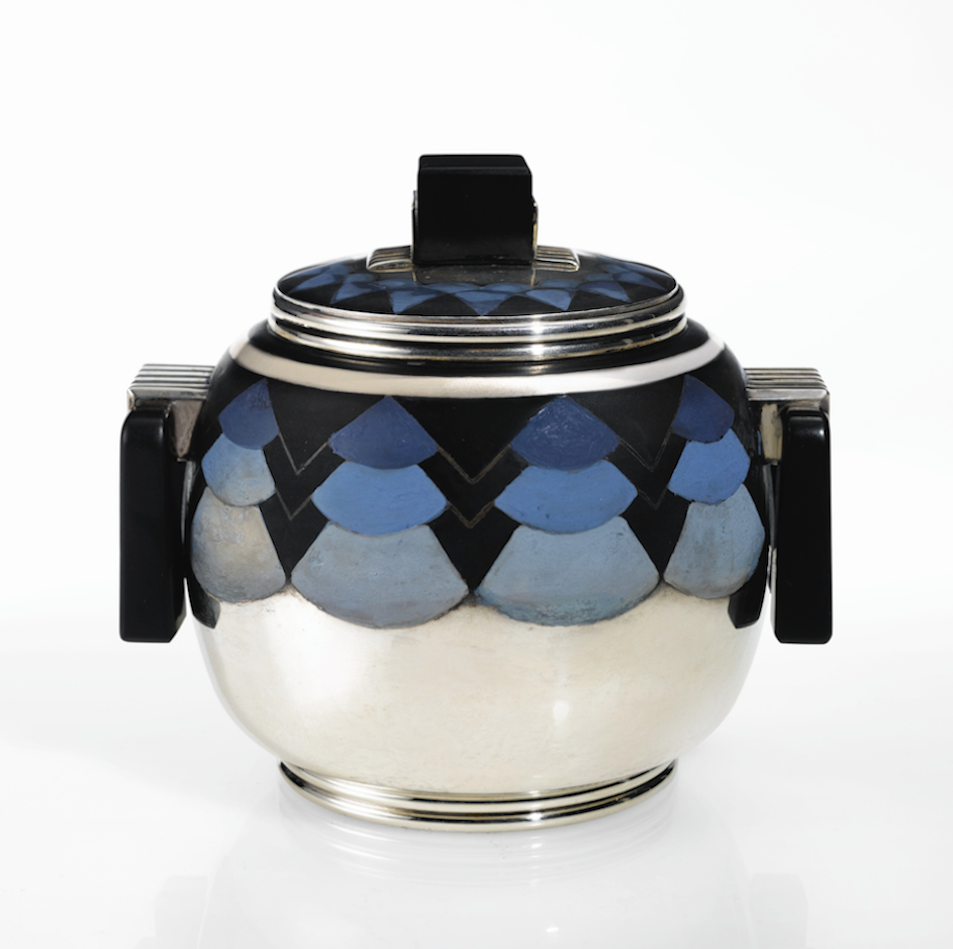
Henri Lapparra Art Deco “Mikado” covered sugar bowl c. 1930
More Information
Henri Lapparra Art Deco “Mikado” covered sugar bowl c. 1930
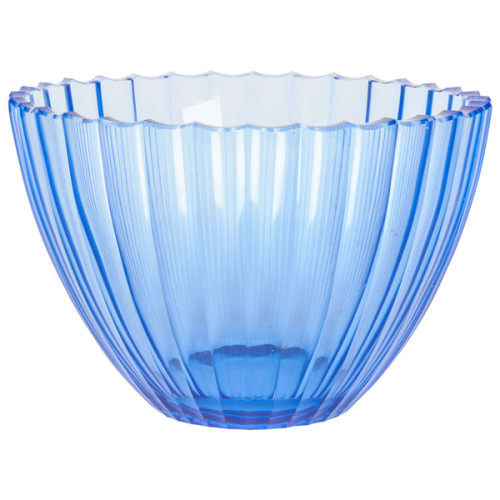
Silver lidded bowl with ebony finial and rectangular ebony handles, decorated with enamel in fan shapped tiers of three shades of blue and black
Marks: French Touchmarks (Head of Minerva) 2x, Lapparra diamond shape silver touch mark, Red Lacquer Cranbrook Museum Accession No. 1930.77
Exhibited: Third International Exposition of Contemporary Industrial Arts, 1930-1931 The American Federation of Arts 1930-1931, The Museum of Fine Arts Boston, October 15 – November 10, 1930, The Metropolitan Museum of Art New York, December 1 – December 28, 1930, The Art Institute of Chicago, January 19 – February 15, 1931, The Cleveland Museum of Art Cleveland, March 11 – April 5, 1931; Art Deco, 1971 (Minneapolis: Minneapolis Institute of Arts)
Model illustrated: Art Deco, A Guide for Collectors, Katherine Morrison McClinton (New York: Clarkson N. Potter, Inc., 1972) p. 162; Art Deco, Judith Applegate (New York: Finch College Museum of Art, 1970) illustr. 392; The Cranbrook Collections, Sotheby, Parke-Bernet, New York, 1972, illustr. 31, pp. 7 & 9, Third International Exposition of Contemporary Industrial Arts, 1930 (New York: Finch College Museum of Art) No. 392; Art Deco, 1971 (Minneapolis: Minneapolis Institute of Arts) No. 164; International Exhibition of Metalwork and Cotton Textiles exhibition catalogue (The American Federation of Arts, 1930) No. 169
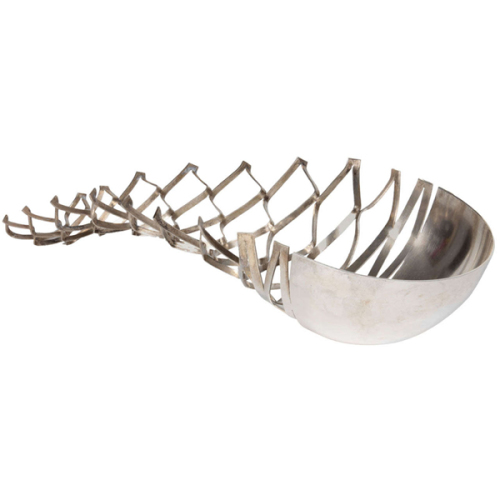
Ane Christensen Contemporary British Sterling Silver Bowl 1999
ANE CHRISTENSEN (b.1972) born in Copenhagen, Denmark/ based in London, UK
Bowl 1999
Sterling silver
Marks: AKC, 925, Z, British hallmarks
H: 2 ½” x L: 12”
Price: $5,950
The starting point for all of metalworker Ane Christensen’s tableware is a single sheet of metal. Her aim is to develop a three dimensional object from a flat sheet without adding or removing any elements. Japanese paper packaging influences Ane’s work, but a more important influence is the half finished or half demolished structures of building sites that she says can hold unexpected sculptural qualities.
Ane graduated from the Royal College of Art and has since been involved in exhibitions in London, Denmark and Copenhagen, including more recently at Collect, V&A.
Ane makes pieces in a variety of metals including silver, stainless steel and powder coated copper.
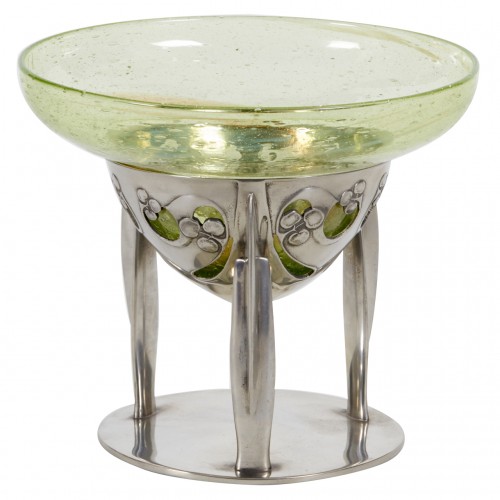
Archibald Knox / Liberty & Co. Clutha bowl on tri-leg Tudric stand c. 1902
ARCHIBALD KNOX (1864-1933) UK
LIBERTY & CO. London
JAMES COUPER & SONS Glasgow
Clutha bowl on tri-leg stand c. 1902
Clutha glass with inclusions of aventurine streaks and bubbles, polished tri-leg Tudric pewter stand.
Marks: Tudric, 0276
Illustrated: Liberty’s 1875-1975, An Exhibition to mark the Firm’s Centenary (London: Victoria & Albert Museum, 1975), p. 89, number D 250 A; The Designs of Archibald Knox for Liberty & Co., A.J. Tilbrook (London: Ornament Press Ltd., 1976), p. 114; Liberty Style, The Classic Years: 1898-1910, Mervyn Levy (New York: Rizzoli, 1986), p. 31; Archibald Knox, ed. by Stephen A. Martin (London: Academy Editions, 1995), p. 96.
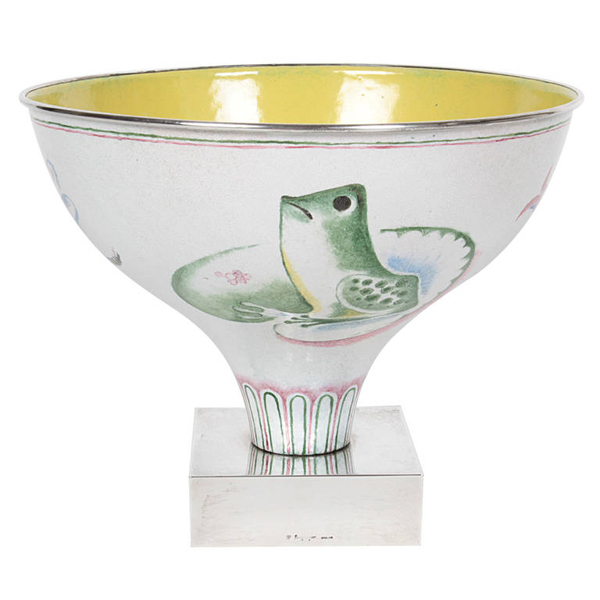
Tommi Parzinger, Sterling and enamel pedestal centerpiece bowl on an attached square base with a frog, lily pad and fish motif as part of the overall enamel design c. 1938
TOMMI PARZINGER (1903-1981) Germany/USA
WILLIAM STARK / KARL DRERUP Enamel
PETER REIMES Silversmith
Sterling and enamel pedestal centerpiece bowl on an
attached square base with a frog, lily pad and fish motif as part of the
overall enamel design c. 1938
 @hd_jewels