Product Description
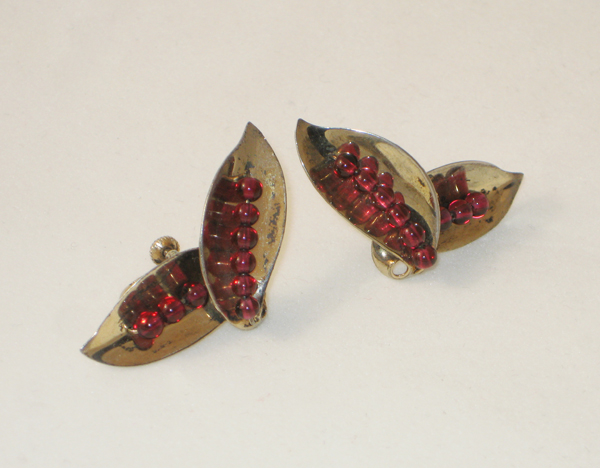
Theodor Fahrner “Jugendstil Planter” brooch, silver and enamel set with sodalite cabochons and pearls, signed c. 1905

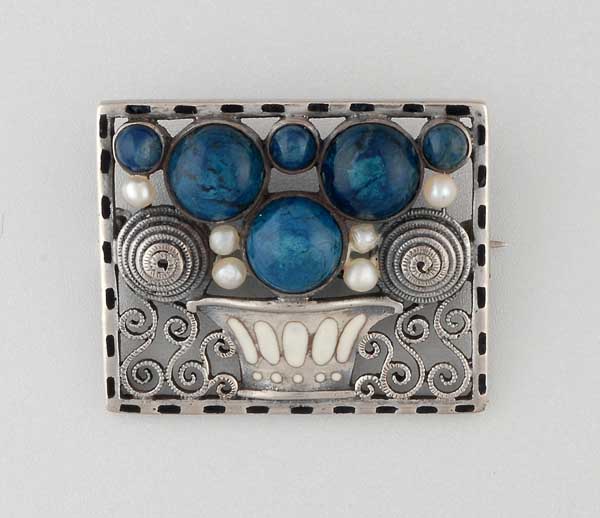
Theodor Fahrner “Jugendstil Planter” brooch, silver and enamel set with sodalite cabochons and pearls, signed c. 1905

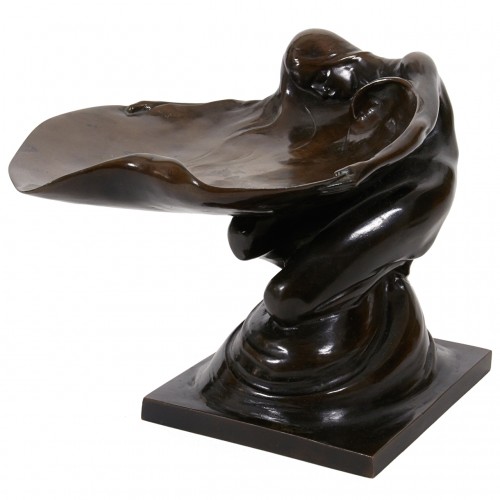
SOPHIE BURGER-HARTMANN (1868-1940) Munich, Germany
Vide Poche c. 1900
Richly patinated dark brown bronze Vide Poche modeled as a swirling Art Nouveau nymph holding a stylized shell form low tray.
Marks: VW (Vereinigte Werkstätten für Kunst im Handwerk Munich)
H: 6 1/2″ D: 7″ x W: 8″
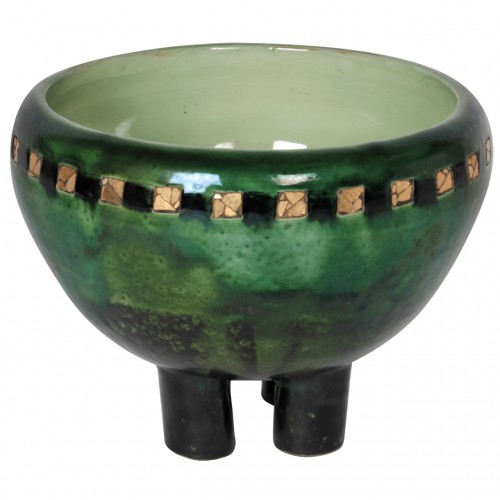
PROF. MAX LÄUGER (1864-1952) Karlsruhe, Germany
Unique Jugendstil ceramic footed bowl inlaid with gold mosaic 1906
Light and dark green glazed earthenware inlaid with mosaic gold glass squares on four cylindrical feet.
Marks: ML, K (monogram)338 (incised), 4., MUSTER B.., GESCHTZ
For other mosaic inlaid works by Max Läuger see: Max Laeuger (1864-1952): sein graphisches, kunsthandwerkliches und keramisches Oeuvre, Elisabeth Kessler-Slotta (Saarbrücken: Saarbrücker Druckerei und Verlag, 1985) pp. 178/179; Europäisches Kunstgewerbe 1927, Stadtisches Kunstgewerbe-Museum zu Leipzig, (Leipzig: E.A. Seeman, 1928) p. 86; Deutsche Kunst und Dekoration vol. XII “Professor Max Laeuger Karlsruhe”, pp. 221-237; Modernism: Modernist Design 1880-1940 (The Norwest Collection, Norwest Corporation, Minneapolis), Alastair Duncan (Woodbridge, Suffolk, England: The Antique Collector’s Club, 1998), p. 86.
H: 5 3/4″ x Dia: 7 1/4″
Max Laeuger (or Läuger) was born in Lörrach on September 30, 1864. Laeuger was a self taught ceramicist, studied at the Karlsruhe Polytechnic a hundred miles to the north-west of Lörrach (now Karlsruhe University) and eventually became a professor at the university. In 1895 after travelling throughout Europe visiting the major cultural centers to study art he was appointed director of the art pottery department of Tonwerke Kanderne close to his home town. He stayed there until 1913 and later took up a similar position at Majolika-Manufaktur in Karlsruhe.
From 1921 he had his own workshop on the premises formerly owned by the company and produced designs there. The work produced fell into three categories, slip decorated wares designed by Laeuger but produced entirely by the factory, pieces made at the factory but decorated and glazed by Laeuger and one-off pieces by the professor made from beginning to end in his own workshop. All were marketed by Majolika-Manufaktur. Laeuger’s one-off pieces had the brushed initials ‘ML’ and the other works were marked ‘LAEUGER’ or ‘PROF. MAX LAEUGER’
Through the thirties and into the Second World War he worked on his own, but after his workshop was destroyed in 1944 he returned to Lörrach where he died on December 12, 1952. Laeuger was a major figure in German ceramics. His designs and his glazes had ‘organic’ characteristics that are his signature design and his work is much sought-after by collectors. Examples of Laeuger pieces are on display at the Badisches Landesmuseum in Karlsruhe.
MITZI OTTEN-FRIEDMANN (1884-1955) Austria
WIENER WERKSTÄTTE (1903-1932)
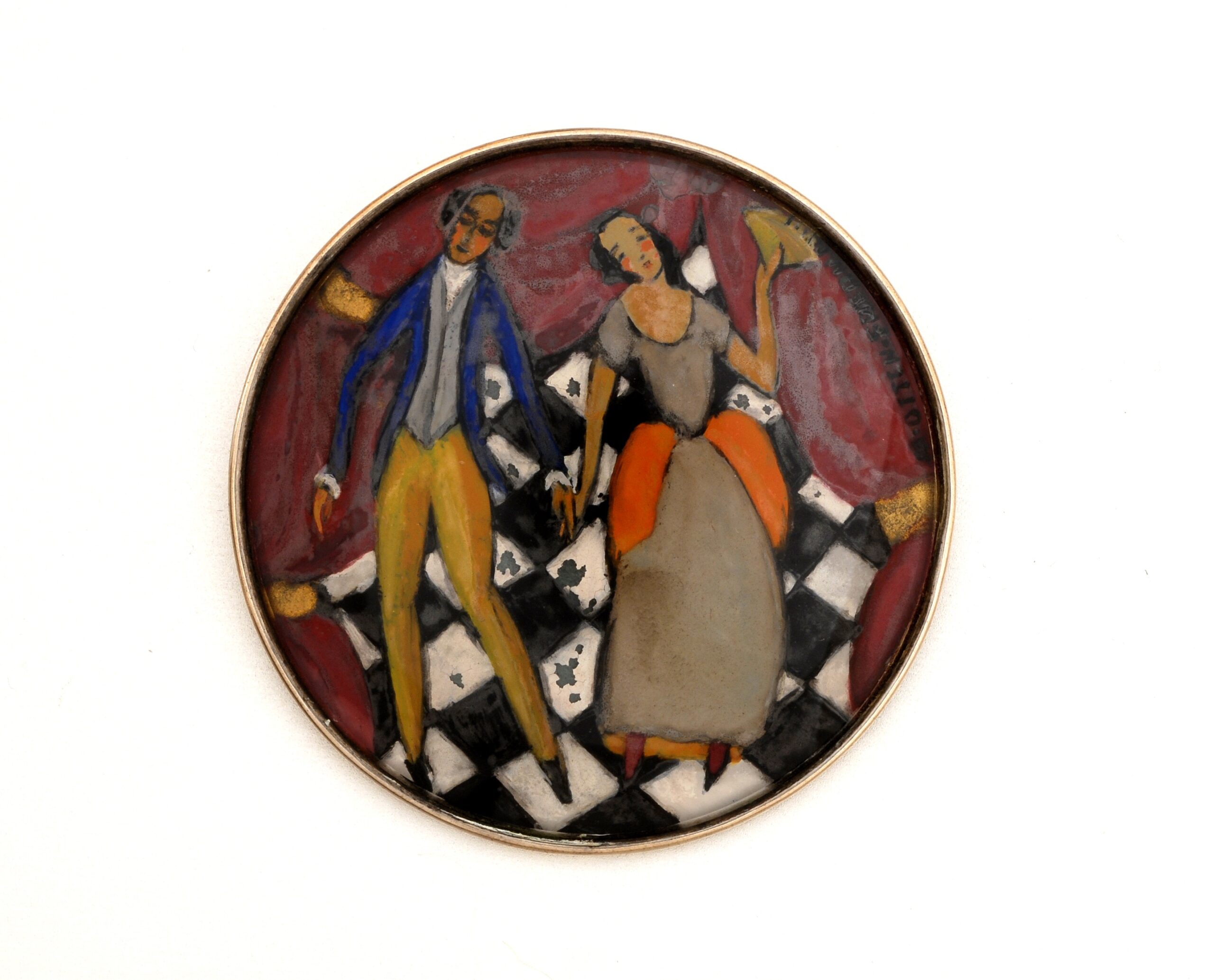
Brooch c. 1915
Reverse-painted glass depicting a couple set in a silver frame / back
Marks: M. OTTEN-FRIEDMANN on the front (right), the reverse stamped: WW, Vienna assay mark for 900 silver
D: 2 3/8”
Rosalia Marie Friedmann-Otten (“Mitzi”) * November 28, 1884 Vienna, † May 5, 1955 New York, NY
Student at the School of Applied Arts in Vienna (with Oskar Strnad), Friedmann-Otten participated in numerous exhibitions (including art shows in 1908, 1920; Neukunstgruppe 1909; German Women’s Art in 1925; Werkbundausstellung 1930). Member of the Austrian Werkbund, the Wiener Werkstätte and the Neukunstgruppe. One of the most versatile artists (commercial art, metalwork, jewelry, fashion, starting from 1920 mainly enamel works, including large-scale email pictures), Friedmann-Otten had to flee in 1938 to the United States.