Product Description
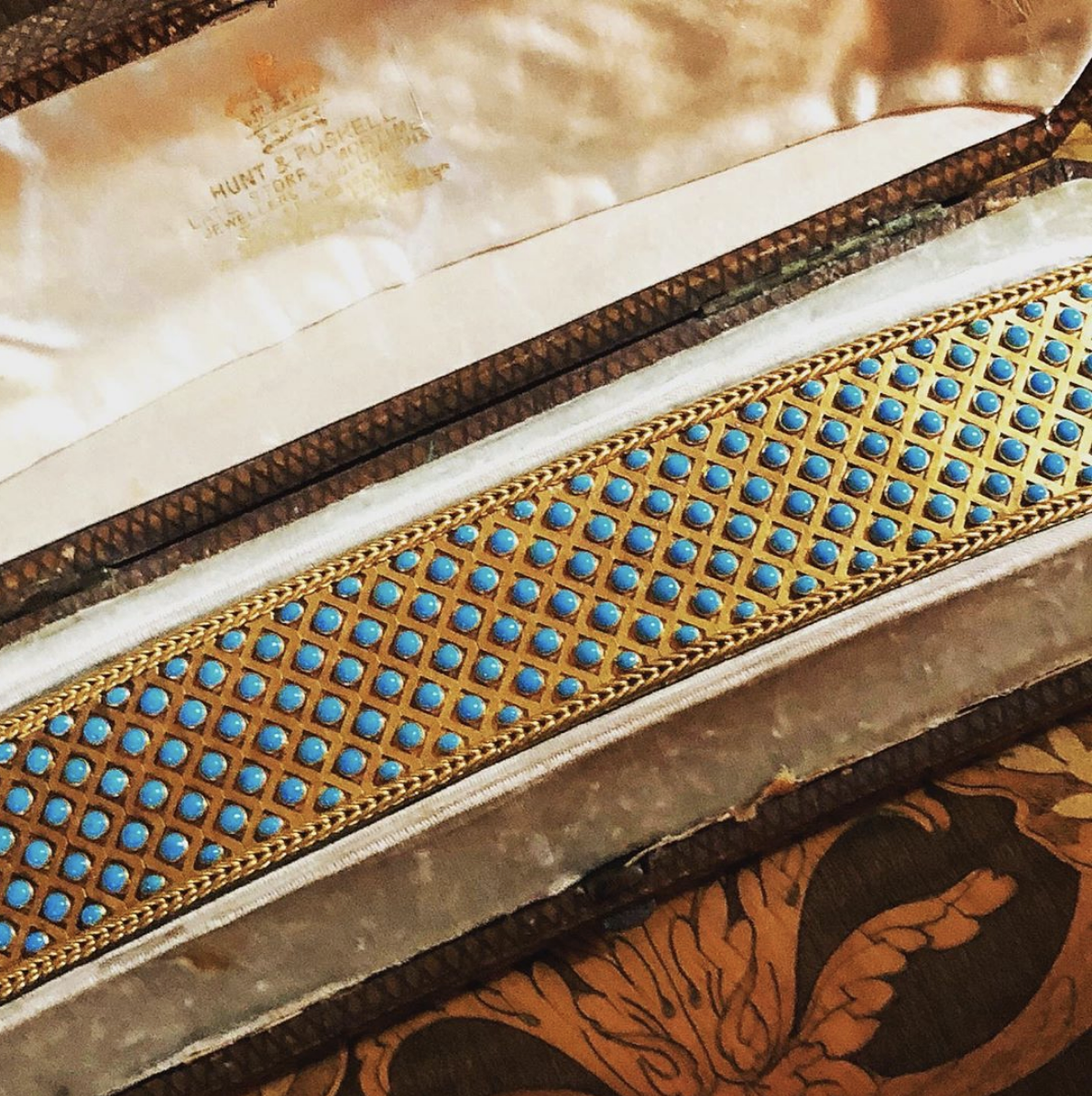
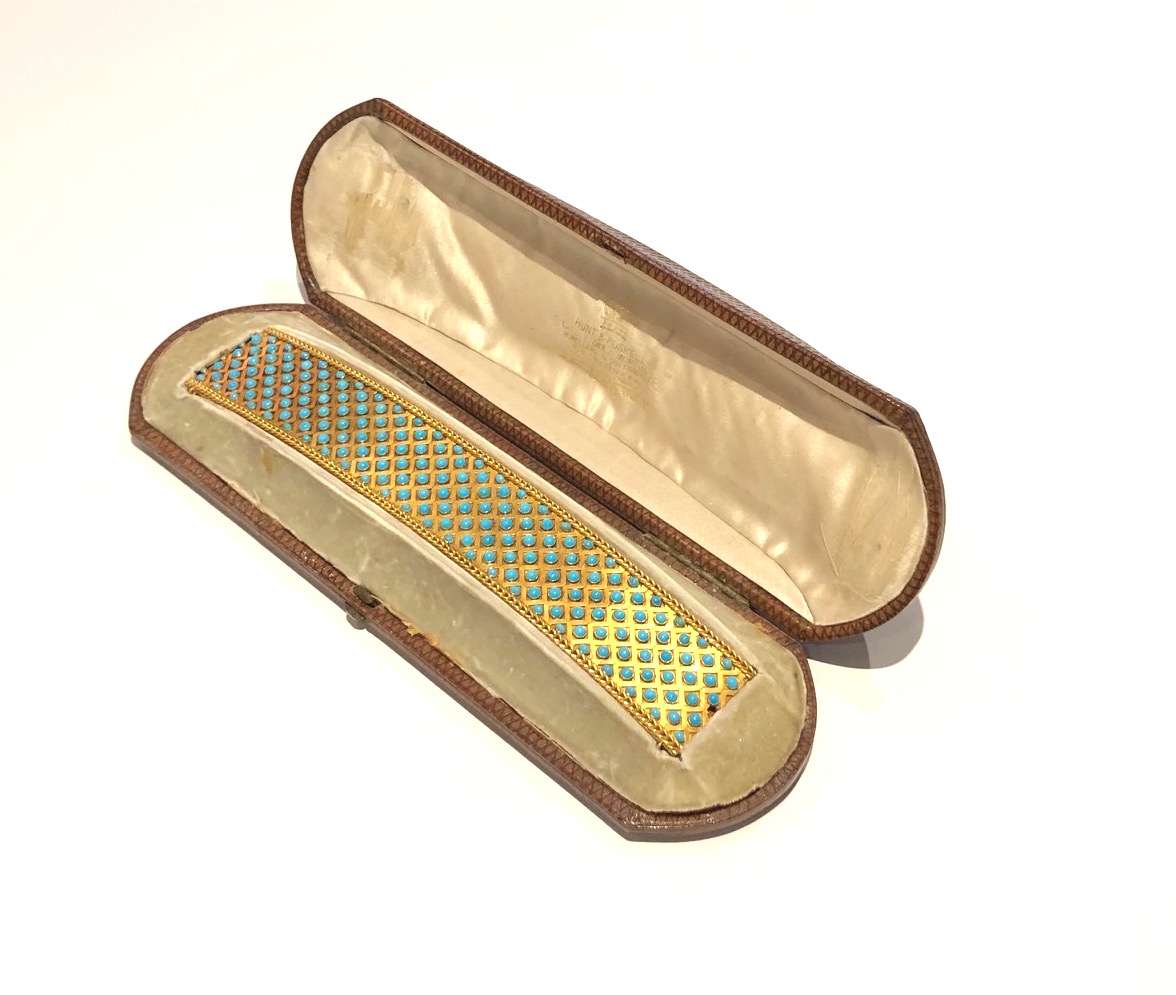
Hunt and Roskell (1843-1897) Wide 18k gold bracelet in a delicate crisscross design with woven gold borders and set with 192 cabochon turquoise jewels, original signed embossed brown leather presentation box, c. 1875

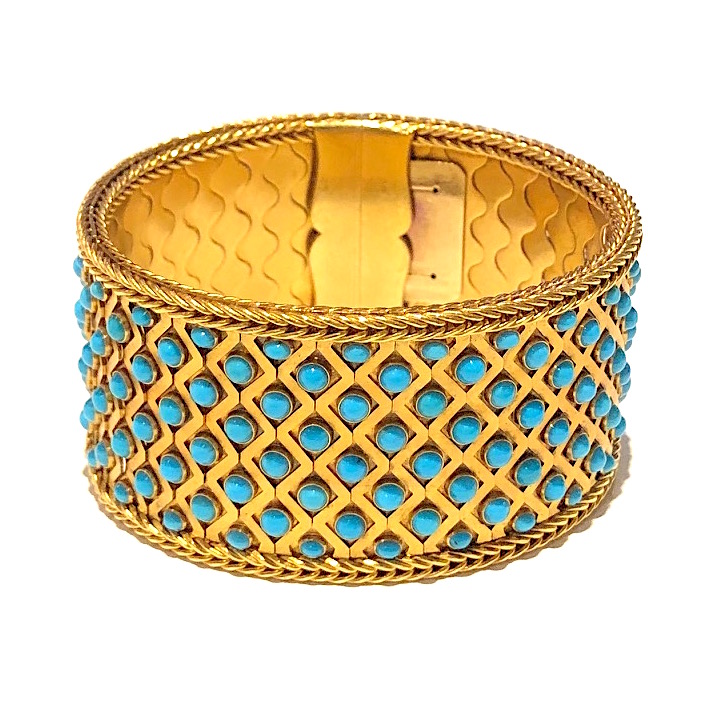
Jewellers and Goldsmiths to Queen Victoria. Successors to Mortimer & Hunt on the retirement of John Mortimer but still trading until 1876. Hunt & Roskell, a firm of manufacturing and retail jewellers and silversmiths, was founded by Paul Storr in 1819, trading as Storr & Co. (1819-1822), Storr & Mortimer (1822-1838), Mortimer & Hunt (1838-1843) and then Hunt & Roskell (1843-1897). Hunt & Roskell had retail premises at 156 New Bond Street and a manufactory at 26 Harrison Street, near Clerkenwell. John Samuel Hunt, who had assisted Storr from the start, continued as a partner until his death in 1865. J. S. Hunt was then succeeded by his son, John Hunt (d.1879). Robert Roskell, formerly a watchmaker and merchant of Liverpool, joined in 1844 and remained in the firm until his death in 1888. In 1889 the firm was taken over by J.W. Benson and continued in business as Hunt & Roskell Ltd.
Hunt and Roskell (1843-1897) Wide 18k gold bracelet in a delicate crisscross design with woven gold borders and set with 192 cabochon turquoise jewels, original signed embossed brown leather presentation box, c. 1875
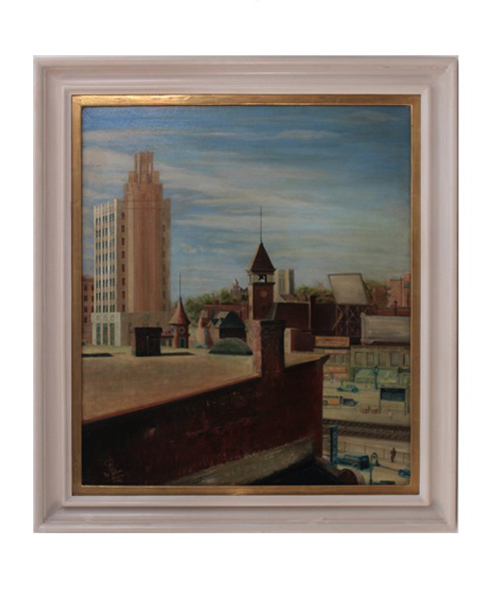
HUBERT SCHMALIX (1952-) Austria
Mount Washington 2005/06
Oil on canvas
Signed and dated on back: Schmalix 05 06
Provenance: Hubert Schmalix Vienna
For related works by Hubert Schmalix see: Hubert Schmalix, Lóránd Hegyi exhibition catalog (Museum moderner Kunst Stiftung Ludwig Wien) November 19, 1994 – January 1995.
H: 69” x W: 51”
Hubert Schmalix was born in Graz, Austria, on December 17, 1952 and studied at the Vienna Art Academy from 1971 to 1976. By 1979 Schmalix was showing work at the forward-looking exhibition ‘Europa 79 – Kunst der 80er Jahre’ in Stuttgart. In 1983 the London Tate Gallery invited Schmalix to present work at ‘New Art’, an important survey of contemporary art. Schmalix has become well-known world-wide as an exponent of ‘New Art’, working with a retrospective glance at both classical art history and modern art. Schmalix focuses on the world of things and the human figure. Although the expressive gesture was the dominant feature of his 1980s work, it yielded early in the 1990s to stringent tectonic composition. In 1984 Hubert Schmalix went to the Philippines and on to the US, moving to Los Angeles in 1987. In 1986-87 Schmalix taught at the Academy for the Decorative and Applied Arts in Vienna and from 1997 he has been a professor at the Vienna Art Academy. Schmalix is a visiting professor at the University of California Los Angeles (UCLA). In 1993 his work was featured at the Venice Biennale and in 1998 he was awarded the Fine Art Prize of the City of Vienna. Schmalix has done several large fresco cycles in Salzburg and his work has been shown extensively at numerous international solo and group shows and most recently at Art Basel 2006.
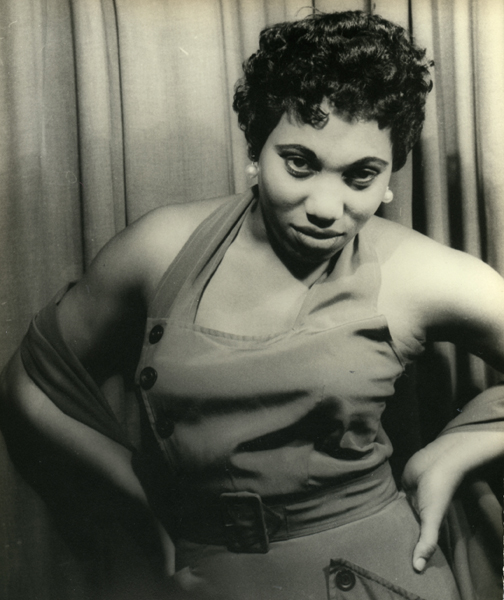
CARL VAN VECHTEN (1880-1964) USA
Leontyne Price 1953
Signed: Leontyne Price as Bes, Porgy & Bess, XVII KK 20, May 19, 53 (in ink on back); PHOTOGRAPH BY CARL VAN VECHTEN, 101 CENTRAL PARK WEST, CANNOT BE REPRODUCED WITHOUT PERMISSION (ink stamp on back)
Size: H: 9 5/8” x W: 7 1/8”
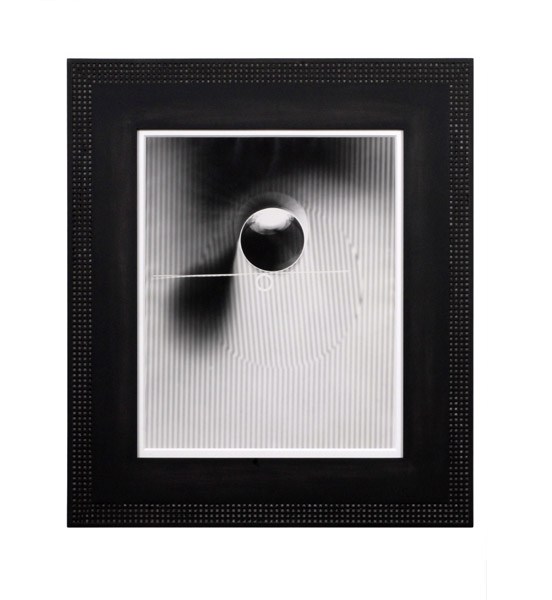
REINHOLD KLAUS (1881-1963) Vienna, Austria
CARL GEYLING ATELIER (founded 1841) Vienna, Austria
Man with tophat and flowers c. 1930
Window of stained and hand-painted leaded glass
Provenance: Estate of Carl Geyling (1814-1880), Vienna
H: 17 3/4″ x W: 14 1/2″
Reinhold Klaus studied from 1898-1902 with Alfred Roller at the Kaiserlich-Königliche Kunstgewerbeschule in Vienna. In 1914 Klaus married into the Carl Geyling family and became extensively involved with with stained glass painting. As early as 1918 Klaus worked on a stained glass window for the Siegestempel am Bisamberg in Vienna. In 1934 he became a professor of stained glass painting at the Kunstgewerbeschule, as well as creative director of the C. Geylings Erben glass painting company. Reinhold Klaus, a member of the Künstlerhaus since 1924 received many prizes and honors. He worked on commissions for the St. Veits cathedral in Prague, the St. Stephan cathedral in Vienna and many others.