Jaipur Enameled and Gem Set Rare Solid Gold Cup and Saucer c. mid-19th Century
More Information
Jaipur Enameled and Gem Set Rare Solid Gold Cup and Saucer c. mid-19th Century
JAIPUR, MUGHAL INDIA
Enameled and gem set gold Cup and Saucer c. mid-19th Century
High carat yellow gold (22-24 carat) cup and saucer set with a fine emerald, ruby and diamonds, the cup with a high foot with rounded sides and handle formed of two snakes intersecting at three points and biting the rim. The exterior is decorated with red, green, blue and white enamels with roundels containing combatant animals on a ground of floral sprays, the saucer with gently rounded sides decorated with lobed cartouches containing warriors combating tigers and birds, the underside with a series of oval panels containing peacocks and hummingbirds.
Provenance: a gift from a European diplomat in the 1930’s-40’s, and thence by descent.
Saucer: Dia: 5 1/4;
Cup: H: 2 3/4″ (with handle) x Dia: 2 5/8″
Similar animal decoration can be found in an epaulette attributed to Rajesthan, probably Jaipur, in the Khalili Collection (Pedro Moura Carvalho, Gems and Jewels of Mughal India, London, 2010, p. 225, no. 120. A related cup and saucer with similar animal depictions was sold at Christie’s (Islamic Art, Indian Miniatures, Rugs and Carpets, London, 21st October 1993, lot 350.
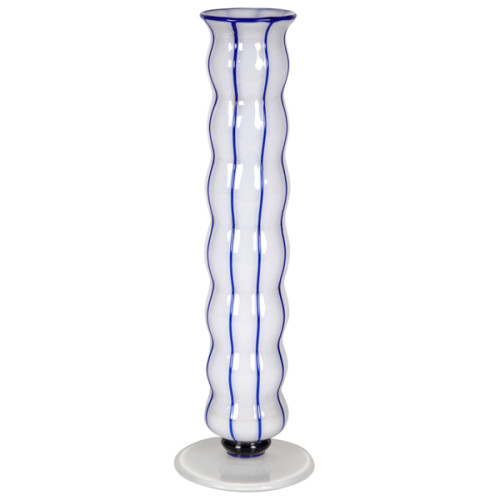
“Opal mit streifen” opaline blown glass with applied blue glass canes and blue knob above opaline base
Exhibited: 1914 Werkbundausstellung, Cologne (Lötz period photograph, vase for the 1914 Cologne Werkbund Exhibition) Lötz: Böhmisches Glas 1880-1940: Werkmonographie, Band 1, Helmut Ricke and Ernst Ploil (Munich: Prestal-Verlag, 1989), p. 267; Wiener Werkstätte Design in Vienna 1903-1932, Christian Brandstätter (New York:Verlag Harry Abrams, 2003) p. 247.
Form illustrated: Lötz: Böhmisches Glas 1880-1940: Werkmonographie, Band 1, Helmut Ricke and Ernst Ploil (Munich: Prestal-Verlag, 1989), p. 267
Same ”opal mit streifen” technique illustrated: Glaskunst der Moderne: von Josef Hoffmann bis Wilhelm Wagenfeld, Torsten Bröhan (Munich: Klinkhardt & Biermann, 1992), cat. no. 19, pp. 74-77.
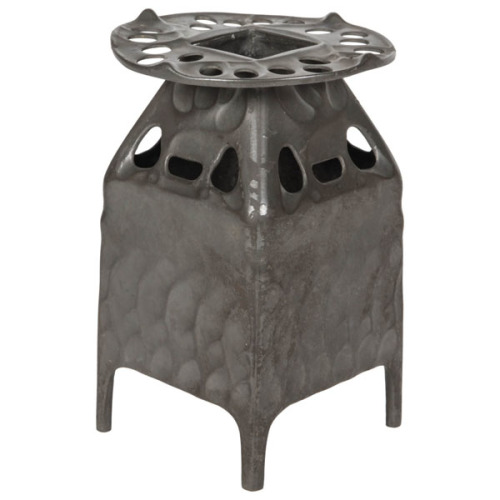
Karl Berghof / Kayserzinn Extremely Rare German Jugendstil Art Nouveau Pewter Vase 1904
KARL BERGHOF Germany
J. P. KAYSER SOHN Krefeld, Germany
Vase 1904
Pewter squared vase with round flange top, open work details
Marks: Kayserzinn 4541 7 (in a raised oval)
Illustrated: Zinn des Jugendstils, Eckard Wagner (Cologne: Rheinland-Verlag, 1978), p. 63, cat. no. 148; J. P. Kayser Sohn Krefeld: Fabrik kunstgewerblicher Metallgegenstände, Musterbuch 1907 (Munich: Verlag Dry, 1982) p. 46.
***This is an extremely rare, other worldly Kayserzinn form.
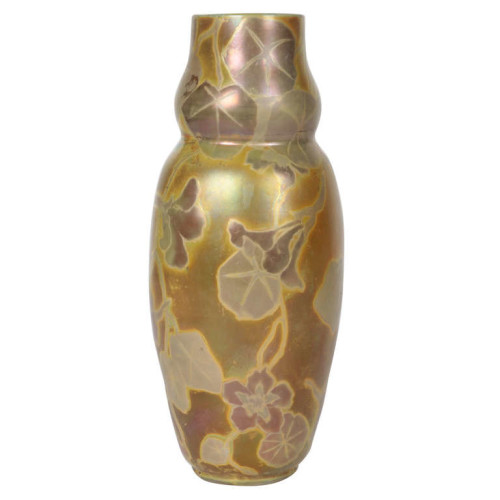
Amedee de Caranza Art Nouveau Rare Iridescent Art Glass vase 1903-1906
AMÉDÉE DE CARANZA (active 1875-1914) (b. Turkey / active France)
COPILLET ET CIE Noyon
Nasturtium vase 1903-1906
Blown glass with floral & foliate luster decoration handpainted on a muted iridescent ground.
Signed: A. de CARANZA (on the side near base)
Marks: Copillet et Cie, Noyon, 842 (twice)
For more information and related illustrations: European Art Glass (New York: Ray & Lee Grover, Charles E. Tuttle Publishers, Inc., 1970) pp. 69, 94-96; L’Art Du Verre En France 1860-1914, Janine Bloch-Dermant (Edita Denoel, 1974) pp. 36-37; Glass: Art Nouveau to Art Deco, Victor Arwas (New York: Abrams, 1987) pp. 56-58; L’Europe de L’Art Verrier, des Precurseurs de l’Art Nouveau a l’Art Actuel 1850-1990, Giuseppe Cappa (Liège: Mardaga, 1991) pp. 72-74.
H: 10″
Copillet, H.A. Thomas Henri Alfred Copillet was originally a printer, and produced a local newspaper in Paris. When he moved his works to 13 Fauburg de Paris he acquired a kiln in the process, and thus in 1903 was began a new glass works. His designers were Amedee de Caranza and Edouard de Neuville. They produced a whole range of Art Nouveau glassware, many with a dark iridescent finish. They also produced opaline glass, and glass panels for use in church windows. The company went bankrupt in 1906, although the new management (Lefevre and Lhomme) kept a little of the production going for a while, the factory was destroyed during the First World War.
Hendrik Petrus Berlage Holland Rare Architectural Candelabrum c. 1900
HENDRIK PETRUS BERLAGE (1856 – 1934) Netherlands
BECHT & DYSERINCK for ‘t Binnenhuis
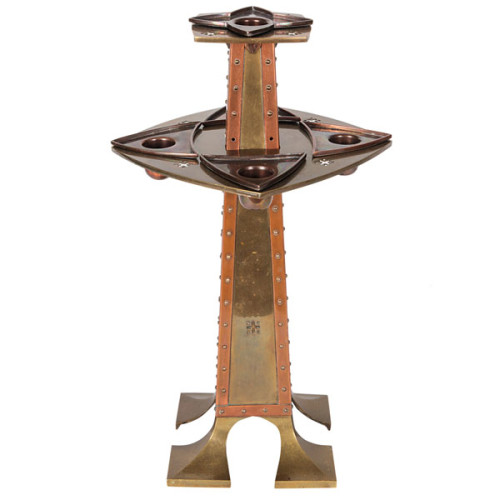
Rare Architectural Candelabrum c. 1900
Riveted and detailed “Eiffel Tower” like form in brass and copper with four feet, small cut out designs and two bobeche trays supporting five candles.
H: 14″ x W: 8 1/4″ x D: 8 1/4″
Hendrik Petrus Berlage, a Dutch architect and designer attended the Rijksakademie in Amsterdam and a year later switched to architecture. Berlage enrolled in 1875 in the architecture department of the Eidgenössische Technische Hochschule in Zurich. Through 1878 Berlage studied in Zurich under Gottfried Semper, whose teachings had a lasting influence on his work. After finishing these studies, Berlage spent three years traveling in Germany (1879) and Italy (1880-1881) before returning to his native Amsterdam. From 1881 Berlage was employed by the Amsterdam architect Theodor Sanders and from 1884 Berlage was a partner in the business until he opened his own practice in 1889. In 1884 he submitted a design for the projected Commodity Exchange (Beurs van Berlage) in Amsterdam, winning the competition in 1896. This building, completed in 1903, was Hendrik Paulus Berlage’s first important commission, which also solidified his reputation. Also in Amsterdam and at this same time, Berlage built the Diamond Guild building (1897-1900). In 1900 along with the architect and designer Jacob van den Bosch, Hendrik Paulus Berlage opened the gallery, “‘t Binnenhuis”. They sold their own designed furniture and objects they from 1900-1929. In 1900 Berlage was also commissioned to plan a southern extension of Amsterdam. This was Berlage’s most important contribution to urban planning and he worked on the project until 1915. In 1911 Berlage went to the US, where he saw the new buildings by Frank Lloyd Wright and Louis Sullivan. Berlage built his own house in The Hague and moved into it with his family in 1913. The Gemeentemuseum in The Hague (1919-1935) was Berlage’s last important building, however it was not completed until shortly after his death. Hendrik Petrus Berlage was the founder of the “Amsterdam School” and was a pioneer of modern architecture in the Netherlands. In his 1905 essay “Gedanken über Stil in der Baukunst”, Berlage fiercely criticized 19th-century historicizing architecture as pompous, reserving his praise for the austere simplicity of early period styles. His criticism was severe since he stated flatly that historicizing architecture was all appearance rather than reality, was not art; too much was imitation, more iron was used than stone, and so on. Hendrik Petrus Berlage was therefore an early critic of Historicism even though his Amsterdam Exchange still reveals Romanesque features.





 @hd_jewels