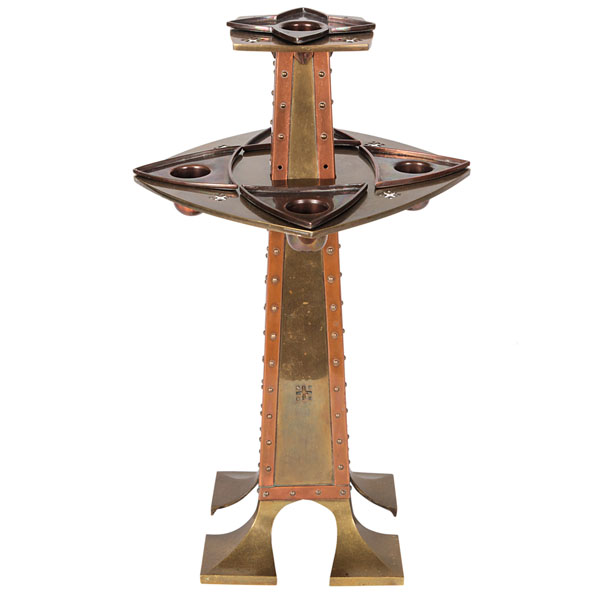
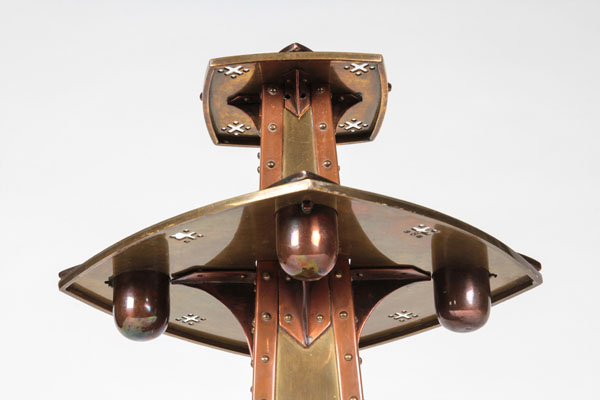
Hendrik Petrus Berlage Holland Rare Architectural Candelabrum c. 1900
More Information
Hendrik Petrus Berlage Holland Rare Architectural Candelabrum c. 1900
HENDRIK PETRUS BERLAGE (1856 – 1934) Netherlands
BECHT & DYSERINCK for ‘t Binnenhuis
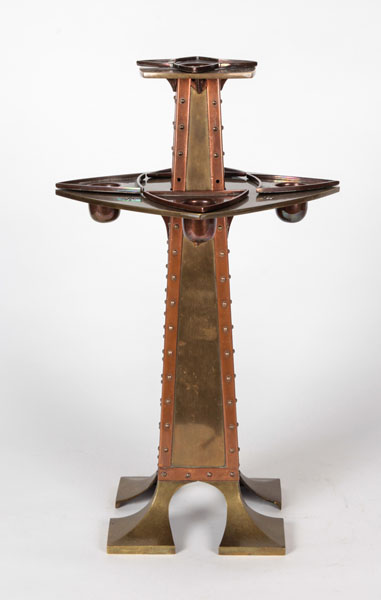
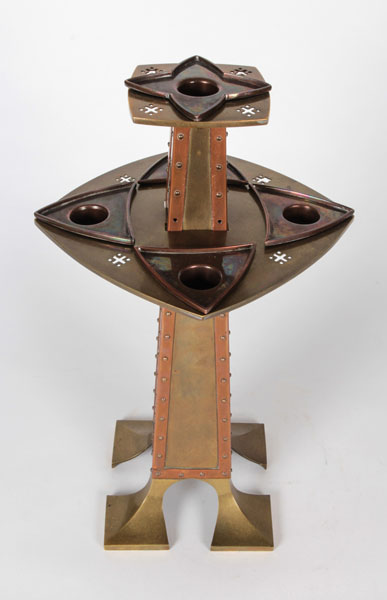
Rare Architectural Candelabrum c. 1900
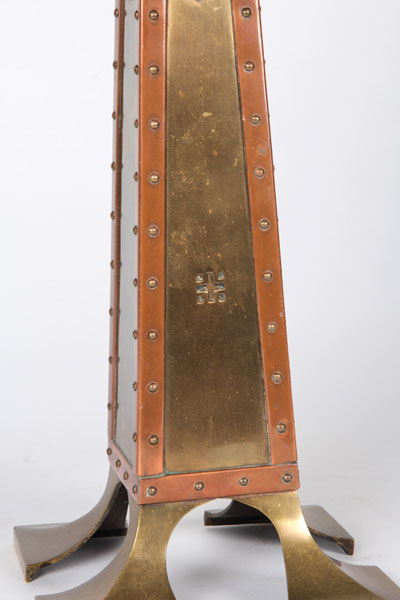
Riveted and detailed “Eiffel Tower” like form in brass and copper with four feet, small cut out designs and two bobeche trays supporting five candles.
H: 14″ x W: 8 1/4″ x D: 8 1/4″
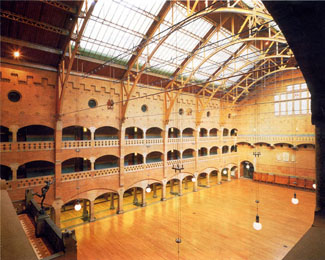
Hendrik Petrus Berlage, a Dutch architect and designer attended the Rijksakademie in Amsterdam and a year later switched to architecture. Berlage enrolled in 1875 in the architecture department of the Eidgenössische Technische Hochschule in Zurich. Through 1878 Berlage studied in Zurich under Gottfried Semper, whose teachings had a lasting influence on his work. After finishing these studies, Berlage spent three years traveling in Germany (1879) and Italy (1880-1881) before returning to his native Amsterdam. From 1881 Berlage was employed by the Amsterdam architect Theodor Sanders and from 1884 Berlage was a partner in the business until he opened his own practice in 1889. In 1884 he submitted a design for the projected Commodity Exchange (Beurs van Berlage) in Amsterdam, winning the competition in 1896. This building, completed in 1903, was Hendrik Paulus Berlage’s first important commission, which also solidified his reputation. Also in Amsterdam and at this same time, Berlage built the Diamond Guild building (1897-1900). In 1900 along with the architect and designer Jacob van den Bosch, Hendrik Paulus Berlage opened the gallery, “‘t Binnenhuis”. They sold their own designed furniture and objects they from 1900-1929. In 1900 Berlage was also commissioned to plan a southern extension of Amsterdam. This was Berlage’s most important contribution to urban planning and he worked on the project until 1915. In 1911 Berlage went to the US, where he saw the new buildings by Frank Lloyd Wright and Louis Sullivan. Berlage built his own house in The Hague and moved into it with his family in 1913. The Gemeentemuseum in The Hague (1919-1935) was Berlage’s last important building, however it was not completed until shortly after his death. Hendrik Petrus Berlage was the founder of the “Amsterdam School” and was a pioneer of modern architecture in the Netherlands. In his 1905 essay “Gedanken über Stil in der Baukunst”, Berlage fiercely criticized 19th-century historicizing architecture as pompous, reserving his praise for the austere simplicity of early period styles. His criticism was severe since he stated flatly that historicizing architecture was all appearance rather than reality, was not art; too much was imitation, more iron was used than stone, and so on. Hendrik Petrus Berlage was therefore an early critic of Historicism even though his Amsterdam Exchange still reveals Romanesque features.
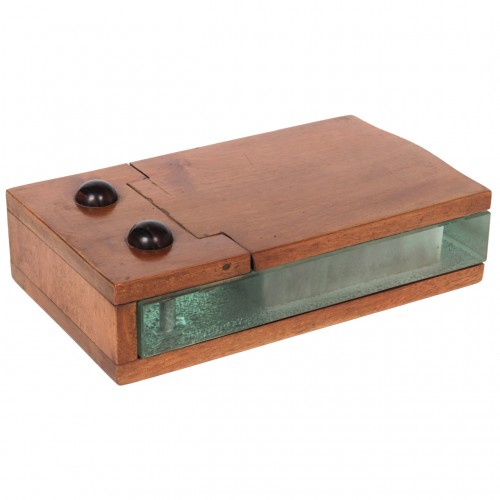
Alexandre Noll rare and early Art Deco mahogany and glass box c. 1930
ALEXANDRE NOLL (1890-1970) France
Covered box c. 1930
Mahogany with ebony peg details and 1 ¼ inch thick Saint-Gobain glass.
Marks: ANoll
Provenance: Private Collection New York, Galerie de Beyrie Paris, Odile Noll (A. Noll’s daughter), Alexandre Noll Estate
For more information see: Alexandre Noll, Olivier Jean-Elie, Pierre Passebon (Paris:Edition du Regard, 1999); Alexandre Noll: Les Matres de L’ Art Decoratif Contemporain, Collection dirigée par R. Moutard-Uldry edited by (Geneve: Pierre Cailler, 1954); Le Mobilier du Xxe Siécle: Dictionnaire des
Créateurs, Pierre Kjellberg (Paris: Les Éditons de l’Amateur, 1994) p. 455-456.
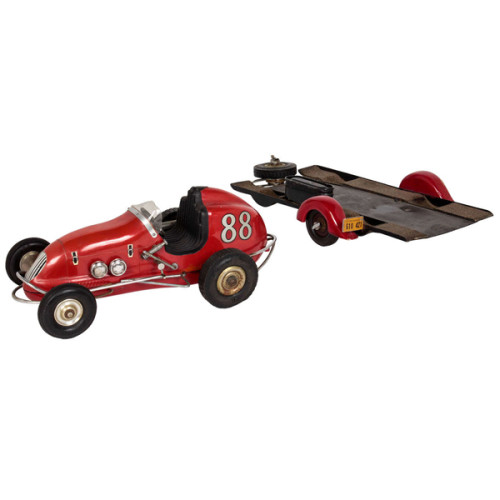
Ohlsson & Rice Rare Streamline American Art Deco Tether Race Car Model No. 88 with Trailer c. 1950
OHLSSON & RICE (founded 1941) Los Angeles, CA
Tether Race Red car Model No. 88
Gas powered tether car racer 1950
Steel and various metals with the car and trailer details painted red, rubber tires and cork details
The license plate reads: California, 19-50, 61U421
H: 5″ x L” 13 1/2″ x D: 7 1/2″
Price: $3,000
In 1941 Irv Ohlsson teamed up with Harry Rice, and the firm of Ohlsson & Rice was founded producing model race cars and propellers. No other engines at the time combined the reliability, ease of maintenance, simplicity of operation and unlimited life of the Ohlsson & Rice engines. The Second World War put a temporary hold on their success, however, as all manufacturing facilities were turned over to military production. By the time the war shut down their production, they had produced about 75,000 engines.
As soon as the war was over, Ohlsson & Rice got back into production. Even with a shortage of needed materials and machines somewhat worn out by 3-shift a day wartime production use, they jumped back into a market that had a seemingly endless demand for their products. Modelers were hungry to get back into flying, and O & R took advantage of the market by buying the machinery needed to meet the huge demand.
Ohllson & Rice die cast tether cars were first manufactured in 1946. The early model cars had solid rear brake drums. open air front grill, 10 air vent slots in the seat, windshield, manual fuel pump, external hand brake lever, 4 nerf bars or radius rods, and plated front axle. The cars were fitted with a .23 or .29 Ohlsson and Rice engine. The easiest way to tell their plane engines from the car engines was the exhaust port. The cars have a straight cut exhaust and the planes had an angled cut port. However they are interchangeable except to be estetically correct. Basic colors included white, black, red , blue and yellow. The .29 engine were available in either spark ignition models or with a glow plug. In the early days Ohlsson and Rice had trouble with their engines and discovered a lot of the problems were due to inferior fuel sources. To rectify this they started to manufacture their own Nitro Glow fuel. This seemed to cure their engine problems. The later models in the fifties went to a closed front grill , 1 air vent slot in seat, hollow brake drums, no windshield and a smaller .049 engine. The last of the midget racers were made in 1959.
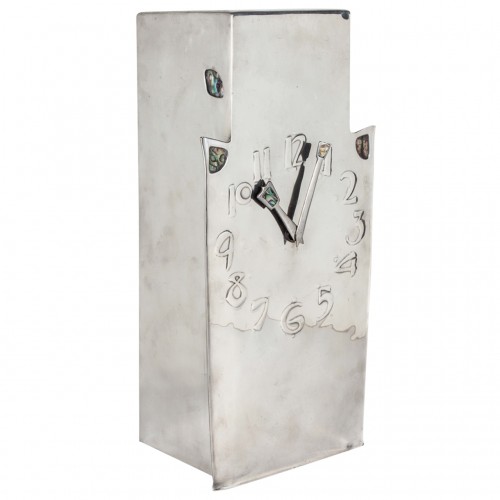
Archibald Knox / Liberty & Co. Important and Rare Tudric Clock 1902
ARCHIBALD KNOX (1864-1933) UK
LIBERTY & CO. London
Extremely rare and important grand clock by Archibald Knox for Liberty & Co. This is the largest of all of the Tudric models designed and is inset with abalone shell on the sides, the front corners and on the hands of the clock.
Marks: TUDRIC, 098
Illustrated: The Designs of Archibald Knox for Liberty & Co., A..J. Tilbrook (London: Ornament Press Ltd., 1976) pg. 88; The Liberty Style, (Japan: Hida Takayama Museum of Arts, 1999) fig. 168, p 114; Archibald Knox, ed. by Stephen A. Martin (London: Academy Editions, 1995) p. 88.
H: 15″ x W: 7″ x D: 5″
***This is the largest clock designed by Archibald Knox for
Liberty & Co. and one of only three models known.
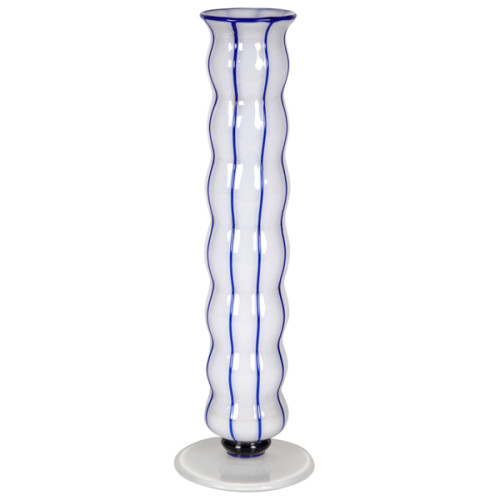
“Opal mit streifen” opaline blown glass with applied blue glass canes and blue knob above opaline base
Exhibited: 1914 Werkbundausstellung, Cologne (Lötz period photograph, vase for the 1914 Cologne Werkbund Exhibition) Lötz: Böhmisches Glas 1880-1940: Werkmonographie, Band 1, Helmut Ricke and Ernst Ploil (Munich: Prestal-Verlag, 1989), p. 267; Wiener Werkstätte Design in Vienna 1903-1932, Christian Brandstätter (New York:Verlag Harry Abrams, 2003) p. 247.
Form illustrated: Lötz: Böhmisches Glas 1880-1940: Werkmonographie, Band 1, Helmut Ricke and Ernst Ploil (Munich: Prestal-Verlag, 1989), p. 267
Same ”opal mit streifen” technique illustrated: Glaskunst der Moderne: von Josef Hoffmann bis Wilhelm Wagenfeld, Torsten Bröhan (Munich: Klinkhardt & Biermann, 1992), cat. no. 19, pp. 74-77.

 @hd_jewels