Product Description
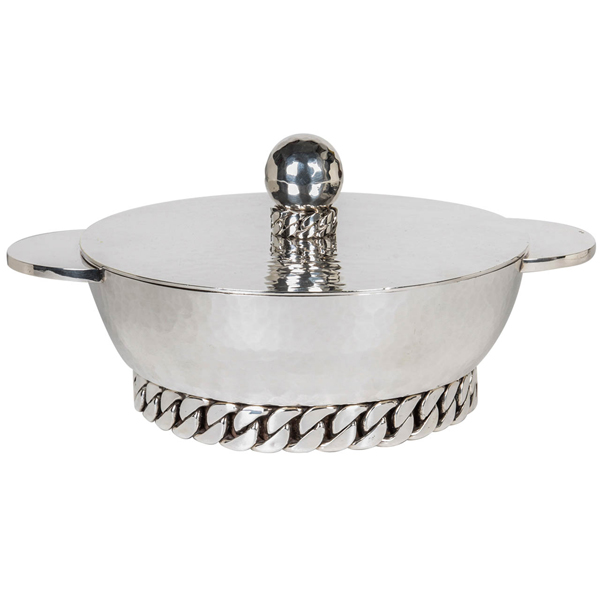
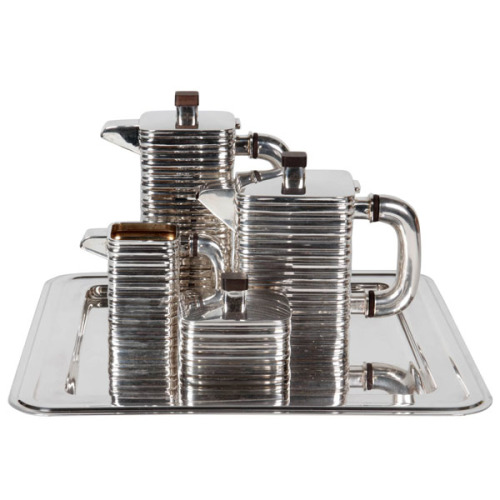
Jean Despres, French Art Deco Modernist Covered Centerpiece c. 1940

Jean Despres (1889-1980) France.
Modernist covered centerpiece, circa 1940.
Hand-wrought and hand-hammered silver plate.
Marks: J. Despres (script incised signature on the edge on one handle),
JD French Jean Despres touchmark (2x).
For related works see: Jean Després: Maestro Orafo Tra Art Déco e Avanguardie, Melissa Gabardi (Milano: IDEA Books, 1999) Metallkunst: Kunst vom Jugendstil zur Moderne (1889-1939) Band IV, Karl H. Brohan (Berlin: Brohan-Museum, 1990); Silver of a New Era: International Highlights of Precious Metalwork from 1880 to 1940 (Rotterdam: Museum Boymans van-Beuningen, 1992)
H: 5 ¼” x W: 11 ½” x diameter: 8 ¾”
Jean Despres, French Art Deco Modernist Covered Centerpiece c. 1940
RICHARD HAROLD REDVERS TAYLOR (1900-1975) United Kingdom
Modernist building staircase c. 1949
Gouache on paper, metal and wood frame
Signed: RHRT (lower left)
Marks: Gimpel Fils exhibition label (on back)
Exhibited: “An Exhibition in the Kettle’s Yard Loan Gallery: Sculpture & Painter,
14 February – 10 March, 1972” Gimpel Fils, London
Framed: H: 41 7/16” x W: 30 5/16”
Richard Harold Redvers Taylor (1900-1975) was born in Brighton on March 14th, 1900 and educated at Brighton College and Heatherleys School of Fine Art, Chelsea. His father, Harold Taylor, was a headmaster. Redvers Taylor retired from the Army (where he specialized in topographical surveying in Africa) in 1937 but was recalled for war service. In 1946 he began a new career as a professional painter. Between 1948 and 1958 Taylor was given a series of six one-man shows by Lefevre and Gimple Fils in London. In the 1960’s he turned to sculpture, and in 1972 an exhibition of his sculpture and paintings was held at the Kettle’s Yard Loan Gallery in Cambridge. His work is held in the permanent collection at the Beith Uri V Rami Museum in Israel. Louise Taylor (née Hayden), his wife, was an American and the adopted daughter and heiress of Alice B. Toklas, the companion of Gertrude Stein. Louise Taylor died on 21 July 1977.
Purism, otherwise known as l’esprit nouveau was directly inspired by a spare, functionalist aesthetic and is closely associated with the work of Le Corbusier and his circle in Paris in the second quarter of the 20th Century. In America this purist style was known as Precisionism, which explored similar imaginary during the late 1920’s and 30’s with artists like Charles Sheeler, Charles Demuth and Ralston Crawford at the forefront of this movement. In England, the Vorticist movement (1912-1915) was founded by Wyndham Lewis and others and was the precursor to the Purist movement in Great Britain in the 1930’s and 1940’s. Redvers Taylor created geometrical landscapes while reducing volumes to colored planes and outlines to ridges. His artwork combines depth and perspective with flattened cubist fields of color. Architecture of industrial buildings was his favorite subject, whereas people and nature were usually absent from his compositions.
TOMMI PARZINGER (1903-1981) Germany/USA
PARZINGER, INC. New York
Coffee table c.1939
Carved and ceruse oak with an incised diamond pattern pewter top
Illustrated: Arts and Decoration, June 1940
***This table was originally priced at $80 during the period, as it appears in the Arts and Decoration vintage illustration from 1940.
For other examples of Parzinger’s work see: Town & Country, Vol. 54, “Counter Points”, December 1939, p. 31; Town & Country, Vol. 95, “Counter Points”, June 1940, p. 19; The Studio, 1938, “For the Table”, p.107-09; The Studio, 1942, “Tommi Parzinger, Designer of Modern Interiors and Silver”, p.37; Decorative Art, Studio Yearbook (London & New York: The Studio Publications, 1952-53), p. 98; Craft in the Machine Age, ed. Janet Kardon (New York: American Craft Museum, 1995) p.128, 134, 183, 241.
H: 12” x L: 42” x D: 14”
Price: $34,500
This is a wonderful and rare coffee table by Tommi Parzinger in beautifully detailed ceruse oak with a diamond pattern pewter inset top. This table was
completely handmade and dates from 1940, shortly after Parzinger opened his first eponymous gallery on East 57th Street. It is low and lean with exquisite Neoclassical Revival carved details and a silhouette that calls to mind an American take on Jean Michel Frank’s sober and refined elegance of the same time period. The cross-hatch carving with tassels on the two long sides and the related top corner details also have a charm reminiscent of Parzinger’s affable personality and effervescent design sensibility.
WILHELM WAGENFELD (1900-1990) Germany
WMF [Württembergische Metallwarenfabrik] Geislingen, Germany
Tazza c. 1935
Hexagonal green-tinted lead crystal covered dish / tazza with lid in a stepped jewel-like form mounted with a silver lid and footed base silver
Marks: WMF logo, moon, crown, 800
For more information see: Wilhelm Wagenfeld und die Moderne Glasindustrie,Walter Scheiffele (Stuttgart: Verlag Gerd Hatje, 1994); WMF Ikora Metall / Metalwork, Carlo Burschel and Heinz Scheiffele (Stuttgart, Germany: ARNOLDSCHE, 2006).
H: 5 1/4″ x D: 7″ x W: 7″
Price: $3,500