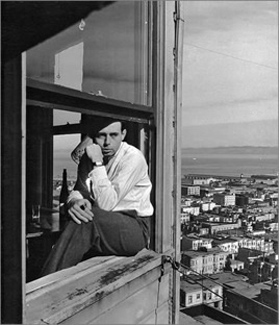
John Gutmann was a German-born American photographer and painter. After fleeing Nazi Germany to the United States, Gutmann acquired a job as a photographer for various German magazines. Gutmann quickly took an interest in the American way of life and sought to capture it through the lense of his camera. He especially took an interest in the Jazz music scene. Gutmann is recognized for his unique “worm’s-eye view” camera angle. He enjoyed taking photos of ordinary things and making them seem special.His work was shown in important galleries such as Castelli’s in NYC, Fraenkel in San Francisco, and the Centre National de la Photographie in Paris. After his death, Gutmann’s oeuvre was given to the Center for Creative Photography at the University of Arizona.
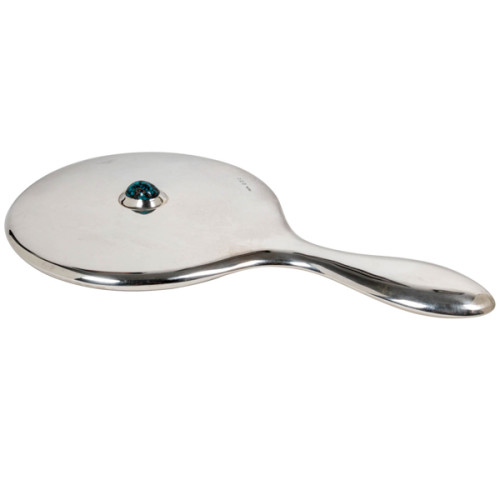
Archibald Knox / Liberty & Co. Sterling hand mirror 1908
ARCHIBALD KNOX (1864-1933) UK
LIBERTY & CO. London, UK
Hand mirror 1908
Sterling with large matrix cabochon turquoise
Marks: L & Co. cipher, Birmingham assay marks for 1908
Similar works with turquoise Illustrated: Archibald Knox, ed. by Stephen A. Martin (London: Academy Editions, 1995) ; Liberty Design 1874-1914, Barbara Morris (London: Pyramid Books, 1989) p. ; The Designs of Archibald Knox for Liberty & Co., A.J. Tilbrook (London: Ornament Press Ltd., 1976)
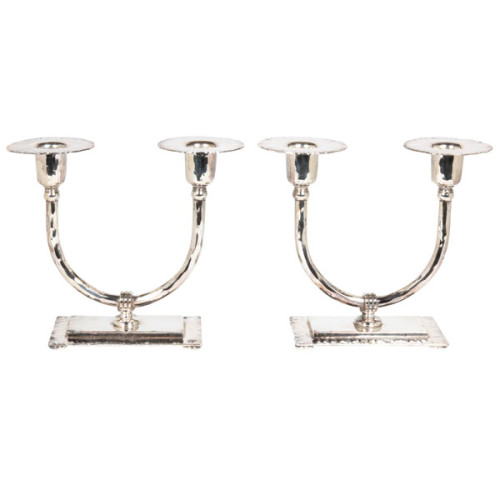
Roycroft / American Arts & Crafts Pair of Candlesticks c. 1915
ROYCROFT COPPER SHOP East Aurora, N.Y.
Pair of candlesticks c. 1915.
Hand wrought and textured copper, silver-plated.
Marks: impressed R, in orb with cross, ROYCROFT
For more information see: The American Arts & Crafts Movement in Western New York 1900-1928, Bruce A. Austin (Rochester Institute of Technology, 1992); Arts & Crafts Movement in New York State 1890’s – 1920’s, Coy Ludwig (Hamilton, N.Y.: Gallery Association of New York, 1983).
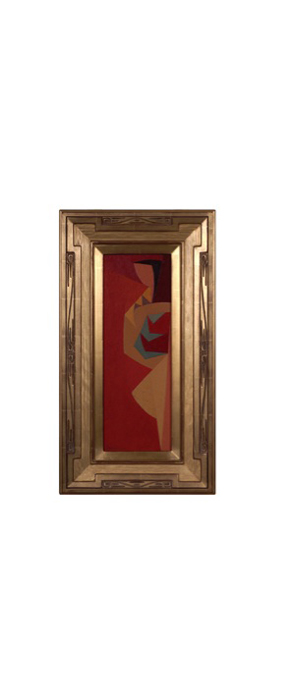
Karl Benjamin, “Geo-metricized figure”, Oil on canvas 1954
KARL BENJAMIN (1925-2012) USA
Geometricized figure 1954
Oil on canvas
Signed: Benjamin 54 (lower left)
For more information see: Dictionnaire des Peintres, Sculpteurs, Dessinateurs et Graveurs, Vol. 1 to 10, E. Bénézit (Paris: Librairie Gründ, 1976).
Canvas: H: 17″ x W: 6″
Framed: H: 24 1/2″ x W: 13 1/2″
Karl Benjamin was born in Chicago, IL in 1925. He received his BA from the University of Redlands, CA and his MFA at Claremont Graduate School, CA. Benjamin belonged to the Hard Edge group of West Coast painters led by John McLaughlin during the 1950s, 60s and early 70s. He was awarded the National Endowment for the Arts Grant for Visual Arts in both 1983 and 1989. His work has been featured in numerous museum exhibitions and is included in the public collections of the Los Angeles County Museum of Art; Museum of Contemporary Art, Los Angeles; Museum of Modern Art, Israel; Oakland Museum, Oakland, CA; San Francisco Museum of Modern Art, CA; Seattle Art Museum, WA; and the Whitney Museum of American Art, NY, among others. For many years, Benjamin taught painting at Pomona College and Claremont Graduate School, and currently is Professor Emeritus. He lived in Claremont, CA.



 @hd_jewels