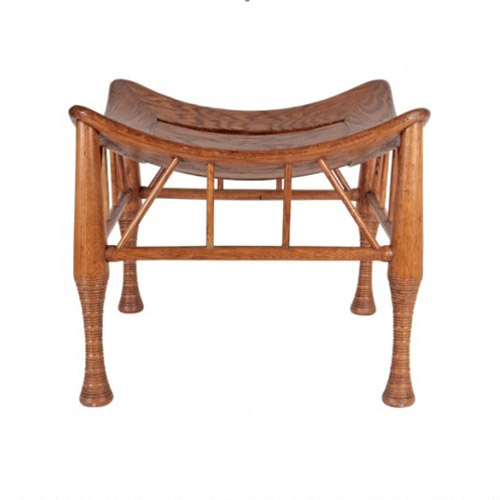
Liberty & Co. / Leonard Wyburd Egyptian Revival Four-Legged Oak Thebes Stool c. 1890-1895
More Information
Liberty & Co. / Leonard Wyburd Egyptian Revival Four-Legged Oak Thebes Stool c. 1890-1895
Leonard Wyburd UK
Liberty & Company London
Four-legged Thebes stool circa 1890-95. Oak with highly figured grain, concave slat seat, turned details.
Marks: 4 (impressed on underside)
This design was registered by Liberty & Co. in 1884.
Related Liberty & Co. stools illustrated: Liberty’s 1875-1975 : An Exhibition to Mark the Firm’s Centenary (London: Victoria & Albert Museum, 1975) p. 35, illustr. C1, Liberty Design, 1874-1914 , Barbara Morris (London: Octopus Publishing Group:, 1989) p. 103; Egyptomania: Egypt in Western Art, 1730-1930 (Paris: Éditions de la Réunion des Musées Nationaux and Ottawa: National Gallery of Canada, 1994), pp. 465-66.
H: 15″ x D: 17″ x W: 17″
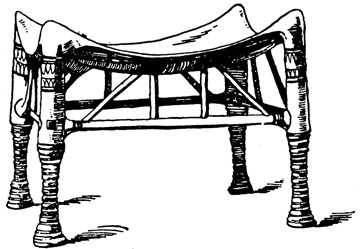
One of the driving influences of the Aesthetic Movement of the late 19th century was an informed interest in authentic ancient designs inspired by recent archaeological discoveries. Both the three and four-legged Thebes stool were inspired by actual furniture and wall paintings unearthed from royal tombs in the ancient Egyptian city for which they are named. Leonard Wyburd, who was one of the principal designers for Liberty, patented his designs for the Thebes stools in 1884. Liberty & Co. continued to make the popular stools into the early 1900’s.
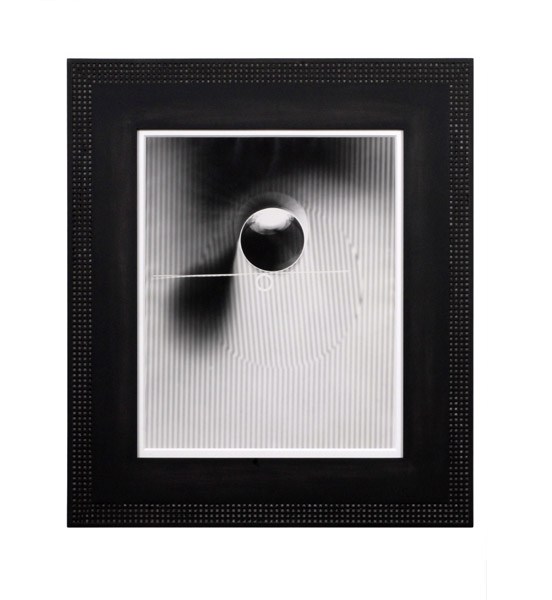
György Kepes, Abstraction, Gelatin silver print, 1942
GYÖRGY KEPES (1906-2001) Hungary/USA
Abstraction 1942
Silver gelatin print
Signed: 9 (in a circle, on back); Gyorgy Kepes 1942 (in ink on back)
György Kepes was a Hungarian-born painter, designer, educator and art theorist. After emigrating to the U.S. in 1937, he taught design at the New Bauhaus (later the School of Design, then Institute of Design, then Illinois Institute of Design or IIT) in Chicago. In 1947 He founded the Center for Advanced Visual Studies at the Massachusetts Institute of Technology (MIT) where he taught until his retirement in 1974.
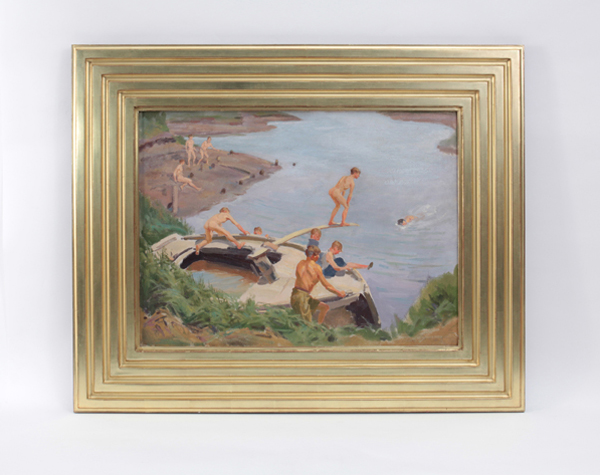
Edmund F. Ward “The Swimming Hole” Oil on canvas c. 1930
EDMUND F. WARD (b. 1892 – 1991) USA
“The Swimming Hole” c. 1930
Oil on canvas
Marks: signed Edm. F. Ward (lower right); partial labels verso:Westchester Arts and Crafts Guild; 4 Edmund F. Ward
For more information on the artist see: Who Was Who in American Art,Peter Hastings Falk, ed. (Madison, Conn.: Sound View Press, 1985), p. 658.
Canvas H: 18” x W: 24”
Framed H: 27 9/16” x W: 33 9/16”
Price: $14,000
Ward studied at the Arts Student’s League with Edward Dufner, George Bridgeman, and Thomas Fogarty. He was an illustrator for several national magazines and books. In 1925, Ward exhibited an award winning work at the Art Institute of Chicago. He is perhaps best known for his WPA mural in the Federal Building, White Plains, New York.
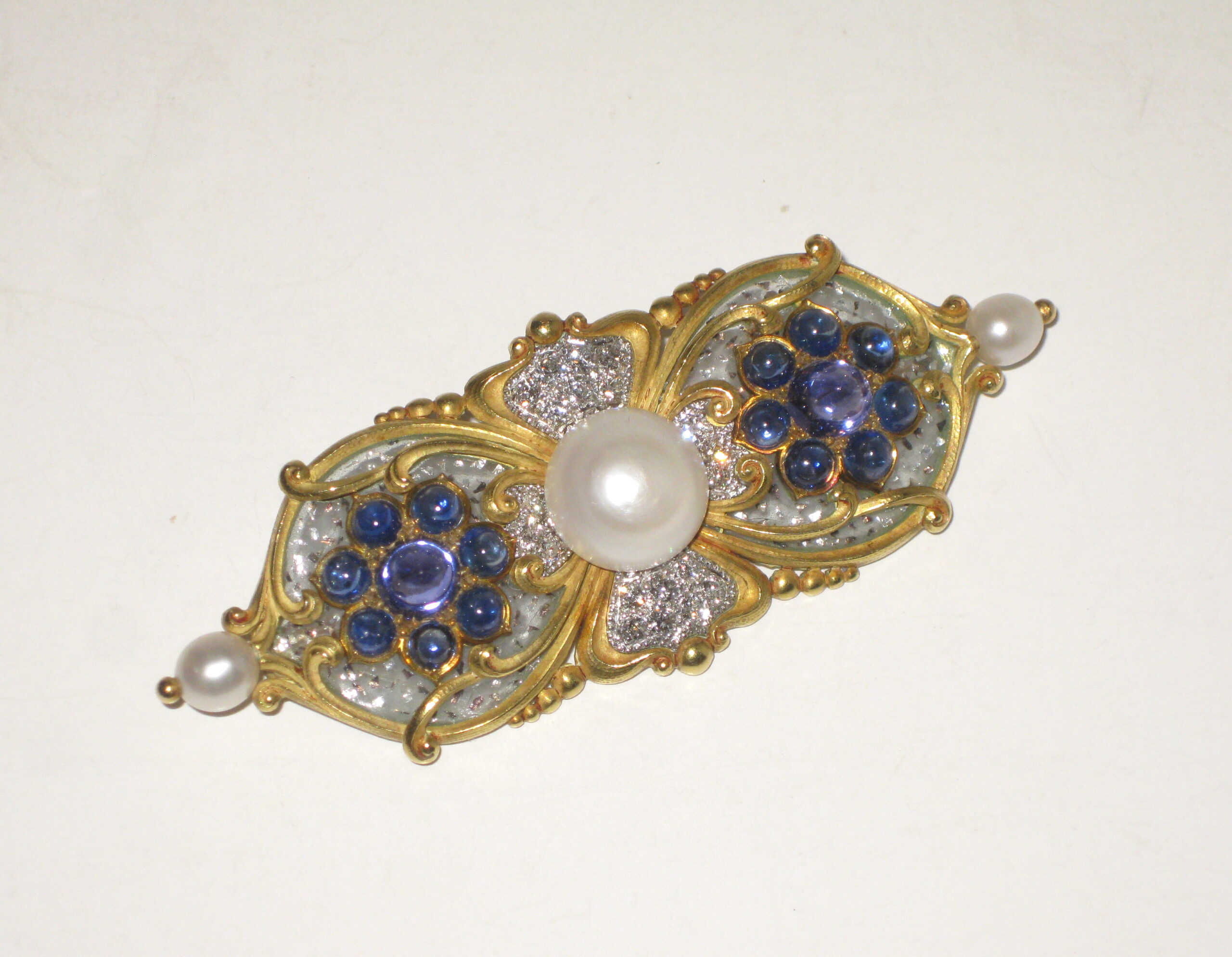
Marcus & Co. Art Nouveau brooch, “Tibula” shaped 18k yellow gold brooch set with three natural pearls, the natural center button pearl approx. 10 mm in diameter (G.I.A. certificate, 3 natural freshwater pearls, weight 24.90 grams, measurement range from 5.46 to 12.26mm), 16 sugarloaf cabochon sapphires, the two large and high dome middle sapphires with a purple hue, 20 pave set round diamonds all surrounded with clear plique-a-jour further trapped with platinum flakes, signed c. 1897




 @hd_jewels