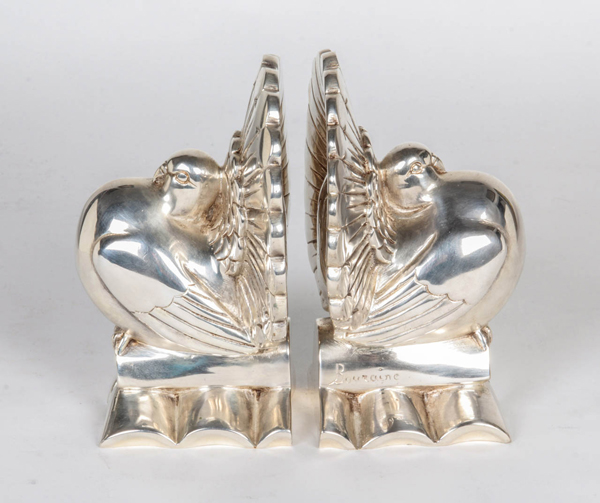
Marcel Bouraine, Pair of French Art Deco “Dove” Bookends c. 1930
More Information
Marcel Bouraine, Pair of French Art Deco “Dove” Bookends c. 1930
Marcel Bouraine (active 1925-1930) France.
Pair of Art Deco “Dove” sculptural bookends, circa 1930.
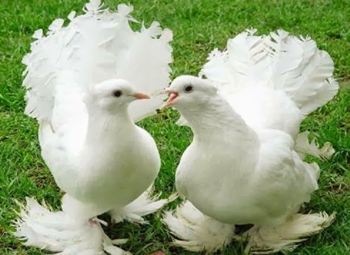
Silvered bronze (sand cast technique) in the form of doves with openly displayed and fan shaped tail feathers perched on roof pan tiles.
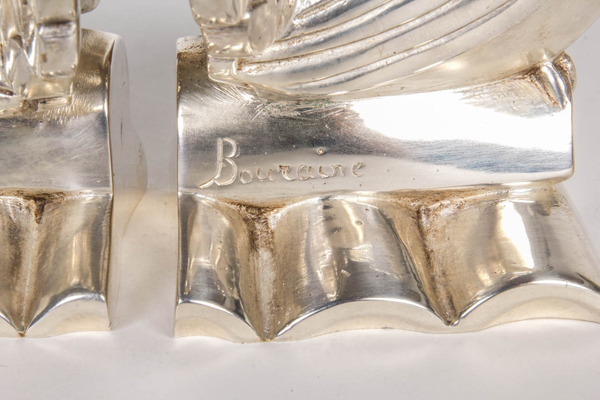
Marks: Bouraine (2x), #’s 52 and 53.
For more information and other works by Bouraine see: Les Echoes D’Art (May 1927), p. 21; Art Deco Sculpture, Bryan Catley; The Art Deco Style, Selected by Theodore Menten (New York: Dover Publications, 1972), p. 172; Dictionnaire critique et documentaire des Peintres, Sculpteurs, Dessinateurs et Graveurs, E. Bénézit, vol. 2 (Paris: Librarie Grund, 1976), p. 231, An Encylopedia of Art Deco, Edited by Alastair Duncan (New York: E.P. Dutton, 1988) pp. 26,28-29,31,104; Art Deco, Victor Arwas (New York, Harry Abrams,1980) pp. 163, 269.
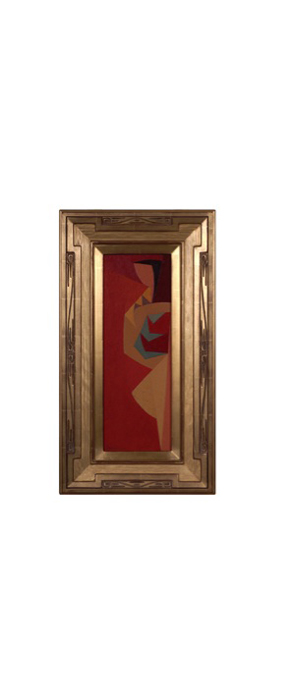
Karl Benjamin, “Geo-metricized figure”, Oil on canvas 1954
KARL BENJAMIN (1925-2012) USA
Geometricized figure 1954
Oil on canvas
Signed: Benjamin 54 (lower left)
For more information see: Dictionnaire des Peintres, Sculpteurs, Dessinateurs et Graveurs, Vol. 1 to 10, E. Bénézit (Paris: Librairie Gründ, 1976).
Canvas: H: 17″ x W: 6″
Framed: H: 24 1/2″ x W: 13 1/2″
Karl Benjamin was born in Chicago, IL in 1925. He received his BA from the University of Redlands, CA and his MFA at Claremont Graduate School, CA. Benjamin belonged to the Hard Edge group of West Coast painters led by John McLaughlin during the 1950s, 60s and early 70s. He was awarded the National Endowment for the Arts Grant for Visual Arts in both 1983 and 1989. His work has been featured in numerous museum exhibitions and is included in the public collections of the Los Angeles County Museum of Art; Museum of Contemporary Art, Los Angeles; Museum of Modern Art, Israel; Oakland Museum, Oakland, CA; San Francisco Museum of Modern Art, CA; Seattle Art Museum, WA; and the Whitney Museum of American Art, NY, among others. For many years, Benjamin taught painting at Pomona College and Claremont Graduate School, and currently is Professor Emeritus. He lived in Claremont, CA.
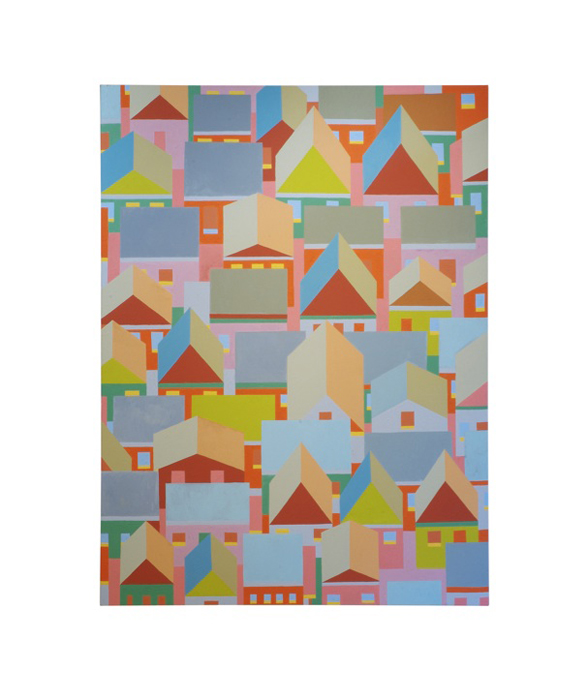
Hubert Schmalix “Mount Washington” Oil on Canvas 2005/2006
HUBERT SCHMALIX (1952-) Austria
Mount Washington 2005/06
Oil on canvas
Signed and dated on back: Schmalix 05 06
Provenance: Hubert Schmalix Vienna
For related works by Hubert Schmalix see: Hubert Schmalix, Lóránd Hegyi exhibition catalog (Museum moderner Kunst Stiftung Ludwig Wien) November 19, 1994 – January 1995.
H: 69” x W: 51”
Hubert Schmalix was born in Graz, Austria, on December 17, 1952 and studied at the Vienna Art Academy from 1971 to 1976. By 1979 Schmalix was showing work at the forward-looking exhibition ‘Europa 79 – Kunst der 80er Jahre’ in Stuttgart. In 1983 the London Tate Gallery invited Schmalix to present work at ‘New Art’, an important survey of contemporary art. Schmalix has become well-known world-wide as an exponent of ‘New Art’, working with a retrospective glance at both classical art history and modern art. Schmalix focuses on the world of things and the human figure. Although the expressive gesture was the dominant feature of his 1980s work, it yielded early in the 1990s to stringent tectonic composition. In 1984 Hubert Schmalix went to the Philippines and on to the US, moving to Los Angeles in 1987. In 1986-87 Schmalix taught at the Academy for the Decorative and Applied Arts in Vienna and from 1997 he has been a professor at the Vienna Art Academy. Schmalix is a visiting professor at the University of California Los Angeles (UCLA). In 1993 his work was featured at the Venice Biennale and in 1998 he was awarded the Fine Art Prize of the City of Vienna. Schmalix has done several large fresco cycles in Salzburg and his work has been shown extensively at numerous international solo and group shows and most recently at Art Basel 2006.
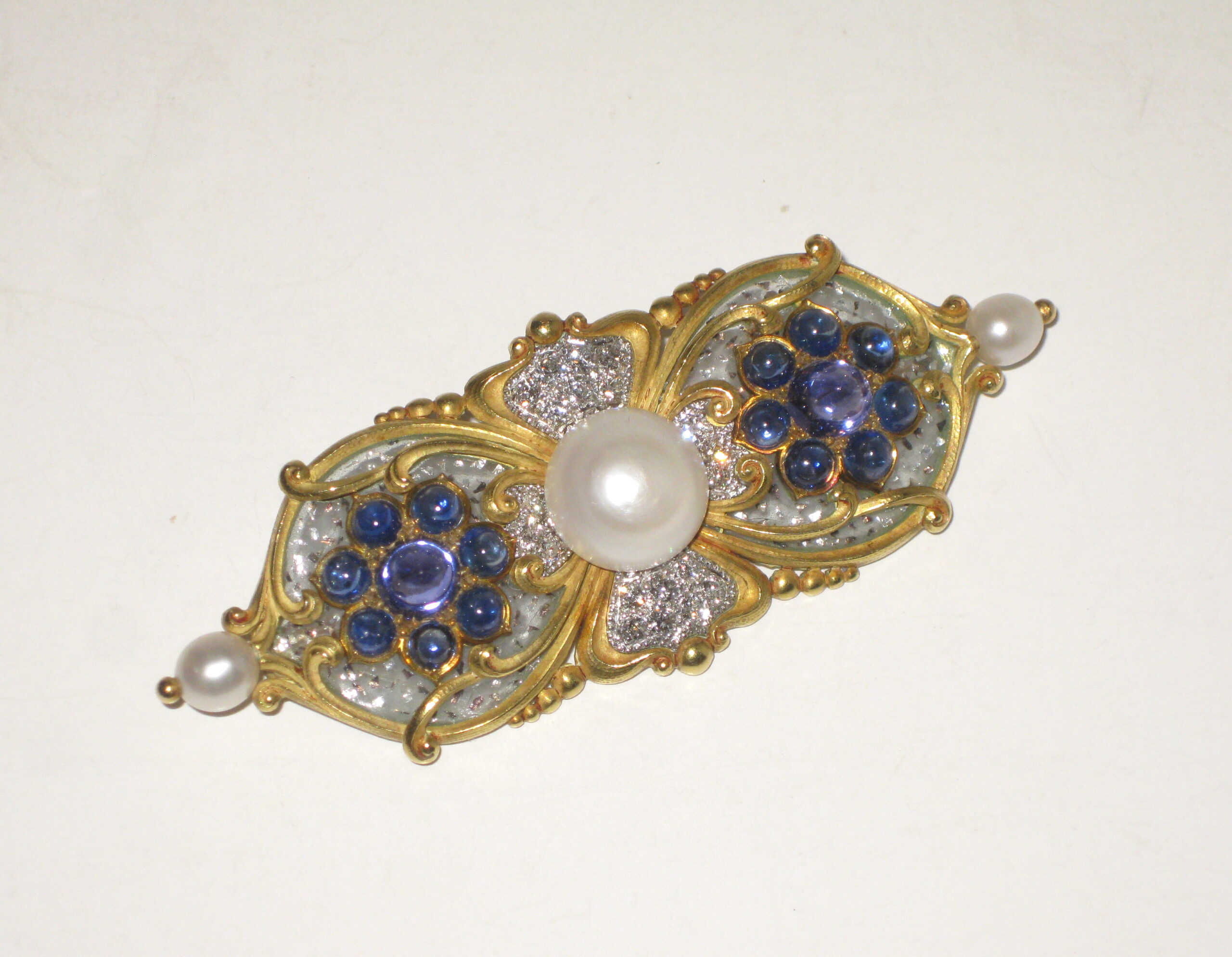
Marcus & Co. Art Nouveau brooch, “Tibula” shaped 18k yellow gold brooch set with three natural pearls, the natural center button pearl approx. 10 mm in diameter (G.I.A. certificate, 3 natural freshwater pearls, weight 24.90 grams, measurement range from 5.46 to 12.26mm), 16 sugarloaf cabochon sapphires, the two large and high dome middle sapphires with a purple hue, 20 pave set round diamonds all surrounded with clear plique-a-jour further trapped with platinum flakes, signed c. 1897







 @hd_jewels