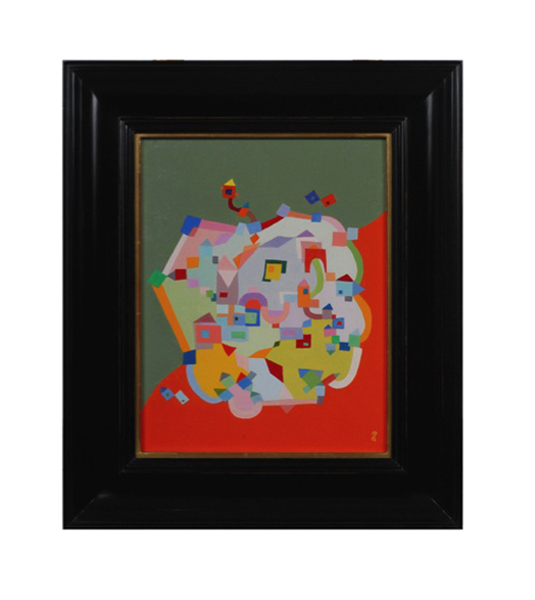
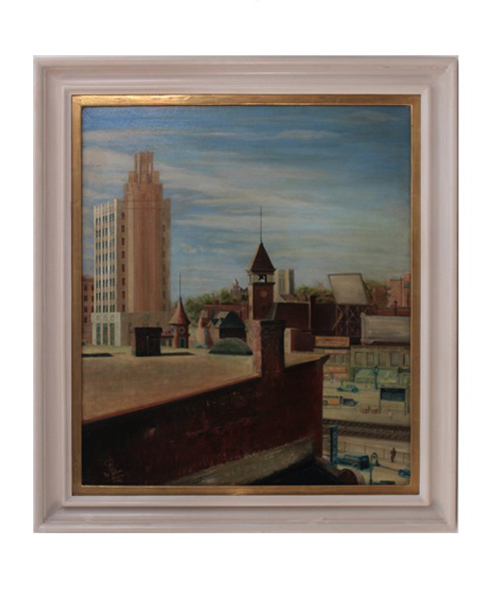
Michiel Gloeckner “Old Town No. 2”, Oil on Canvas 1960
MICHIEL GLOECKNER (1915-1989) Germany / USA
Old Town No. 2 1960
Oil on Canvas
Signed: MG (lower right corner)
Canvas: H: 14 1/16” x W: 11 1/16”
Framed: H: 19 9/16” x W: 16 9/16”
Price: 32,000
Michiel Gloeckner, known for his highly refined, balanced abstract, geometric style derived from natural forms, was the son of a well-known art collector. He graduated from the University of Dresden with a degree in mathematics and art history. He received a degree from the Royal Academy of Dresden where he studied under Otto Dix. Paul Klee also influenced Gloeckner’s work. After WWII Gloeckner moved to New York City. He continued to maintain a studio in New York at 115 East 70th Street, even after he moved to West Cornwall, Connecticut where he spent the later years of his life.
EXHIBITIONS
Gallery Seventy-Five, New York 1955, 1956, 1958
Jacques Seligman Galleries, New York 1960, 1961, 1962
Wadsworth Atheneum 1960
Wesleyan University 1961
Philadelphia Art Alliance 1962
Philadelphia Academy of Fine Arts 1963
World House Galleries, New York 1963, 1962, 1965, 1966
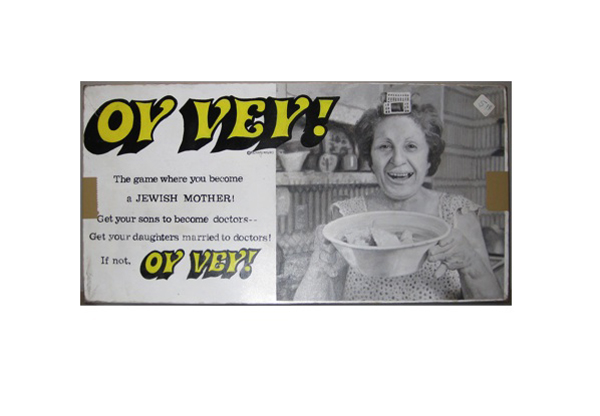
Tim Liddy Oy Vey (1979) The game where you become a JEWISH MOTHER! Get your sons to become doctors—Get your daughters married to doctors! If not, OY VEY! 2008 Oil and enamel on copper, plywood back
TIM LIDDY
“Oy Vey” (1979) The game where you become a JEWISH MOTHER! Get your sons to become doctors—Get your daughters married to doctors! If not, OY VEY! 2008
Oil and enamel on copper, plywood back
Signed in script: Tim Liddy, red circular ring, “circa 1979”, 2008
Provenance: William Shearburn Gallery, St. Louis, MO
H: 10 ¼” x W: 20 ½” x D: 1 ¾”
With his recent paintings, Liddy has both reasserted the construct of hyperrealist painting and developed a thoroughly unique advancement of that mode by extending the cultural reality of the indexed original. Based on the illustrated box lids of vintage board games, Liddy has recontextualized a subject, which evokes the underlying rules of life. Painted on copper or steel in the precise dimensions of the original, the metal is then manipulated to demonstrate the exact rips and tears from years of usage and includes trompe-l’oeil renditions of the scotch tape that might be holding the cardboard box together, the assorted stains, or the various graffiti of time. Liddy leaves no possibility of ambivalence, these works speak to a concurrent understanding of their original object identity and to themselves as works of art engaged in historical and psychological dialogue.
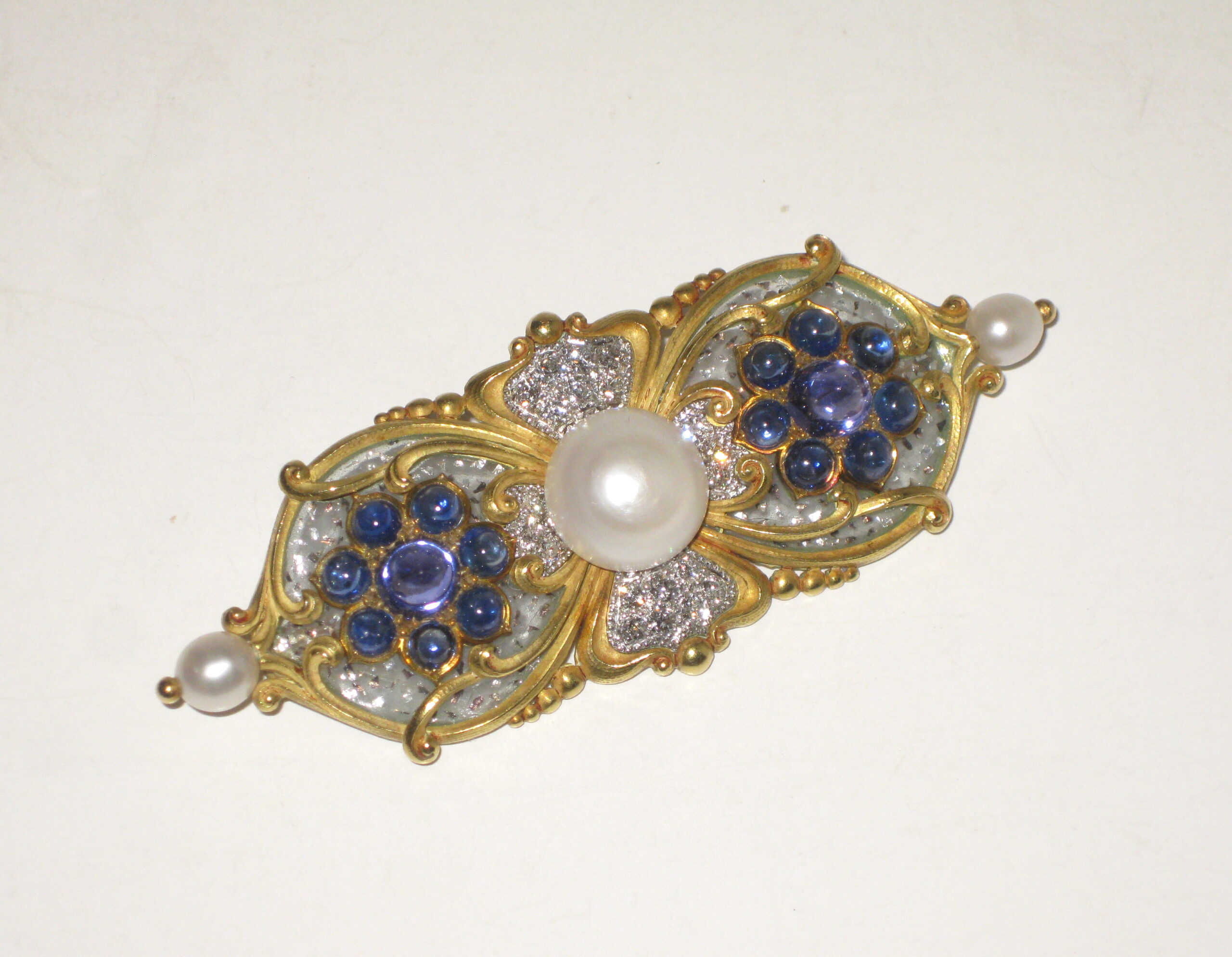
Marcus & Co. Art Nouveau brooch, “Tibula” shaped 18k yellow gold brooch set with three natural pearls, the natural center button pearl approx. 10 mm in diameter (G.I.A. certificate, 3 natural freshwater pearls, weight 24.90 grams, measurement range from 5.46 to 12.26mm), 16 sugarloaf cabochon sapphires, the two large and high dome middle sapphires with a purple hue, 20 pave set round diamonds all surrounded with clear plique-a-jour further trapped with platinum flakes, signed c. 1897

 @hd_jewels