Product Description
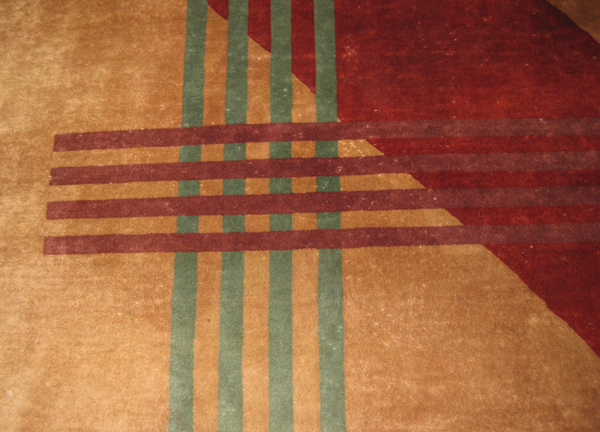
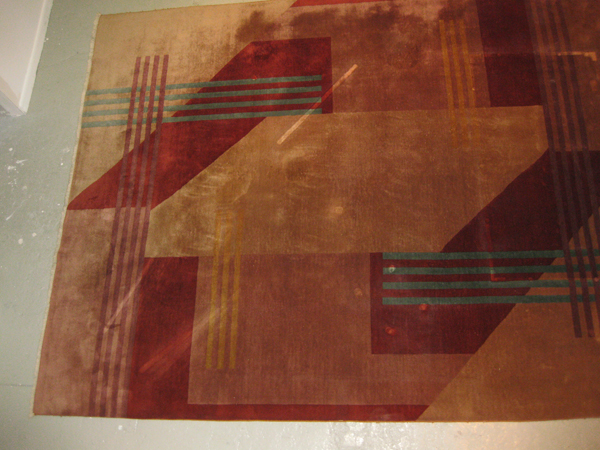
Walter Nichols Chinese Art Deco / Modernist rug c. 1935

WALTER NICHOLS China
Art Deco / Modernist rug c. 1935
106” x 137”
Walter Abner Burns Nichols was one of the most colorful of the American adventurer/entrepreneurs in 1920s China. The Nichols name has come to be used almost synonymously with the ‘Chinese deco’ rugs manufactured in Tientsin, China in the 1920s and 1930s. Nichols did not originate the Chinese deco style, but he did a great deal to popularize it and to maintain its high standards of manufacture.
Nichols began in his youth as a first-class wool grader who went to Tientsin around 1920 to work for the Elbrook family of wool merchants. Nichols started his own business a couple of years later. In a brochure he produced in the late ’20s, with the assistance of Pande-Cameron, he announced: “In 1924 W.A.B. Nichols of Tientsin, North China, introduced the Super Chinese Rug which has become world famous. It is known in every market as the most durable and beautiful product of the modern Chinese weavers art and adorns the homes of people all over the earth.”
Walter Nichols Chinese Art Deco / Modernist rug c. 1935
DONALD DESKEY attributed (1894-1989) USA
DESKEY-VOLLMER, INC. (maker)
Modernist intersecting-circles store display c.1928-30
Chrome-plated sphere and cylindrical shaft and details, original plate glass shelves and mirrored base
***This store display piece is exceptional quality and survives in mint condition.
For more information and related designs see: Donald Deskey: Decorative Designs and Interiors, David A. Hanks and Jennifer Toher, E.P. Dutton: New York, 1987, pages 12-17 and 96-98 (Abby Rockefeller table centerpiece)
H: 8 ¾” x W: 11” x D of base: 10 ¼”
HAYNO FOCKEN (1905-1968) Germany
Round covered box c. 1935
Hand-wrought and hand-hammered copper with brass details
Marks under the foot: HF (conjoined monogram)
For other works by Hayno Focken see: Metallkunst: Vom Jugendstil zur Moderne (1889-1939), ed. Karl H. Bröhan (Berlin: Bröhan Museum, 1990), illus. 177, p. 183; Avantgarde Design 1880=1930,Torsten Bröhan & Thomas Berg (Köln, Benedict Taschen, 1994) p. 116; , (Berlin 1937) S. 43f, Abb. 37, Abb. S 128, S 146, Sl 243; Die Schaulade 15 Ausg. A (1939) Abb. S. 197, S. 204, S. 213; Die Schaulade 16 Ausg. A (1940) Abb. S. 44, S. 51., S. 54, S. 71, S. 83. S. 89; Die Kunst 84 (1941) S. 136, S. 139-39; Die Schaulade 17 (1941) Abb. S. 13, S. 41, S. 82, S. 229;
H: 4 ¼” x Dia: 4 7/8”
Hayno Focken (1905-1968) was an eminent German metal artist. He completed his training under Professor Karl Müller (1888-1972) at the design and arts school on Giebichenstein Castle in Halle (Saale), which was strongly tied to the ideals of the Deutsche Werkbund and the Bauhaus. In 1932 he established his own workshop in Lahr/Schwarzwald and continued his work until shortly before his death. His artistic work always stood out with a strong preference for large, organic forms, a similar manner of surface design and the same adherence to the principle of handicraft. Even his artist signet was modelled on the simple, square castle mark. In the 1950s he became one of those significant artists who had a major impact on contemporary metal design. The foundation of his creative work was a masterful understanding of proportions.
Walter Nichols Chinese Art Deco rug c. 1935
WALTER NICHOLS China
Chinese Art Deco rug c. 1935
Walter Abner Burns Nichols was one of the most colorful of the American adventurer/entrepreneurs in 1920s China. The Nichols name has come to be used almost synonymously with the ‘Chinese deco’ rugs manufactured in Tientsin, China in the 1920s and 1930s. Nichols did not originate the Chinese deco style, but he did a great deal to popularize it and to maintain its high standards of manufacture.
Nichols began in his youth as a first-class wool grader who went to Tientsin around 1920 to work for the Elbrook family of wool merchants. Nichols started his own business a couple of years later. In a brochure he produced in the late ’20s, with the assistance of Pande-Cameron, he announced: “In 1924 W.A.B. Nichols of Tientsin, North China, introduced the Super Chinese Rug which has become world famous. It is known in every market as the most durable and beautiful product of the modern Chinese weavers art and adorns the homes of people all over the earth.”
INGEGERD TORHAMN (1898-1994) Sweden
Modernist rug c. 1930
Hand-knotted wool
Signed: it (Ingegerd Torhamn) lower left
Exhibited: Stockholm Exhibition 1930, Stockholmsutställningen 1930, Villa 42; V.I.P. in Swedish Design, Kalmar Konstmuseum 1996.
Illustrated: Katalog Över Bostadsavdelningen: Stockholms Utställningen 1930 (illustrated in situ) Stockholm Exhibition1930 (Stockholm: Tryckt Hos Bröderna Lagerström, Boktryckare, 1930) p. 149
Drawing illustrated: V.I.P. in Swedish Design: Axel Larsso, Ingegerd Torhamn, Inga Linden & Paula Sokolow, Arkiv for Svensk Formgivning, Kalmar Konstmuseum
For more information see: Svenska Textilier 1930, Stockholm 1930, Nils G. Wollin, plate nr. 50
Dimensions: 7’2” square
One of the ten rugs of her designs (including this rug as part of the music room) exhibited at the important Stockholm Exhibition of 1930 is now in the permanent collection of the Nationalmuseum in Stockholm.