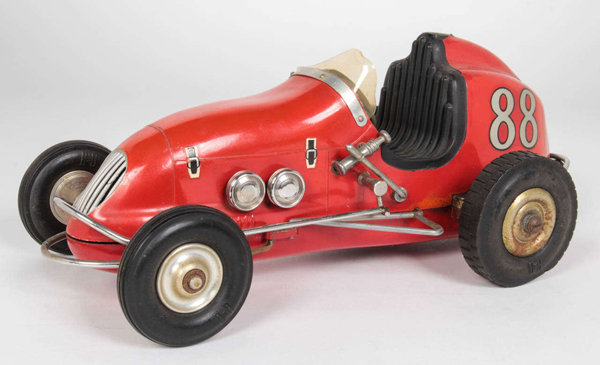
Ohlsson & Rice Rare Streamline American Art Deco Tether Race Car Model No. 88 with Trailer c. 1950
More Information
Ohlsson & Rice Rare Streamline American Art Deco Tether Race Car Model No. 88 with Trailer c. 1950
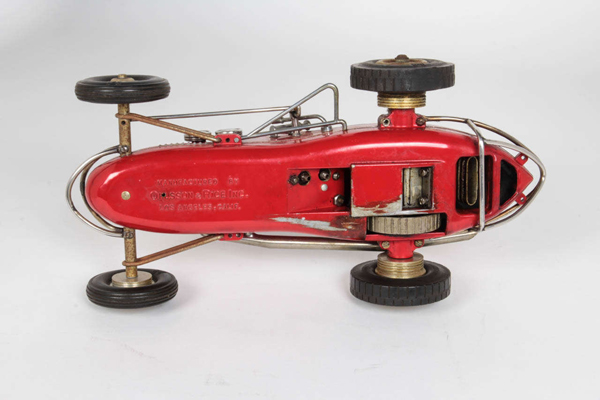
OHLSSON & RICE (founded 1941) Los Angeles, CA
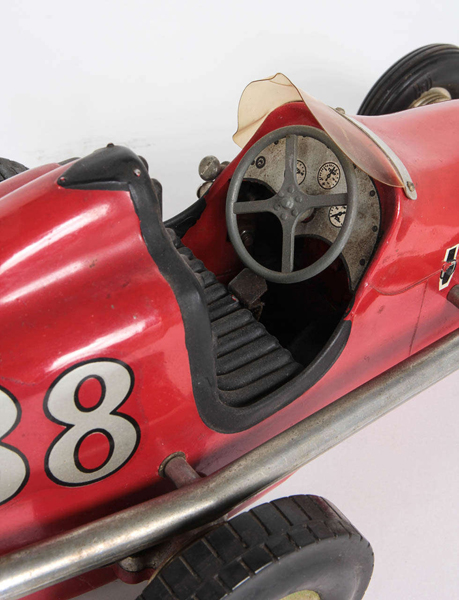
Tether Race Red car Model No. 88
Gas powered tether car racer 1950
Steel and various metals with the car and trailer details painted red, rubber tires and cork details
The license plate reads: California, 19-50, 61U421
H: 5″ x L” 13 1/2″ x D: 7 1/2″
Price: $3,000
In 1941 Irv Ohlsson teamed up with Harry Rice, and the firm of Ohlsson & Rice was founded producing model race cars and propellers. No other engines at the time combined the reliability, ease of maintenance, simplicity of operation and unlimited life of the Ohlsson & Rice engines. The Second World War put a temporary hold on their success, however, as all manufacturing facilities were turned over to military production. By the time the war shut down their production, they had produced about 75,000 engines.
As soon as the war was over, Ohlsson & Rice got back into production. Even with a shortage of needed materials and machines somewhat worn out by 3-shift a day wartime production use, they jumped back into a market that had a seemingly endless demand for their products. Modelers were hungry to get back into flying, and O & R took advantage of the market by buying the machinery needed to meet the huge demand.
Ohllson & Rice die cast tether cars were first manufactured in 1946. The early model cars had solid rear brake drums. open air front grill, 10 air vent slots in the seat, windshield, manual fuel pump, external hand brake lever, 4 nerf bars or radius rods, and plated front axle. The cars were fitted with a .23 or .29 Ohlsson and Rice engine. The easiest way to tell their plane engines from the car engines was the exhaust port. The cars have a straight cut exhaust and the planes had an angled cut port. However they are interchangeable except to be estetically correct. Basic colors included white, black, red , blue and yellow. The .29 engine were available in either spark ignition models or with a glow plug. In the early days Ohlsson and Rice had trouble with their engines and discovered a lot of the problems were due to inferior fuel sources. To rectify this they started to manufacture their own Nitro Glow fuel. This seemed to cure their engine problems. The later models in the fifties went to a closed front grill , 1 air vent slot in seat, hollow brake drums, no windshield and a smaller .049 engine. The last of the midget racers were made in 1959.
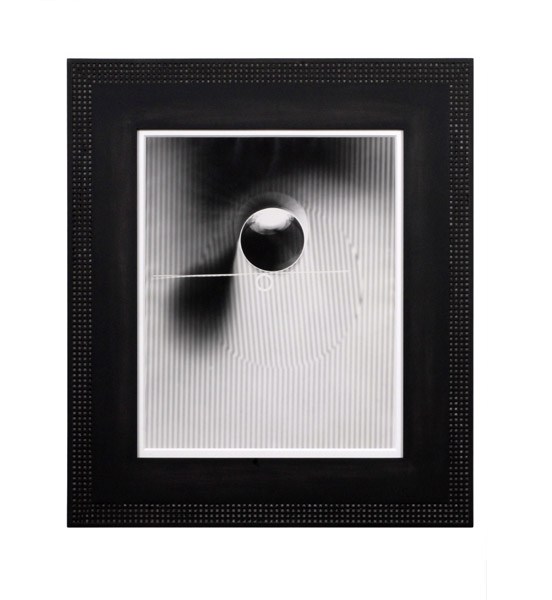
György Kepes, Abstraction, Gelatin silver print, 1942
GYÖRGY KEPES (1906-2001) Hungary/USA
Abstraction 1942
Silver gelatin print
Signed: 9 (in a circle, on back); Gyorgy Kepes 1942 (in ink on back)
György Kepes was a Hungarian-born painter, designer, educator and art theorist. After emigrating to the U.S. in 1937, he taught design at the New Bauhaus (later the School of Design, then Institute of Design, then Illinois Institute of Design or IIT) in Chicago. In 1947 He founded the Center for Advanced Visual Studies at the Massachusetts Institute of Technology (MIT) where he taught until his retirement in 1974.
Aram Gesar has been published internationally and has exhibited his photographic work in New York, San Francisco, Zurich and Geneva since 1977. As a producer, art director and photographer, Gesar created advertising campaigns for major corporations in the U.S. and Europe focusing on the fields of travel, banking, financial services, aerospace and motion pictures. He also created and produced documentaries on travel, aviation and yachting for national cable networks and the home video markets and television commercials and corporate programs for various U.S. and European corporations.
Gesar is currently one of the leading international experts on travel and air transport, and the founder and CEO of The Pyramid Media Group, which includes several magazines, newsletters, web sites, books, eBooks and other publications integrating a spectrum of business, travel and aviation content.
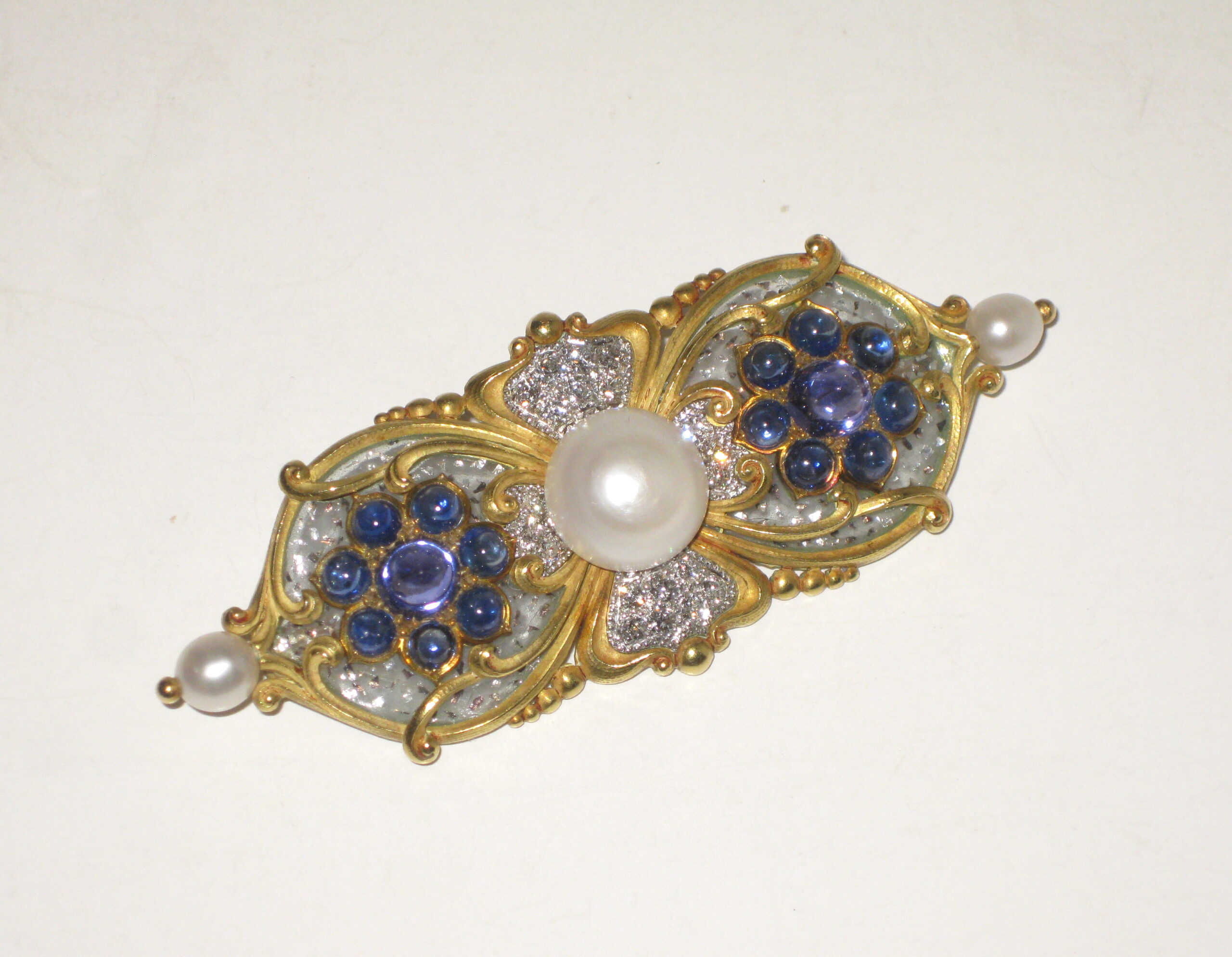
Marcus & Co. Art Nouveau brooch, “Tibula” shaped 18k yellow gold brooch set with three natural pearls, the natural center button pearl approx. 10 mm in diameter (G.I.A. certificate, 3 natural freshwater pearls, weight 24.90 grams, measurement range from 5.46 to 12.26mm), 16 sugarloaf cabochon sapphires, the two large and high dome middle sapphires with a purple hue, 20 pave set round diamonds all surrounded with clear plique-a-jour further trapped with platinum flakes, signed c. 1897









 @hd_jewels