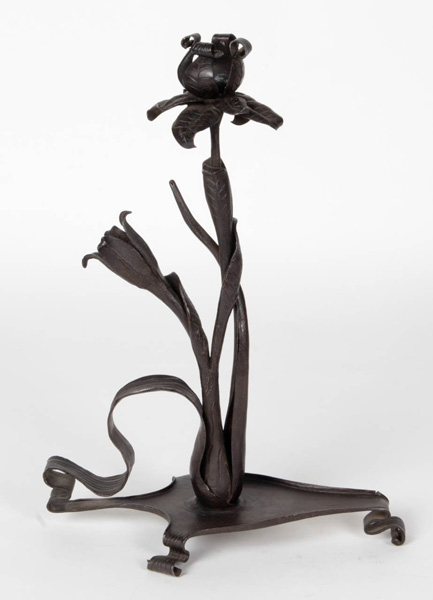
Otto Eckmann (attr.) Pair Of Hand Wrought Iron Floral Candlesticks c. 1900
More Information
Otto Eckmann (attr.) Pair Of Hand Wrought Iron Floral Candlesticks c. 1900
OTTO ECKMANN attr. (1865-1902) Germany
Pair of candlesticks c. 1900
Hand-wrought iron with floral and foliage design
H: 12 ¼” x W: 8 ¼”
Price: $7,475
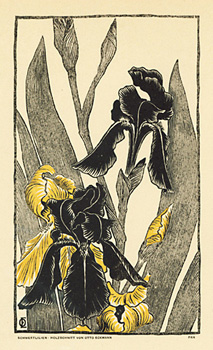
Otto Eckmann (19 November 1865 – 11 June 1902) was a German painter and graphic artist. He was a prominent member of the “floral” branch of Jugendstil. Otto Eckmann was born in Hamburg, Germany in 1865. He studied at the Kunstgewerbeschule in Hamburg and Nuernberg and at the academy in Munich. In 1894, Eckmann gave up painting (and auctioned off his works) in order to concentrate on applied design. He began producing graphic work for the magazines Pan in 1895 and Jugend in 1896. He also designed book covers for the publishers Cotta, Diederichs, Scherl and Seemann, as well as the logo for the publishing house S. Fischer Verlag. In 1897 he taught ornamental painting at the Unterrichtsanstalt des Königlichen Kunstgewerbemuseums in Berlin. In 1899, he designed the logo for the magazine Die Woche. From 1900 to 1902, Eckmann did graphic work for the Allgemeine Elektrizitätsgesellschaft (AEG). During this time, he designed the fonts Eckmann (in 1900) and Fette Eckmann (in 1902), probably the most common Jugendstil fonts still in use today.
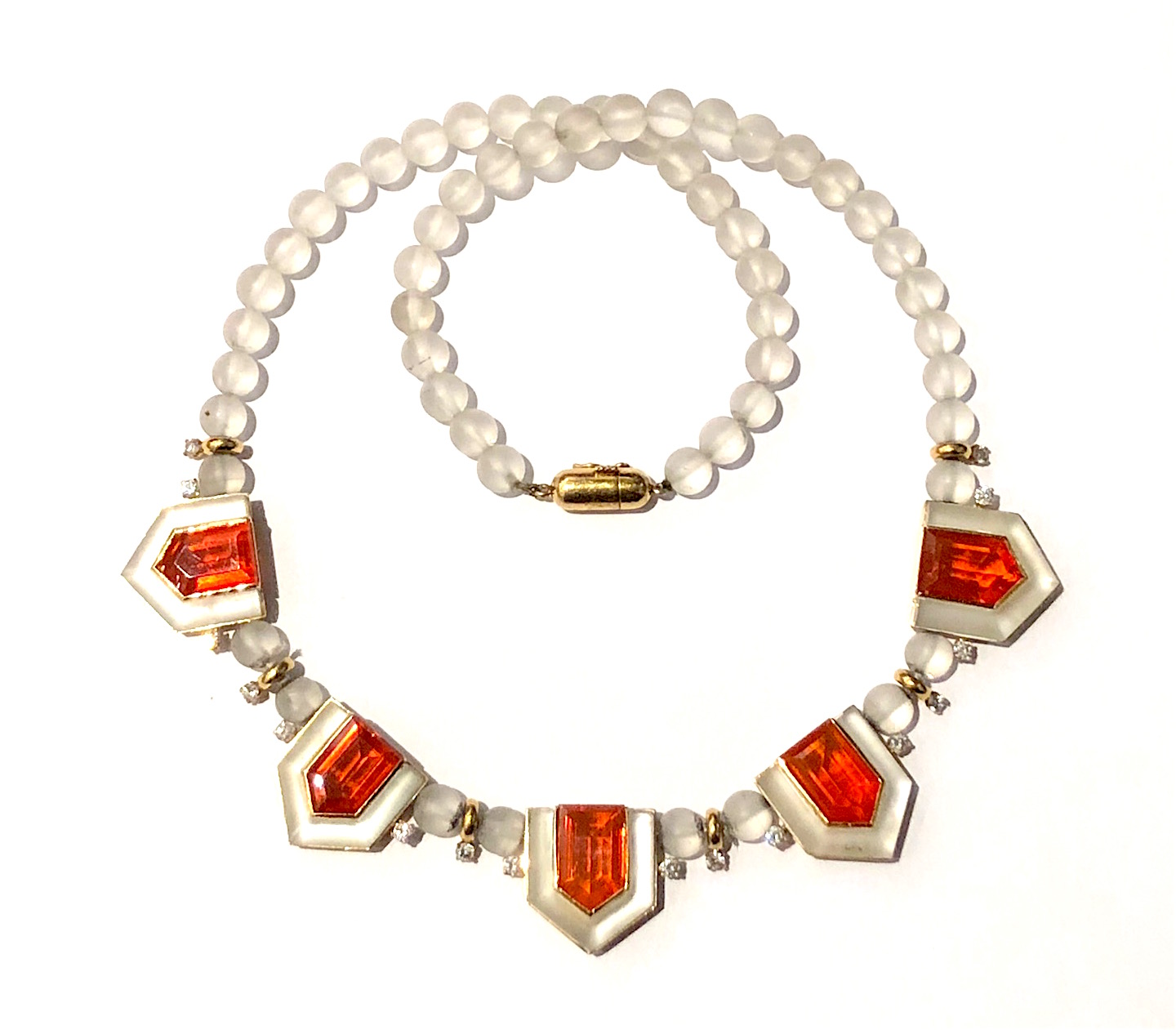
Art Deco “Fire Opal” necklace, frosted rock crystal round beads and four sided custom rock crystal bezels set in 18K yellow gold with 16 round–cut accent diamonds featuring five large natural fire opals (G.I.A certificate, dimension of each fire opal, 13.00 x 8.15 x 6.20mm for a TW of approx. 17.50 carats), c. 1940’s
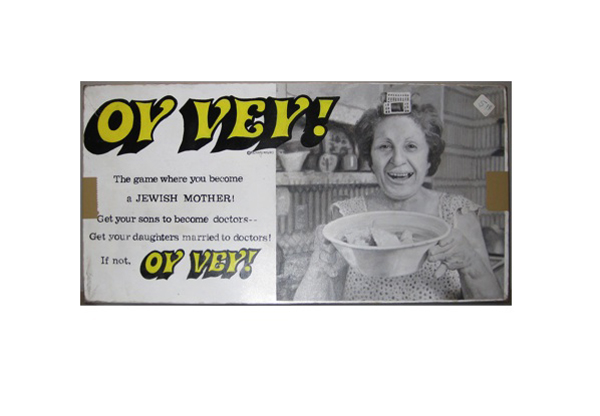
Tim Liddy Oy Vey (1979) The game where you become a JEWISH MOTHER! Get your sons to become doctors—Get your daughters married to doctors! If not, OY VEY! 2008 Oil and enamel on copper, plywood back
TIM LIDDY
“Oy Vey” (1979) The game where you become a JEWISH MOTHER! Get your sons to become doctors—Get your daughters married to doctors! If not, OY VEY! 2008
Oil and enamel on copper, plywood back
Signed in script: Tim Liddy, red circular ring, “circa 1979”, 2008
Provenance: William Shearburn Gallery, St. Louis, MO
H: 10 ¼” x W: 20 ½” x D: 1 ¾”
With his recent paintings, Liddy has both reasserted the construct of hyperrealist painting and developed a thoroughly unique advancement of that mode by extending the cultural reality of the indexed original. Based on the illustrated box lids of vintage board games, Liddy has recontextualized a subject, which evokes the underlying rules of life. Painted on copper or steel in the precise dimensions of the original, the metal is then manipulated to demonstrate the exact rips and tears from years of usage and includes trompe-l’oeil renditions of the scotch tape that might be holding the cardboard box together, the assorted stains, or the various graffiti of time. Liddy leaves no possibility of ambivalence, these works speak to a concurrent understanding of their original object identity and to themselves as works of art engaged in historical and psychological dialogue.
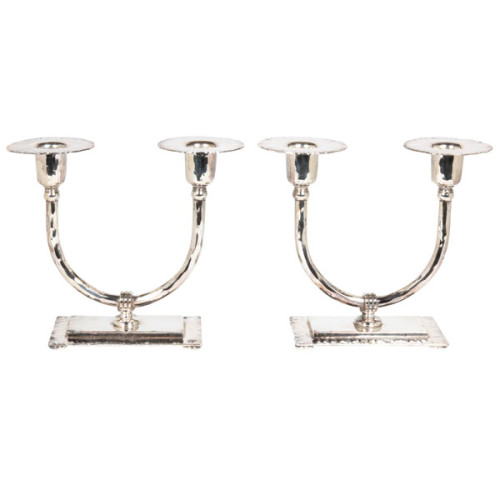
Roycroft / American Arts & Crafts Pair of Candlesticks c. 1915
ROYCROFT COPPER SHOP East Aurora, N.Y.
Pair of candlesticks c. 1915.
Hand wrought and textured copper, silver-plated.
Marks: impressed R, in orb with cross, ROYCROFT
For more information see: The American Arts & Crafts Movement in Western New York 1900-1928, Bruce A. Austin (Rochester Institute of Technology, 1992); Arts & Crafts Movement in New York State 1890’s – 1920’s, Coy Ludwig (Hamilton, N.Y.: Gallery Association of New York, 1983).





 @hd_jewels