Product Description
Paul Flato (attr.) “Dolores del Rio” cuff bracelet, 3 large rectangular citrines (approx. 200+ carats) and pave diamonds (approx. 9 carats TW) set in 18K yellow gold and platinum, (G.I.A. certificate) c. 1940

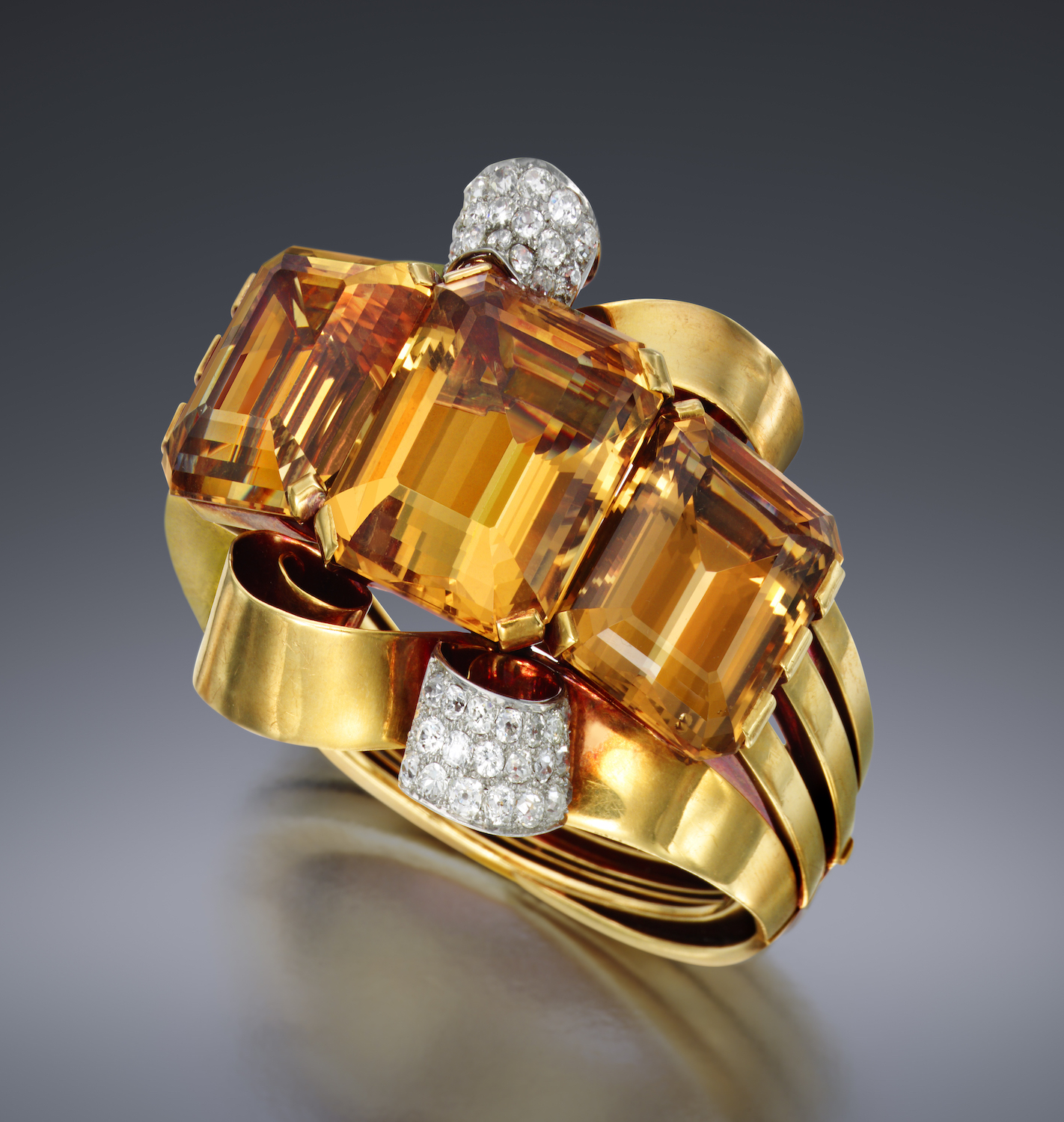
Provenance: Dolores del Rio
Illustrated: “The Impossible Collection of Jewelry” by Vivienne Becker(Assouline, 2015)
Paul Flato (attr.) “Dolores del Rio” cuff bracelet, 3 large rectangular citrines (approx. 200+ carats) and pave diamonds (approx. 9 carats TW) set in 18K yellow gold and platinum, (G.I.A. certificate) c. 1940

***This is a closely related “Grape” cluster clip/brooch model that Seaman Schepps made on commission for the eminent socialite Doris Duke (Collection Seaman Schepps, but there is a predominance of dark blue and purple cabochon sapphires in the DD brooch as opposed to the predominance of larger and more translucent cabochon sapphires as well as cabochon emeralds in this example
LAWRENCE HUNTER, San Diego, California
Punch Bowl set c.1965
Hand hammered and hand wrought large asymmetric punch bowl with matching ladle, turned walnut pedestal platter and twenty four hand wrought brass and walnut pedestal shape goblets
Marks: HUNTER spelled out within a large outline of an H (name logo and monogram mark on all pieces)
Punchbowl H: 13 ½” x Dia: 16”
Cups: H: 5” x Dia: 3 ½”
Serving tray: H: 2 ¾” x Dia: 17 ¾”
Price: $11,500
By repute, this elaborate punch set was a custom commissioned work for a West Coast collector and likewise was purchased directly from Larry Hunter in the mid-1960’s for $2,500.
Lawrence “Larry” Hunter grew up in San Diego and received a BA from San Diego State College in the late 1950s. As an undergraduate, Hunter studied with John Dirks, who founded the furniture design program at San Diego State College, and Ilse Ruocco. While completing an MA at University of California, Los Angeles, Hunter worked in clay and was a teaching assistant for Laura Andreson. Hunter was hired to teach general crafts and design classes at San Diego State in 1962, and later inherited the furniture design program from Dirks.
Hunter was a member of the Allied Craftsmen of San Diego and exhibited furniture regularly in the California Design series at the Pasadena Art Museum and the California Crafts series at the Crocker Art Gallery in Sacramento. Hunter led the San Diego State furniture design program until the late 1980s, helping the furniture program to become a vital part of the community. Featured artists will include Toza and Ruth Radakovich, Rhoda Lopez, Jack Hopkins, Arline Fisch, Ellamarie and Jackson Woolley, Larry Hunter, Kay Whitcomb, Ilse Ruocco, and James Hubbell. It was at this same time that Constantine’s, a New York fine wood merchant, offered plans for clocks with wooden works; that John Gaughan made a skeletal grandfather’s clock with wooden works; and that Larry Hunter, who taught at San Diego State, used the clock form to explore kinetic sculpture within a functional format. Hunter eschewed the older traditional adornment of the case and focused upon visible works so that people could watch time actually move.
A goldsmith and jeweler, Louis Wiese (Berlin 1818 – Paris 1890) began his career in Berlin where he served his apprenticeship before moving to Paris to work for J.V. Morel and then more significantly with F.D. Froment-Meurice, with whom he established a close bond. Weise opened his first atelier rue Jean-Pain-Molet in 1844 and worked exclusively for Froment-Meurice, as ever a supporter of Wiese’s work, he pushed for Wiese to receive the collaborator’s medal at the Exposition of 1849. Jules Wiese eventually worked for many of the top manufacturing jewelers and went on to win a first-class medal at the 1855 Exposition and a medal of honor at the 1862 Exhibition in London. M. Magne was quoted as follows when discussing Jules Wiese in light of the 1855 Exposition, “fine goldsmith and jeweler with an already distinguished reputation which can only be enhanced by his display. The importance of his pieces and his brave experiments reveal, even in the most modest work, an awareness of art and beauty which deserves to be encouraged by the jury.” Louis, Jules’ son, took over the company in 1880, continuing the reputation for fine craftsmanship and artistry that his father had established.