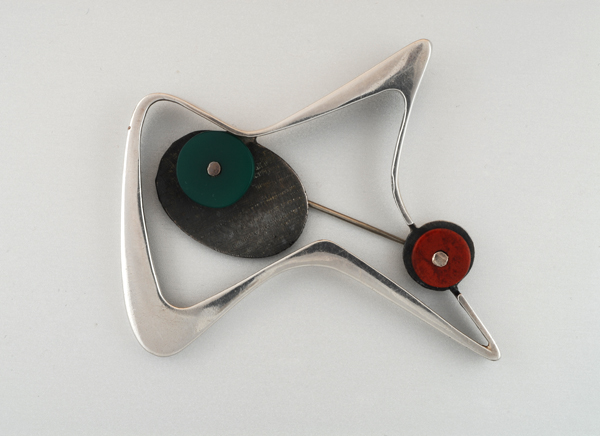
Margaret de Patta “Abstract” brooch, silver, chrysoprase and carnelian, signed, c. 1945, Illustrated: Design 1935 – 1965, What Modern Was: Selections from the Liliane and David M. Stewart collection, 1991
MARGARET DE PATTA (1903-1964) USA
Abstract brooch c. 1945
Sterling with both a smooth finish and a textured surface in a biomorphic design set with rondels of chrysoprase and carnelian
Marks: De Patta chevron insignia, STERLING
Illustrated: Design 1935 – 1965, What Modern Was: selections from the Liliane and David M. Stewart collection ed. Martin Eidelberg, (Montreal/New York: Le Musée des Arts Décoratifs de Montréal/Harry N. Abrams, 1991), p. 100, illus. 130.
Related designs illustrated: The Jewelry of Margaret de Patta: A Retrospective Exhibition, Oakes Gallery and The Oakland Museum (Oakland, Calif.: 1979); Messengers of Modernism: American Studio Jewelry 1940-1960, ed. Martin Eidelberg, (Montreal: The Lake St. Louis Historical Society, 1996).
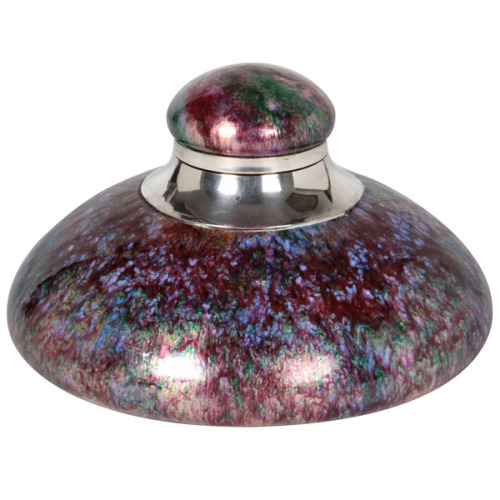
Paul Haustein Germany Rare Jugendstil enamel and silver inkwell c.1900
PAUL HAUSTEIN (1880-1944) Germany
HERMANN BEHRND (b. 1849) SILBERWARENFABRIK (silver) Dresden, Germany
JAKAB RAPOPORT (enamelist) Budapest, Hungary
Inkwell c. 1900
Multicolored burgundy, purple, blue and green enamel with silver mounts, glass insert
Marks: Moon, crown, 800, HB (Hermann Behrnd mark)
Same model with variant mount illustrated: Deutsche Goldschmiede-Zeitung, n.d. (circa 1903-05), p. 23
For related works and more information see: Art Nouveau in Munich: Masters of Jugendstil, ed. Kathryn Bloom Hiesinger (Philadelphia: Philadelphia Museum of Art, 1988) pp. 67-69; Jugendstil in Dresden, Aufbruch in die Moderne, Gisela Haase et al., exh. cat. (Dresden: Staatliche Kunstsammlungen Dresden; Wolfratshausen: Edition Minerva, 1999).



 @hd_jewels