Product Description
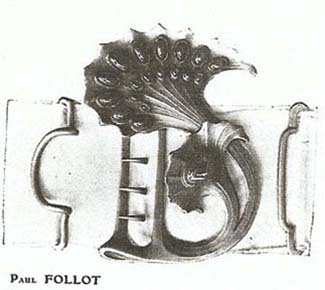
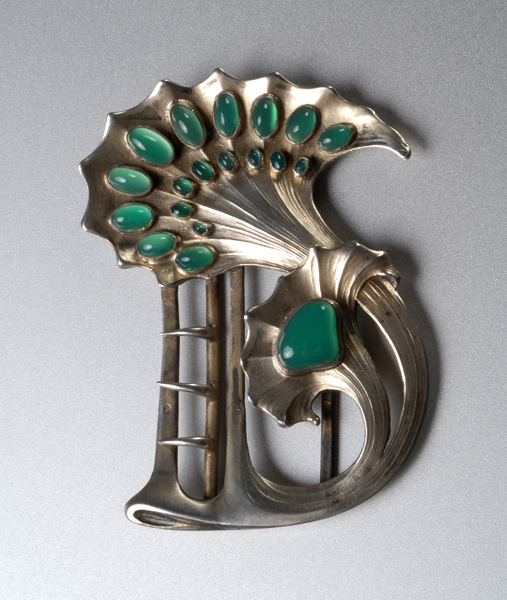
Paul Follot for La Maison Moderne, Art Nouveau waist clasp, silver and chrysoprase, signed c. 1900

PAUL FOLLOT Paris, France
LA MAISON MODERNE Paris, France
Art Nouveau waist clasp c.1900
Gilt silver with chased whiplash design set with 19 cabochons of chrysoprase.
Marks: P. FOLLOT, French swan mark (silver standard mark for small objects)
Illustrated: Documents sur l’Art Industriel au XXe Siecle (Paris: Edition de la Moderne) p. 20, plate 5, n. 53-11
PAUL FOLLOT (1877-1941) French
In the Late 1890’s, Follot studied under graphic designer Eugène Grasset at the Ecole Normale d’Enseignement du Dessin in Paris and later succeeded Grasset in that post. From 1901 to 1904, he designed metalwork, jewelry and textiles for La Maison Moderne, art critic Julius Meier-Graefe’s gallery in Paris. He became director of the interior design studio Pomone of the Paris department store Le Bon Marché in 1923, introducing the Art Deco style into many middle-class home.
Paul Follot for La Maison Moderne, Art Nouveau waist clasp, silver and chrysoprase, signed c. 1900

You must be logged in to post a comment.
SOPHIE BURGER-HARTMANN (1868-1940) Munich, Germany
Vide Poche c. 1900
Richly patinated dark brown bronze Vide Poche modeled as a swirling Art Nouveau nymph holding a stylized shell form low tray.
Marks: VW (Vereinigte Werkstätten für Kunst im Handwerk Munich)
H: 6 1/2″ D: 7″ x W: 8″
MITZI OTTEN-FRIEDMANN (1884-1955) Austria
WIENER WERKSTÄTTE (1903-1932)
Brooch c. 1915
Reverse-painted glass depicting a couple set in a silver frame / back
Marks: M. OTTEN-FRIEDMANN on the front (right), the reverse stamped: WW, Vienna assay mark for 900 silver
D: 2 3/8”
Rosalia Marie Friedmann-Otten (“Mitzi”) * November 28, 1884 Vienna, † May 5, 1955 New York, NY
Student at the School of Applied Arts in Vienna (with Oskar Strnad), Friedmann-Otten participated in numerous exhibitions (including art shows in 1908, 1920; Neukunstgruppe 1909; German Women’s Art in 1925; Werkbundausstellung 1930). Member of the Austrian Werkbund, the Wiener Werkstätte and the Neukunstgruppe. One of the most versatile artists (commercial art, metalwork, jewelry, fashion, starting from 1920 mainly enamel works, including large-scale email pictures), Friedmann-Otten had to flee in 1938 to the United States.
MARGARET DE PATTA (1903-1964) USA
Abstract brooch c. 1945
Sterling with both a smooth finish and a textured surface in a biomorphic design set with rondels of chrysoprase and carnelian
Marks: De Patta chevron insignia, STERLING
Illustrated: Design 1935 – 1965, What Modern Was: selections from the Liliane and David M. Stewart collection ed. Martin Eidelberg, (Montreal/New York: Le Musée des Arts Décoratifs de Montréal/Harry N. Abrams, 1991), p. 100, illus. 130.
Related designs illustrated: The Jewelry of Margaret de Patta: A Retrospective Exhibition, Oakes Gallery and The Oakland Museum (Oakland, Calif.: 1979); Messengers of Modernism: American Studio Jewelry 1940-1960, ed. Martin Eidelberg, (Montreal: The Lake St. Louis Historical Society, 1996).
L: 3 1/4”
Reviews
There are no reviews yet, would you like to submit yours?