Sèvres / Genevieve Rault Rare French Art Nouveau grand vase 1907
More Information
Sèvres / Genevieve Rault Rare French Art Nouveau grand vase 1907
MLLE GENEVIÈVE RAULT (décor 1907) France
MANUFACTURE NATIONALE DE SÈVRES France
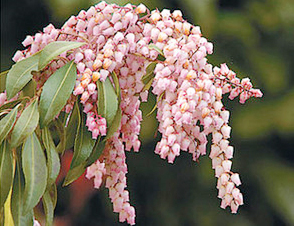
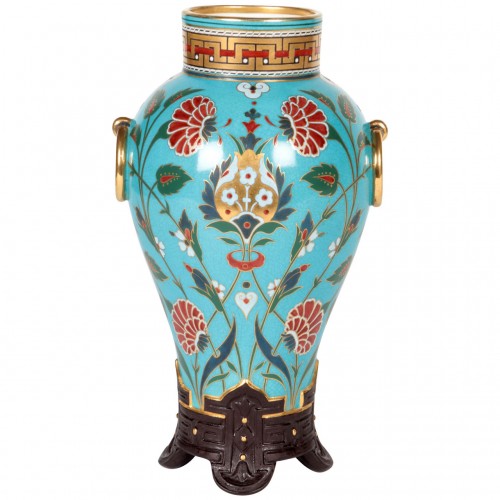
Andromeda branches grand vase 1907
Glazed porcelain with pâte-sur-pâte applications. The multicolored “Andromeda” foliage and branches in shades of pink, salmon, green and taupe on a cream background.
Marks: underglaze green S and 1907 (in triangular cipher), MANUFACTURE RF NATIONALE surrounding DÉCORÉ A SÈVRES 1907, underglaze blue GR (conjoined monogram).
H: 16″ x Dia: 7 1/2″
This example from the Sèvres Manufacture is a tour-de-force of early 20th century porcelain. The graphic Art Nouveau design of the pastel foliage and white blossoms of the Andromeda vase is brought to life thanks to the fine detailing of every individual blossom made with hand-applied pâte-sur-pâte or paste porcelain.
Christopher Dresser / Linthorpe Art Pottery Rare Aesthetic Movement “Gourd” Vase 1879-1882
CHRISTOPHER DRESSER (1834-1904) UK
LINTHORPE ART POTTERY, Middlesbrough
HENRY TOOTH Artistic Manager Linthorpe (1842-1918) UK
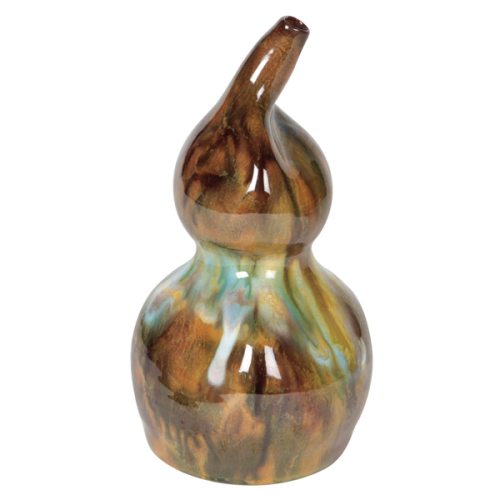
“Gourd Vase” 1879-1882
Glazed Earthenware
***Extremely rare Dresser / Linthorpe model.
Marked: LINTHORPE, Chr. Dresser (facsimile signature) HT, no. 326
Illustrated: Christopher Dresser: Truth, Beauty, Power exh. cat. (New York: Historical Design, 1998) p.75; illustrated in two drawings for gourd vases in Dresser’s 1881 design and account book under heading “Aug. 29, 1881. Sent to J. Harrison Esq. 41 Designs for Linthorpe.”
H: 7 3/4″
The contrasts in Dresser’s designs for different materials showed how his approach to design was also shaped by the properties and nature of a material. In 1879 Dresser was appointed art director at the newly established Linthorpe pottery, near Middlesbrough. Founded by John Harrison, a local businessman, the pottery’s aim was to use local clay to provide jobs for local men. Dresser’s design for the moulds for the pottery were inspired by a wide range of cultures from Japan, Peru, Mexico, Morocco and Ancient British forms. These very striking pieces, with the metal oxides in the complex and innovative glazes providing the only decoration. All of his designs were impressed with a facsimile signature. When Linthorpe closed in 1889, its moulds were acquired by a rival, Ault Pottery in Derbyshire. In 1893, Dresser signed a contract with Ault for new designs specifying that each pot should be marked with his facsimile signature.
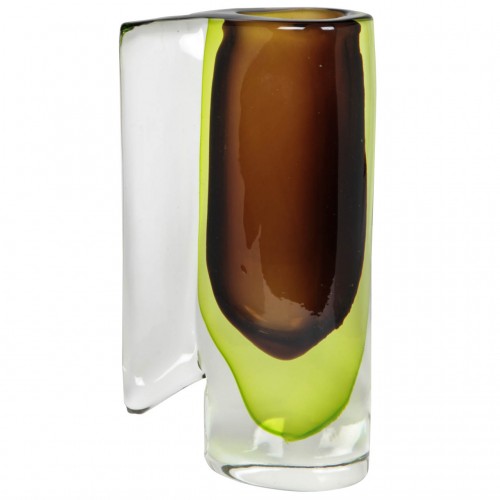
Flavio Poli / Seguso Vetri d’Arte Brown Murano Art glass vase c. 1950’s
FLAVIO POLI (1900-1984) Italy
SEGUSO VETRI D’ARTE Italy
Vase c. 1950’s
Asymmetric vase in a dark brown Murano glass cased inside with a layer of pale green and clear glass
H: 10 1/2″ x W: 5 1/2″ x D: 2 3/4″
Price: $4,000
Designer, businessman, ceramic artist. Born in Chioggia, he attended the Istituto d’Arte di Venezia and began work as a designer in ceramics. in 1929 he switched to glass and for Libero Vitali’s I.V.A.M. he designed animals, splendid Novecento-style nude figures in massiccio glass, as well as bowls and urns with figures resting on the inside, on lids or as handles. He subsequently collaborated with the Compagnia di Venezia e Murano, with the furnace of Mario and Lino Nason and with the engraver Gino Francesconi. in 1934 he accepted the artistic direction of Barovier, Seguso & Ferro, later to become Seguso Vetri d’Arte, and became partner three years later. Together with the master of the principal team Archimede Seguso, Poli was the author of grandiose lighting installations, of corroded vessels, of sculptures in bulicante glass, of animals in massiccio glass shaped while hot, productions which represented a milestone in the development of Murano glass. At the height of his artistic maturity, in the years between 1950 and 1960 he designed a series of sommerso glass pieces in a Nordic style, essential forms and sharp cold colors, which were awarded prestigious prizes (Compasso d’Oro). After leaving Seguso in 1963, between 1964 and 1966 he organized the artistic glass division at the Societˆ Veneziana di Conterie e Cristallerie.




 @hd_jewels