Product Description
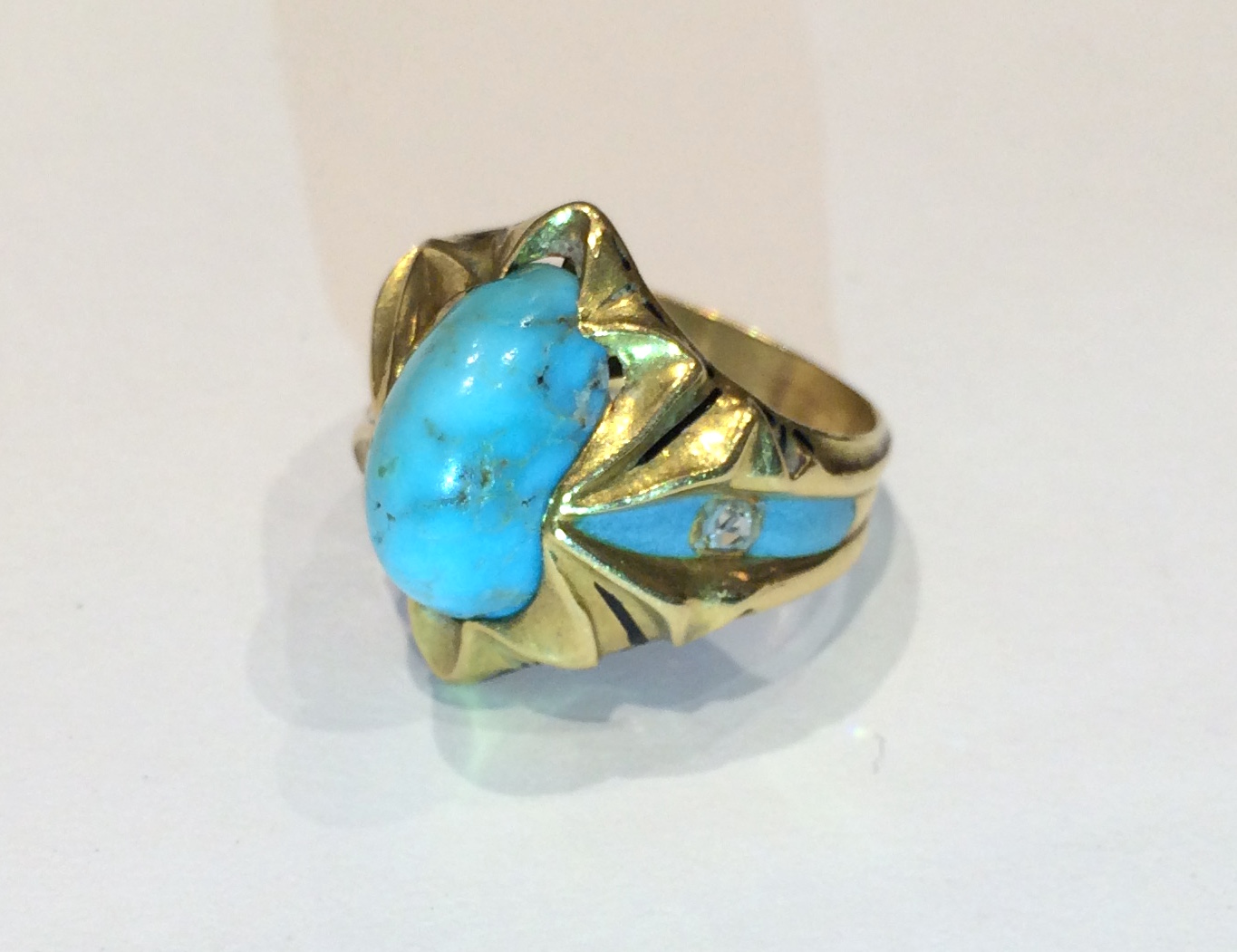
Paul Follot (attr.) 18k gold and turquoise Art Nouveau ring set with two rose cut diamonds, marked, c.1900 SOLD

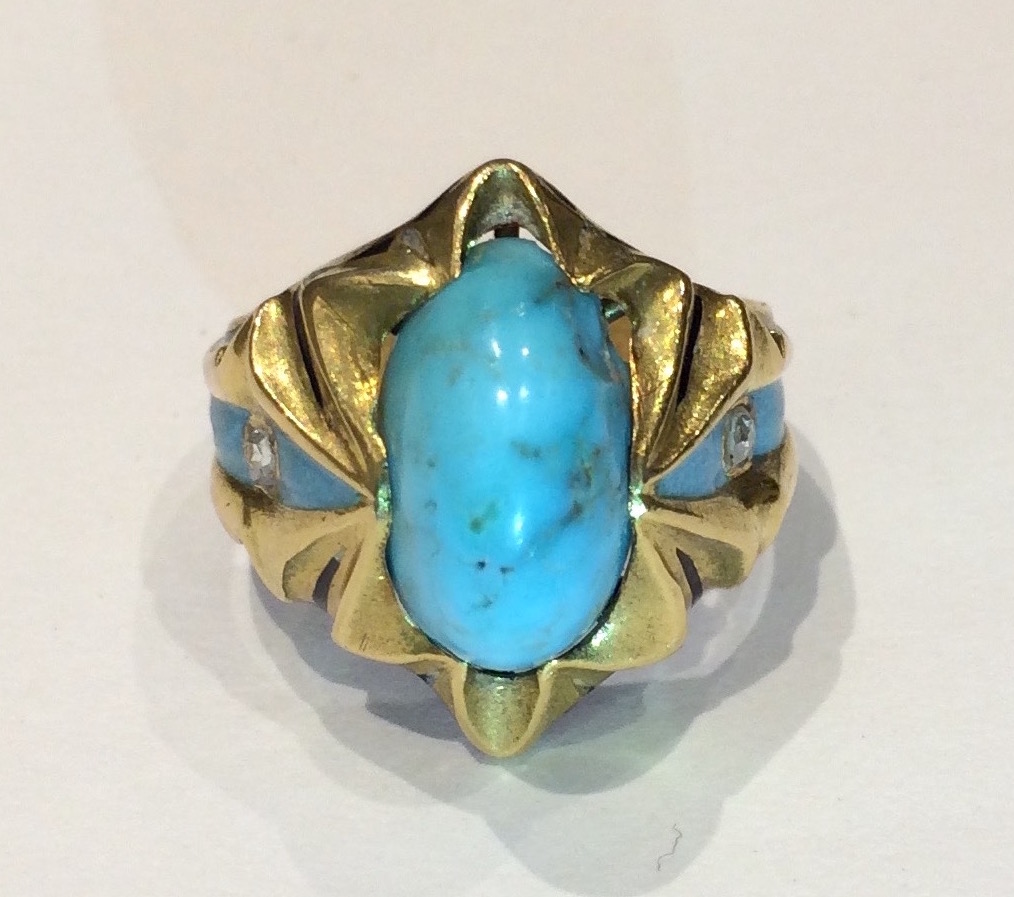
Paul Follot (attr.) 18k gold and turquoise Art Nouveau ring set with two rose cut diamonds, marked, c.1900 SOLD
PAUL FOLLOT Paris, France
LA MAISON MODERNE Paris, France
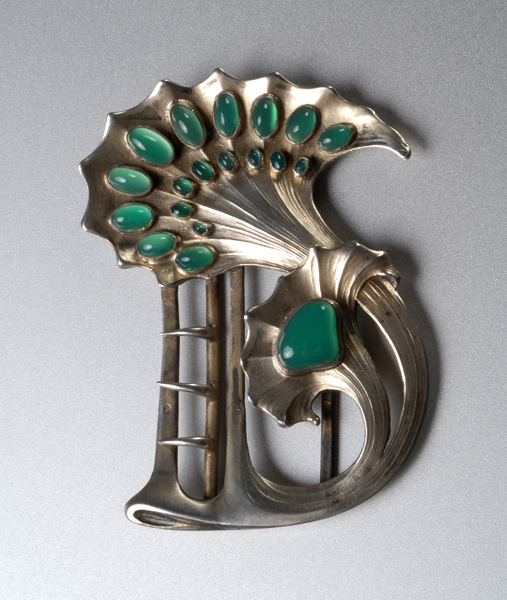
Art Nouveau waist clasp c.1900
Gilt silver with chased whiplash design set with 19 cabochons of chrysoprase.
Marks: P. FOLLOT, French swan mark (silver standard mark for small objects)
Illustrated: Documents sur l’Art Industriel au XXe Siecle (Paris: Edition de la Moderne) p. 20, plate 5, n. 53-11
PAUL FOLLOT (1877-1941) French
In the Late 1890’s, Follot studied under graphic designer Eugène Grasset at the Ecole Normale d’Enseignement du Dessin in Paris and later succeeded Grasset in that post. From 1901 to 1904, he designed metalwork, jewelry and textiles for La Maison Moderne, art critic Julius Meier-Graefe’s gallery in Paris. He became director of the interior design studio Pomone of the Paris department store Le Bon Marché in 1923, introducing the Art Deco style into many middle-class home.
AMÉDÉE DE CARANZA (active 1875-1914) (b. Turkey / active France)
COPILLET ET CIE Noyon
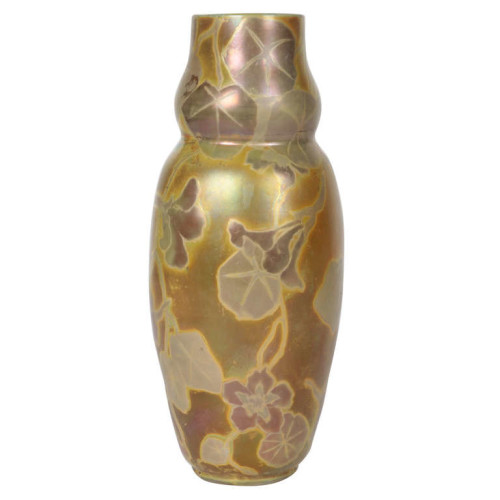
Nasturtium vase 1903-1906
Blown glass with floral & foliate luster decoration handpainted on a muted iridescent ground.
Signed: A. de CARANZA (on the side near base)
Marks: Copillet et Cie, Noyon, 842 (twice)
For more information and related illustrations: European Art Glass (New York: Ray & Lee Grover, Charles E. Tuttle Publishers, Inc., 1970) pp. 69, 94-96; L’Art Du Verre En France 1860-1914, Janine Bloch-Dermant (Edita Denoel, 1974) pp. 36-37; Glass: Art Nouveau to Art Deco, Victor Arwas (New York: Abrams, 1987) pp. 56-58; L’Europe de L’Art Verrier, des Precurseurs de l’Art Nouveau a l’Art Actuel 1850-1990, Giuseppe Cappa (Liège: Mardaga, 1991) pp. 72-74.
H: 10″
Copillet, H.A. Thomas Henri Alfred Copillet was originally a printer, and produced a local newspaper in Paris. When he moved his works to 13 Fauburg de Paris he acquired a kiln in the process, and thus in 1903 was began a new glass works. His designers were Amedee de Caranza and Edouard de Neuville. They produced a whole range of Art Nouveau glassware, many with a dark iridescent finish. They also produced opaline glass, and glass panels for use in church windows. The company went bankrupt in 1906, although the new management (Lefevre and Lhomme) kept a little of the production going for a while, the factory was destroyed during the First World War.
OLIVIER DE SORRA
SOCIETE FAIENCIERE HERALDIQUE DE PIERREFONDS
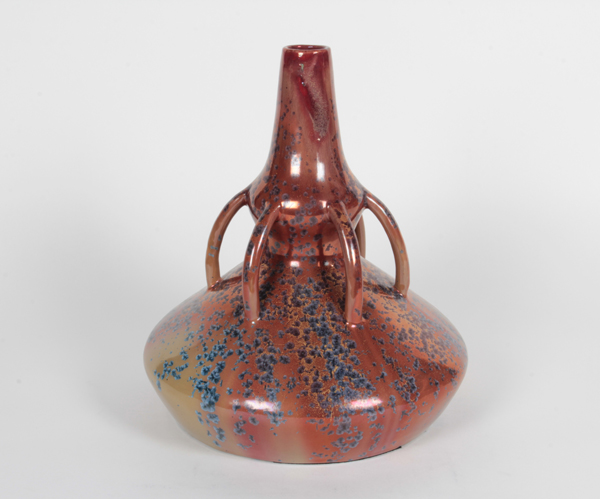
Six-branch vase c. 1900
Copper color glaze with blue oxide flower crystallization
H: 11″ x Dia: 9″
Price: $7,250
The Societe Faienciere Heraldique de Pierrefonds pottery studio was founded in the village of Pierrefonds in 1903 by Count Hallez d’Arros and is renowned for it’s crystalline and flambe glazes
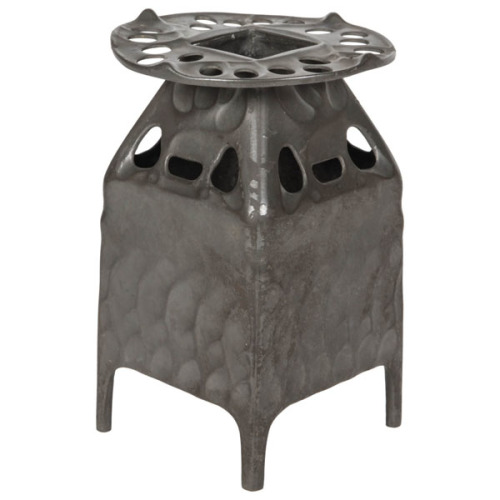
KARL BERGHOF Germany
J. P. KAYSER SOHN Krefeld, Germany
Vase 1904
Pewter squared vase with round flange top, open work details
Marks: Kayserzinn 4541 7 (in a raised oval)
Illustrated: Zinn des Jugendstils, Eckard Wagner (Cologne: Rheinland-Verlag, 1978), p. 63, cat. no. 148; J. P. Kayser Sohn Krefeld: Fabrik kunstgewerblicher Metallgegenstände, Musterbuch 1907 (Munich: Verlag Dry, 1982) p. 46.
***This is an extremely rare, other worldly Kayserzinn form.
H: 7” x Top W: 4 ¾” x Base: 4 x 4 square