Product Description
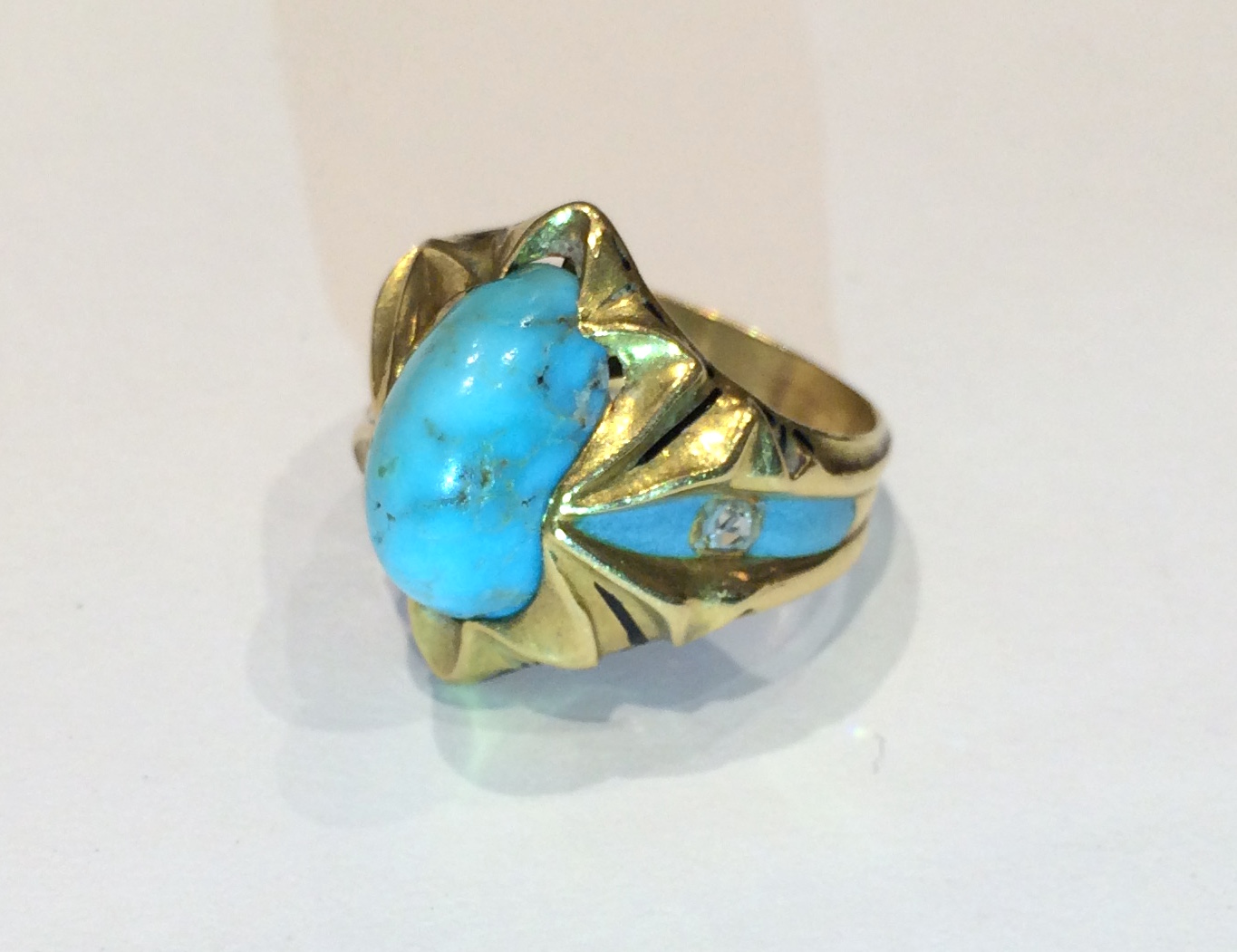
Paul Follot (attr.) 18k gold and turquoise Art Nouveau ring set with two rose cut diamonds, marked, c.1900 SOLD

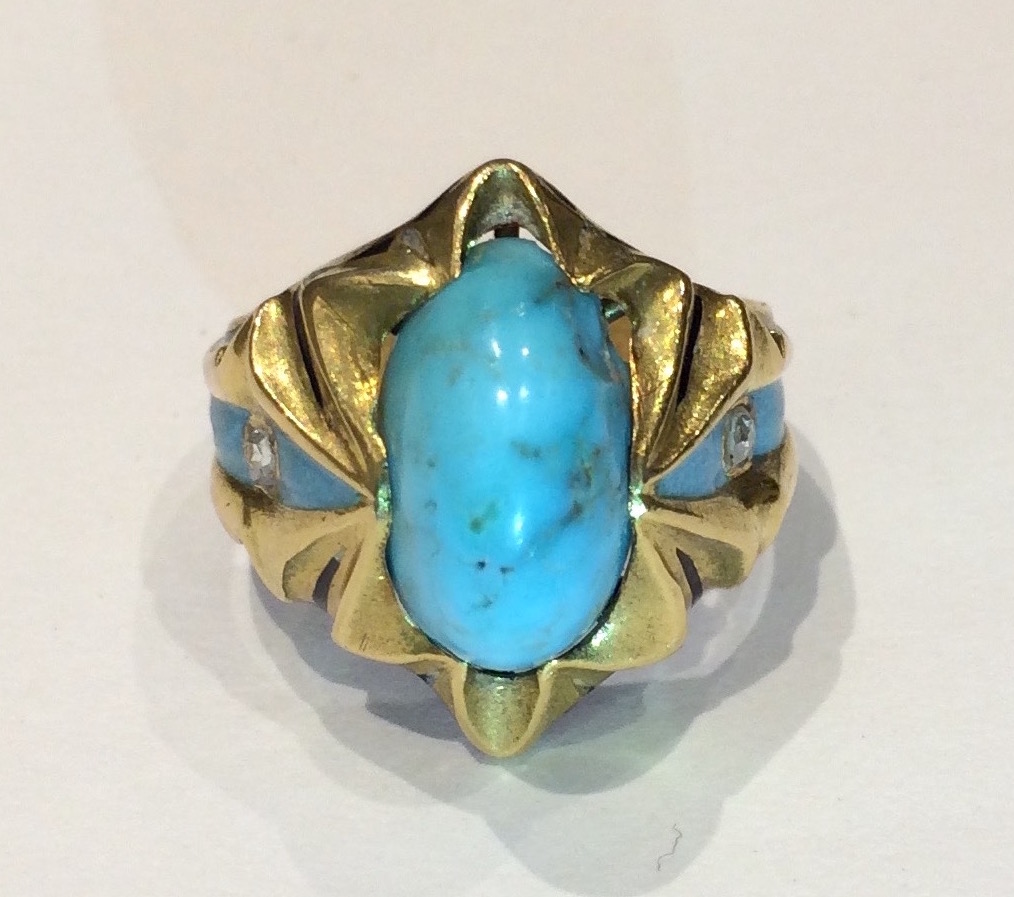
Paul Follot (attr.) 18k gold and turquoise Art Nouveau ring set with two rose cut diamonds, marked, c.1900 SOLD
HENRY VAN DE VELDE (1863-1957) Belgium (design mount)
for “LA MAISON MODERNE” Paris, France
ALPHONSE-EDOUARD DEBAIN France (execution mount)
EUGÈNE BAUDIN (1853-1918) France (pottery)
Vase c. 1900
Matte-glazed pottery, cranberry bright turquoise and white highlights, elaborate Art Nouveau whiplash silver mount.
Marks: E Baudin, AD (silversmith monogram), French 950 silver assay mark
For more information on van de Velde ceramics see: Ceramics of the 20th Century, Tamara Préaud and Serge Gauthier (New York: Rizzoli, 1982) illus. no. 67, p.42; Art Nouveau and Art Deco Silver, Annelies Krekel-Aalberse (New York: Harry N. Abrams, Inc.,1989), pp. 63, 90, 264.
For other A-E. Debain designs see: The Paris Salons 1895-1914, Vol. V: Objets d’Art & Metalware, Alastair Duncan (Woodbridge, Suffolk: Antique Collectors’ Club, 1999), p. 208.
For related Van de Velde mount designs see: Jugendstil, Irmela Franzke (Munich: Battenberg Verlag, 1987), illus. 169, p. 87.
H: 8 1/4” x W: 4”
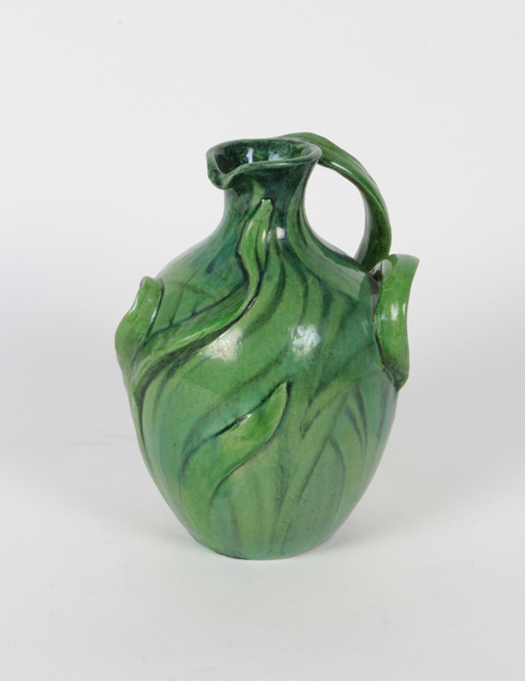
EDMOND LACHENAL (1855-1930) Paris, France
Green glazed pitcher / vase form c. 1900
Marks: E LACHENAL (impressed and glazed in a rectangle on base)
For information on Edmond Lachenal see:”Edmond Lachenal”, Fritz Minkus, Kunst und Kunsthandwerk, IV (1901) pp.390-98; La Céramique Art Nouveau, Edgar Pelichet and Michèle Duperrex (Lausanne: Les Éditions du Grand-Pont, Switzerland, 1976) pp. 66,71,74,78,83,112,115; “l’Atelier Lachenal à la galerie Georges Petit “ in Les Echoes d’Art” (1933), p. Vll; Art Nouveau: Belgium & France, exh. cat. Yvonne Brunhammer et al. (Houston, TX: Institute for the the Arts, Rice University, 1976), p. 48; Le Japonisme (Paris: Éditions de la Réunion des Musées Nationaux, 1988) cat no. 377, p. 321; Japonisme: the Japanese influence on western art in the 19th and 20th Centuries, Siegfried Wichmann (Parklane: New York, 1980) pp. 339, 349; cat. no. 920.
H: 9″ x W: 6 3/4″
AMPHORA ART POTTERY Turn-Teplitz, Austria
Organic vase c. 1900
Glazed earthenware
Marks: AMPHORA (in oval), AUSTRIA (in an oval), 8026, 41
For more information see: Deutsche Kunst und Dekoration, ( March 1901) pp. 346-349; Sammlung Bröhan: Kunsthandwerk, Glas, Holz, Keramik,Vol. 1 Band II (Berlin: Bröhan Museum, 1976), pp. 284-293.
H: 6 3/4″ x W: 5″ x D: 3 1/4″
Price: $2,350
HECTOR GUIMARD (1867-1942) France
MAISON COILLIOT Lille, France
Tile c. 1898
Fired and glazed lava with abstract whiplash motifs in various tones of aqua blue on the obverse and a partial graphic on the reverse with polychrome floral and linear details.
Marks: 16 (on top of tile)
French architect Hector Guimard (1867-1942) realized the decorative possibilities of glazed lava, a substance made from mixing pulverized lava with clay when he built a villa for Louis Coillot, (1898-1900) a ceramics manufacturer in Lille who monopolized the distribution of the material. Guimard sided the entire facade of Maison Coilliot in lava stone.
***A related glazed lava tile from the Castel Henriette is in the Collection of the Musee d’Orsay.
The Maison Coilliot is an Art Nouveau house located on 14, rue de Fleurus in Lille, France. Louis Coilliot, a French ceramic entrepreneur, was fond of enameled lava and wanted to popularize the technique. To do so, Coilliot commissioned Hector Guimard, an architect he’d met at the 1897 fair La Céramique et tous les arts du feu, (“Ceramic Arts & Glass Making”), to apply the technique to his house’s façade. Coilliot’s factory and warehouse were located to the rear of his house, and therefore the façade held a double
purpose, both decorating the front of his home and advertising his business.
For more information see: Hector Guimard, 1867-1942: Architektur in Paris um 1900 (Munich: Museum Villa Stuck, 1975)
H: 25 1/2″ x W: 14″ x D: 9/16″