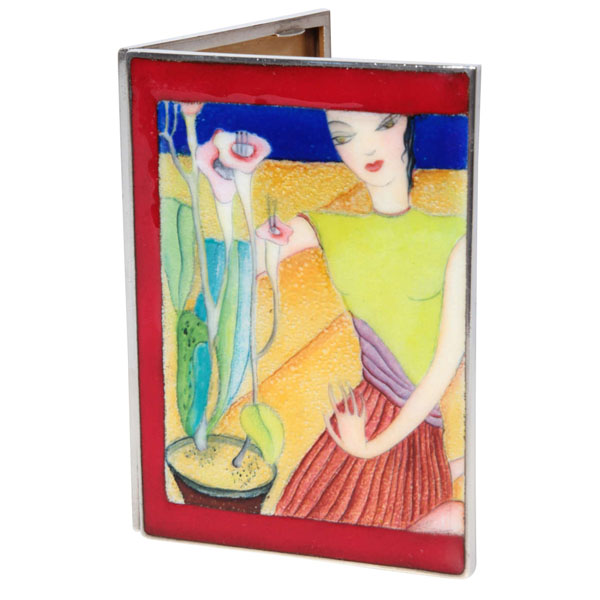
Paul Laszlo Rare Art Deco Enameled Sterling Cigarette Case c.1925
More Information
Paul Laszlo Rare Art Deco Enameled Sterling Cigarette Case c.1925
PAUL LÁSZLÓ (1900-1993) Austria / USA
MARIA ROTT (enamel) Vienna, Austria
Enameled sterling cigarette case c.1925
Hand painted foil backed and colorful fired enamel scene with a figure and a flowering plant all within a red enamel border on sterling
Marks: Paul Laszlo (on inside edge, rubbed), RS in a cartouche (Vienna maker’s mark), STERLING
H: 4″ x W: 3″ x D: 3/8″
Matching enamel dresser set by Paul Laszlo illustrated: “Kunsthandwerk” Band 62, Heft 5, February 1930
Born in Budapest, the architect Paul Laszlo studied in Vienna, Paris and Berlin before setting up an office in Vienna. By 1927, Laszlo had moved to Stuttgart where he quickly made a name for himself across Europe. In 1936, he relocated to Beverly Hills, California, which had become a haven for many artists and designers seeking artistic freedom. There he quietly found work designing modern homes and interiors, often for Hollywood celebrities. Laszlo created textiles, lamps, as well as custom furniture for his modernist homes and corporate interiors. His comfortable, yet elegant designs pay tribute to the modern luxury and easy livability of the early to mid 20th Century interiors of Vienna.
This enamel on sterling case really is one of the very best fired enamel examples of its type. It has a wonderful range of beautifully toned and colored enamel with foil backing in some areas which also gives it extra luminosity and metallic glow. It is in perfect condition and the detail and masterful artistic quality of the painting is also extremely fine and exquisitely rendered.
It has all the style and characteristics of the accomplished Neue Shachlichkeit (or New Realism / Objectivity) painting style Laszlo would have been familiar with and exposed to either in Berlin or Stuttgart as well as the New Realism style in Vogue in Vienna, where Laszlo also worked in the 1920’s. Considering the difficulty in controlling fired enamel, this exceptional Laszlo enameled case is a bargain by comparison of the price per square inch of a comparable painting on canvas such as a Christian Schad or Otto Dix! In fact, paintings are vastly more simple to execute and immediately rendered by comparison to a fired enamel “painting” on sterling like this exceptional case which would require a very lengthy and tedious process to accomplish a work of this caliber.
Paul Laszlo left Germany for America in 1936 and established a successful design firm in Beverly Hills, became an American citizen and lived happily in Southern California for the rest of his life.
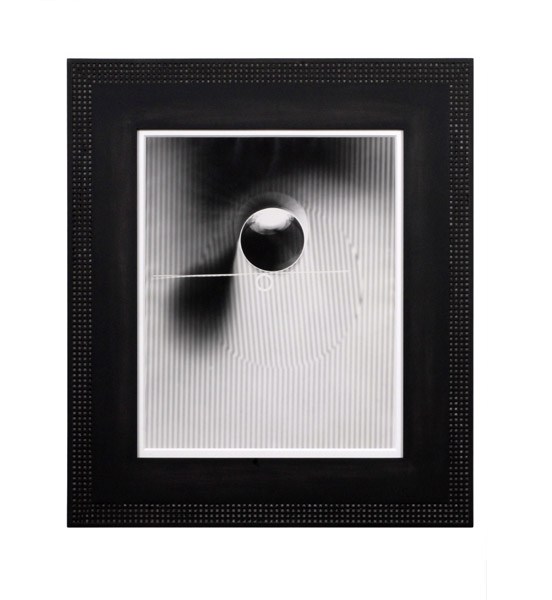
György Kepes, Abstraction, Gelatin silver print, 1942
GYÖRGY KEPES (1906-2001) Hungary/USA
Abstraction 1942
Silver gelatin print
Signed: 9 (in a circle, on back); Gyorgy Kepes 1942 (in ink on back)
György Kepes was a Hungarian-born painter, designer, educator and art theorist. After emigrating to the U.S. in 1937, he taught design at the New Bauhaus (later the School of Design, then Institute of Design, then Illinois Institute of Design or IIT) in Chicago. In 1947 He founded the Center for Advanced Visual Studies at the Massachusetts Institute of Technology (MIT) where he taught until his retirement in 1974.
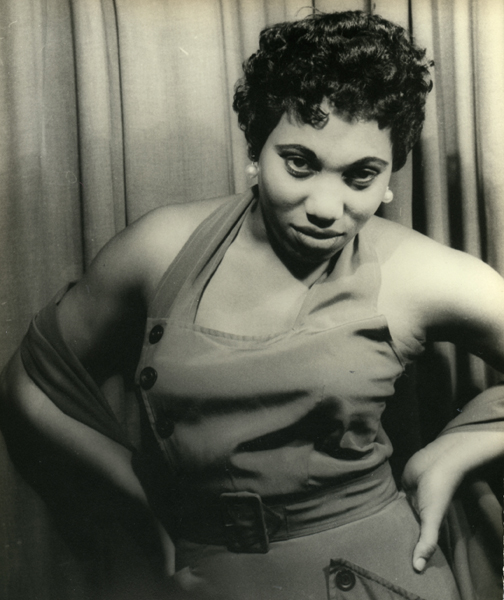
Signed: Leontyne Price as Bes, Porgy & Bess, XVII KK 20, May 19, 53 (in ink on back); PHOTOGRAPH BY CARL VAN VECHTEN, 101 CENTRAL PARK WEST, CANNOT BE REPRODUCED WITHOUT PERMISSION (ink stamp on back)
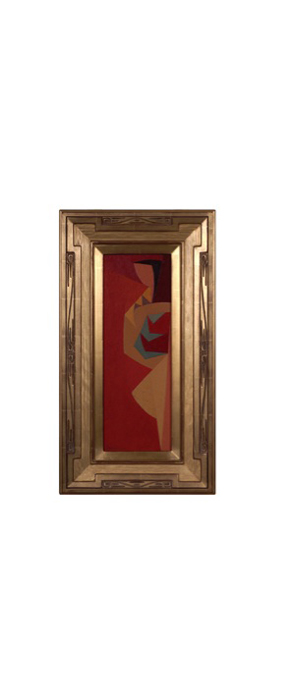
Karl Benjamin, “Geo-metricized figure”, Oil on canvas 1954
KARL BENJAMIN (1925-2012) USA
Geometricized figure 1954
Oil on canvas
Signed: Benjamin 54 (lower left)
For more information see: Dictionnaire des Peintres, Sculpteurs, Dessinateurs et Graveurs, Vol. 1 to 10, E. Bénézit (Paris: Librairie Gründ, 1976).
Canvas: H: 17″ x W: 6″
Framed: H: 24 1/2″ x W: 13 1/2″
Karl Benjamin was born in Chicago, IL in 1925. He received his BA from the University of Redlands, CA and his MFA at Claremont Graduate School, CA. Benjamin belonged to the Hard Edge group of West Coast painters led by John McLaughlin during the 1950s, 60s and early 70s. He was awarded the National Endowment for the Arts Grant for Visual Arts in both 1983 and 1989. His work has been featured in numerous museum exhibitions and is included in the public collections of the Los Angeles County Museum of Art; Museum of Contemporary Art, Los Angeles; Museum of Modern Art, Israel; Oakland Museum, Oakland, CA; San Francisco Museum of Modern Art, CA; Seattle Art Museum, WA; and the Whitney Museum of American Art, NY, among others. For many years, Benjamin taught painting at Pomona College and Claremont Graduate School, and currently is Professor Emeritus. He lived in Claremont, CA.






 @hd_jewels