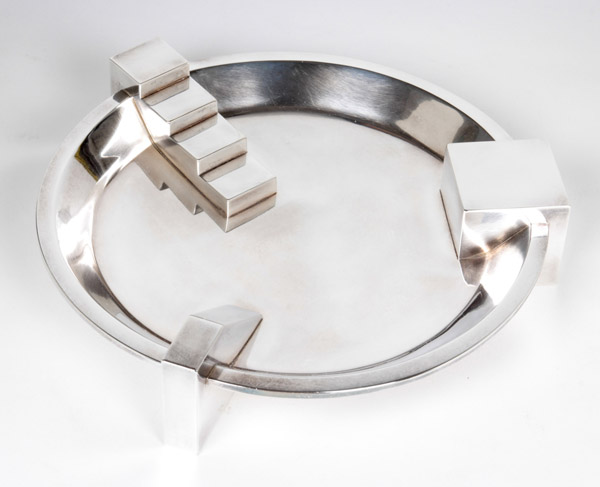
PER SAX MOLLER / Scandinavian Modern Sterling sculptural centerpiece 2000
More Information
PER SAX MOLLER / Scandinavian Modern Sterling sculptural centerpiece 2000
PER SAX MØLLER (b. 1950) Denmark
Round sculptural centerpiece with geometrical shapes 2000
Sterling silver
Marks: PER SAX MØLLER, Copenhagen, 925s, Sterling
Exhibited: Danske Sølsmede-nye arbejder (Danish silversmiths-new work), Museet på Koldingshus, 2002.
Diameter: 8 ¼”
Price: $12,500
The silversmith Per Sax Møller was trained in the Danish silver tradition with Jeweler to the Royal Danish Court, A. Michelsen, from 1968-1972. The workshop specialized in style copies and modern silver, which during the 1900’s was designed by architects such as Thorvald Bindesbøll, Kay Fisker, Erik Herløw, Tove and Edvard Kint-Larsen, among many others.
After completing his apprenticeship, he worked at Preben Salomonsen’s workshop in Copenhagen, mainly creating style copies for stores such as Tiffany, Bloomingdale’s and Aspery. Here, the ancient silversmith’s craft he had learned at A. Michelsen, was further honed. During the years 1973-1975, he attended classes at Guldsmedehøjskolen, but he was disappointed in the low standard of teaching and therefore did not graduate.
He found the opportunity for a far richer artistic education as a conscientious objector, stationed at the art museum Louisiana in Humlebæk, outside Copenhagen. He spent more than a year here, surrounded by the works of Henry Moore, Arp, Calder, Laurent and Danish artists such as Astrid Noack, Ejler Bille, Sonja Ferlov Mancoba, Villy Ørskov and many more, which left a deep and profound mark.
In 1976, Per Sax Møller established himself in a workshop alongside goldsmith Jørgen Bindesbøll, in St. Kongensgade in Copenhagen. Over the next couple af years, he also joined the association “Danske Sølvsmede” in exhibitions throughout Scandivavia. He retired from the workshop with Jørgen Bindesbøll in 1980, but continued to create works in rented space. To help earn a living, he drove a city bus and worked for Folketeateret in Copenhagen, creating theatre sets.
Jørgen Bindesbøll moved to Møn in 1984, and Per Sax Møller took over his workshop in St. Kongensgade. Soon thereafter, he established himself in a workshop in Pilestræde, Copenhagen, and then in 1992, he took over silversmith Kay Bojesen’s workshop in Bredgade 47, where he resides today.
In the mid 1990’s Per Sax Møller rejoins “Danske Sølvsmede”, and in 1999 he succeeds silversmith Ib Andersen as president of the association. As president, he revitalizes Danish silver by initiating the exhibition Danish Silver 2000, which takes up most of the space in the museum Koldinghus and becomes one of the largest manifestations of Danish silver. During one summer month, the exhibition was visited by 30,000 guests.
In 2002, Per Sax Møller resigns the presidency of “Danske Sølvsmede” to once again concentrate on his own works. Per Sax Møller has received Danish State Arts Foundation grant in 1979, 1997, 2000 and 2002. His works are represented at Oslo Museum of Art and Design, Danish Museum of Art and Design, at the museum Koldinghus and in private collections in Europe, USA and Canada.
Tim Liddy, Lie Cheat and Steal (1971) The Game of Political Power Oil and enamel on copper, plywood back 2006
TIM LIDDY (b. 1963) Missouri
“Lie Cheat and Steal” (1971) The Game of Political Power 2006
Oil and enamel on copper, plywood back
Signed in script: Tim Liddy “circa 1971” 2006, red circular ring
Provenance: William Shearburn Gallery (St. Louis, MO)
H: 12” x W: 9” x D: 2”
With his recent paintings, Liddy has both reasserted the construct of hyperrealist painting and developed a thoroughly unique advancement of that mode by extending the cultural reality of the indexed original. Based on the illustrated box lids of vintage board games, Liddy has recontextualized a subject, which evokes the underlying rules of life. Painted on copper or steel in the precise dimensions of the original, the metal is then manipulated to demonstrate the exact rips and tears from years of usage and includes trompe-l’oeil renditions of the scotch tape that might be holding the cardboard box together, the assorted stains, or the various graffiti of time. Liddy leaves no possibility of ambivalence, these works speak to a concurrent understanding of their original object identity and to themselves as works of art engaged in historical and psychological dialogue.
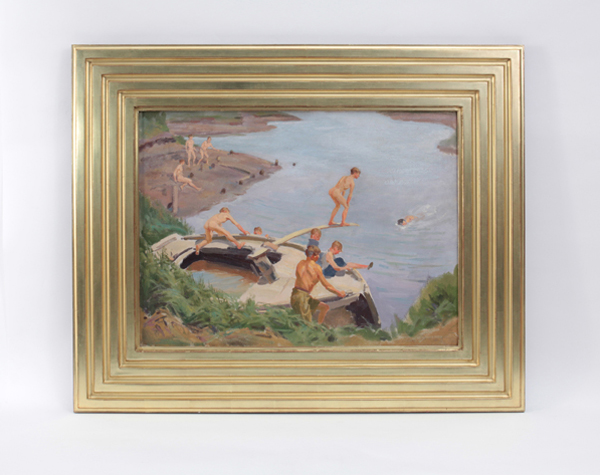
Edmund F. Ward “The Swimming Hole” Oil on canvas c. 1930
EDMUND F. WARD (b. 1892 – 1991) USA
“The Swimming Hole” c. 1930
Oil on canvas
Marks: signed Edm. F. Ward (lower right); partial labels verso:Westchester Arts and Crafts Guild; 4 Edmund F. Ward
For more information on the artist see: Who Was Who in American Art,Peter Hastings Falk, ed. (Madison, Conn.: Sound View Press, 1985), p. 658.
Canvas H: 18” x W: 24”
Framed H: 27 9/16” x W: 33 9/16”
Price: $14,000
Ward studied at the Arts Student’s League with Edward Dufner, George Bridgeman, and Thomas Fogarty. He was an illustrator for several national magazines and books. In 1925, Ward exhibited an award winning work at the Art Institute of Chicago. He is perhaps best known for his WPA mural in the Federal Building, White Plains, New York.
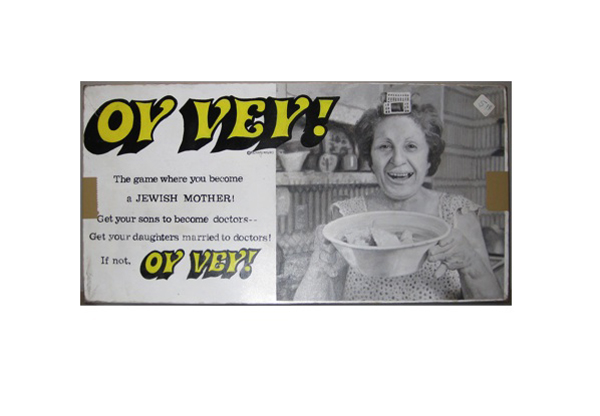
Tim Liddy Oy Vey (1979) The game where you become a JEWISH MOTHER! Get your sons to become doctors—Get your daughters married to doctors! If not, OY VEY! 2008 Oil and enamel on copper, plywood back
TIM LIDDY
“Oy Vey” (1979) The game where you become a JEWISH MOTHER! Get your sons to become doctors—Get your daughters married to doctors! If not, OY VEY! 2008
Oil and enamel on copper, plywood back
Signed in script: Tim Liddy, red circular ring, “circa 1979”, 2008
Provenance: William Shearburn Gallery, St. Louis, MO
H: 10 ¼” x W: 20 ½” x D: 1 ¾”
With his recent paintings, Liddy has both reasserted the construct of hyperrealist painting and developed a thoroughly unique advancement of that mode by extending the cultural reality of the indexed original. Based on the illustrated box lids of vintage board games, Liddy has recontextualized a subject, which evokes the underlying rules of life. Painted on copper or steel in the precise dimensions of the original, the metal is then manipulated to demonstrate the exact rips and tears from years of usage and includes trompe-l’oeil renditions of the scotch tape that might be holding the cardboard box together, the assorted stains, or the various graffiti of time. Liddy leaves no possibility of ambivalence, these works speak to a concurrent understanding of their original object identity and to themselves as works of art engaged in historical and psychological dialogue.









 @hd_jewels