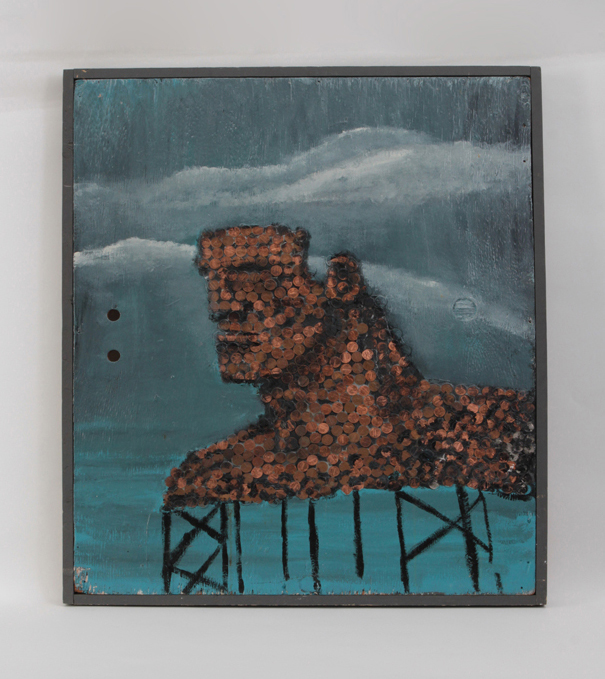
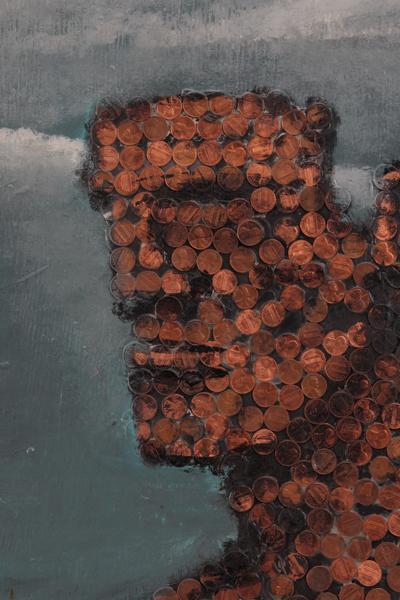
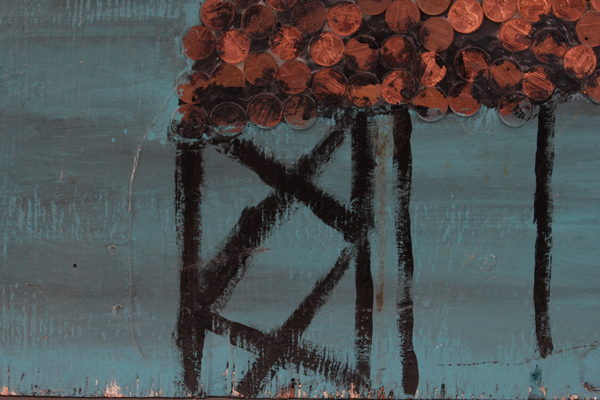
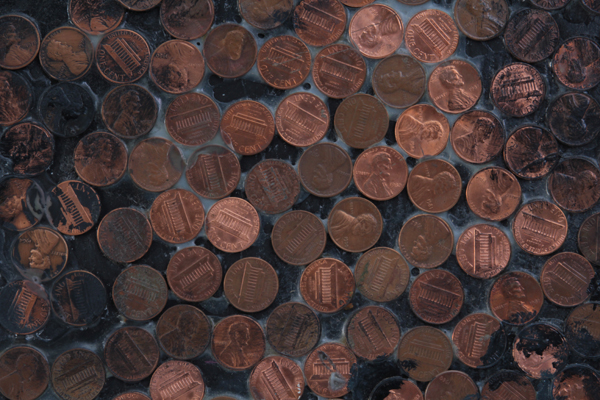
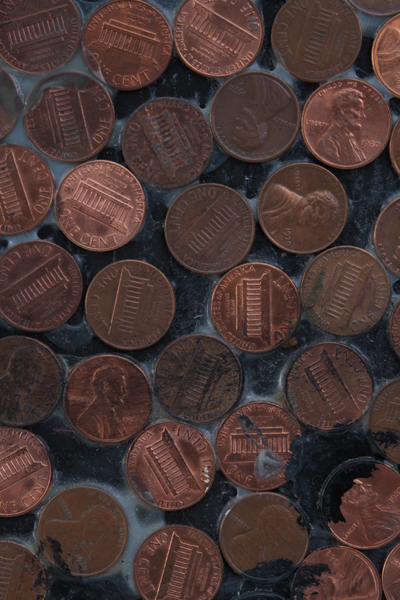
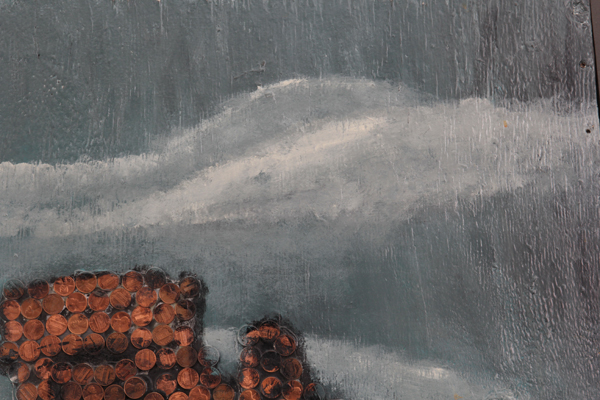
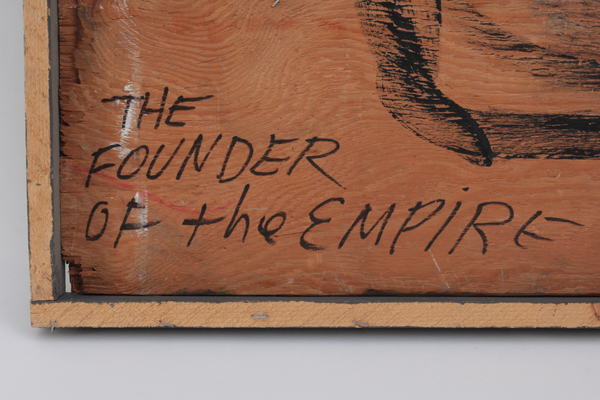
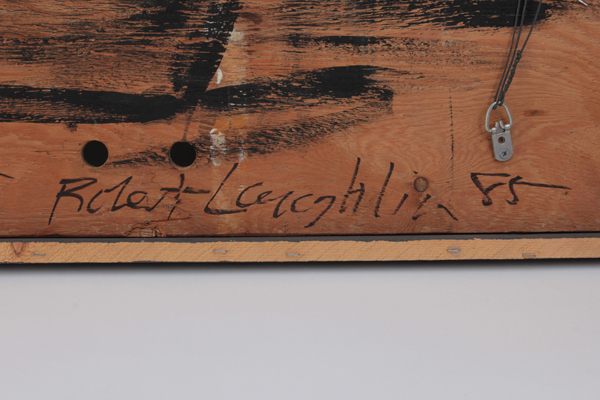
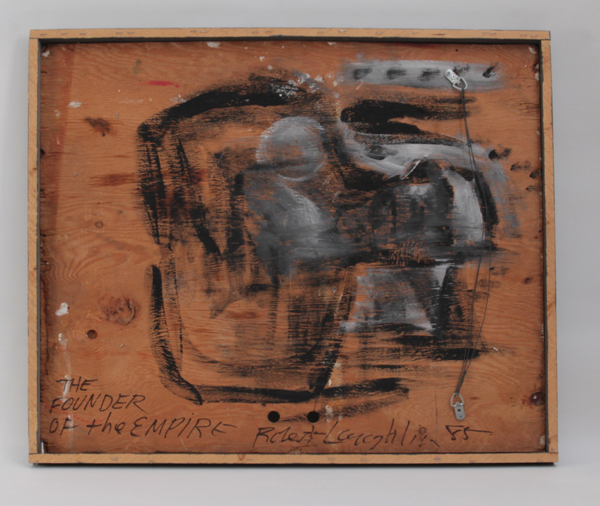
Robert Loughlin, "The Founder of the Empire", Oil paint and pennies on plywood panel 1985
More Information
Robert Loughlin, “The Founder of the Empire”, Oil paint and pennies on plywood panel 1985
For more information on Robert Loughlin see: http://www.nytimes.com/2015/10/02/fashion/mens-style/the-legacy-of-robert-loughlin-artist-behind-the-brute.html?mwrsm=Email
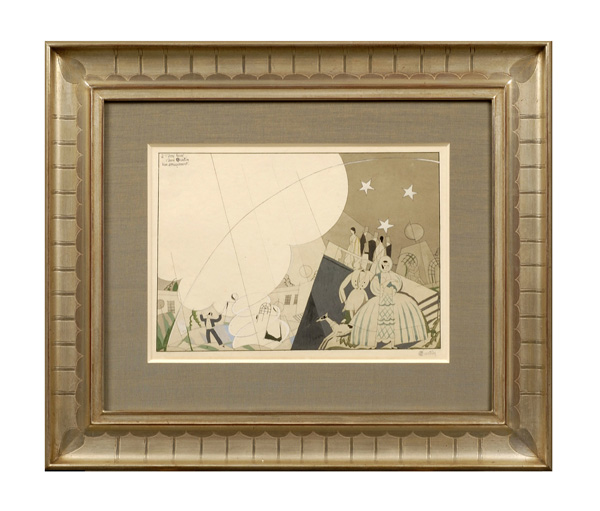
Charles Martin, “Bal Masque”, Pencil, ink, gouache and watercolor on paper 1927
CHARLES MARTIN (1884-1934) France
Bal Masque 1927
Pencil, ink, gouache and watercolor on paper.
Signed: Martin (lower right corner); A l’Ami Koval, l’Ami Martin, Bien Amicalement (upper left corner)
H: 8” x W: 11 7/16”
Price: $12,500
Charles Martin was a notable French illustrator, graphic artist, posterist, fashion and costume designer. His drawings are charming, amusing and sophisticated. The artist studied at the Montpelier Ecole des Beaux Arts, Academie Julian and Ecole Des Beaux Arts, Paris. Throughout his career, Martin was also a contributor to the French fashion journals Gazette du Bon Ton, Modes et Manieres d’Aujourd’hui, Journal Des Dames et Des Modes, and Vogue. His illustrated books include the hat catalogue “Les Modes en 1912,” the erotic “Mascarades et Amusettes” 1920, and “Sports et Divertissements” 1919, written in collaboration with composer Erik Satie.
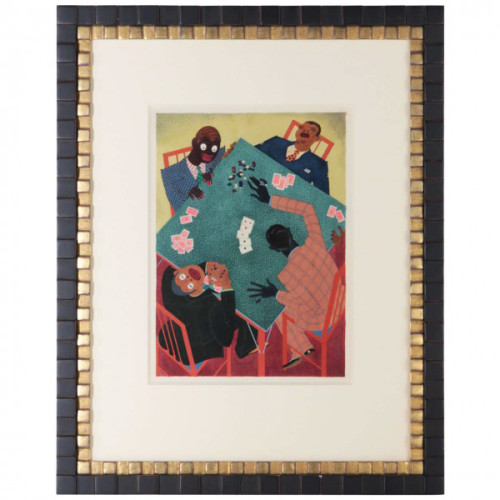
S O G A T A New York, NY “Harlem: Five Aces” Watercolor and pencil on paper 1931
S O G A T A New York, NY
“Harlem: Five Aces” 1931
Watercolor and pencil on paper
Signed: SOGATA, HARLEM 1931 (painted, lower right corner of image); HARLEM: FIVE ACES. (in pencil beneath image on left)
For contextual history and similar art see: Rhapsodies in black : art of the Harlem Renaissance, (Berkeley: University of California Press, 1997); Harlem Renaissance Artists. Jordan, Denise (Chicago: Heinemann Library, 2003).
Paper H: 14 7/8″ x W: 10 7/8 ”
Image H: 11″ x W: 7 1/2″
Frame H: 19” x W: 15 1/4”
*This SOGATA New York Watercolor and pencil on paper has been gifted to The Wolfsonian – FIU, Miami Beach, FL.
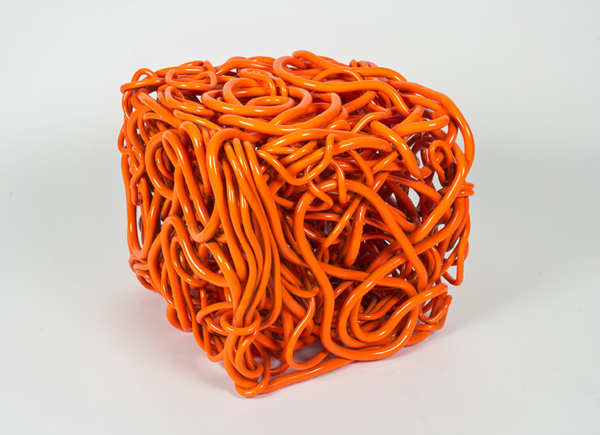
Orange anodized and contoured aluminum wire manipulated into a cube form
Signed: Orange Cube, 08, Forrest Myers (on plaque)
For more information see: Who Was Who in American Art(Madison, Conn.: Sound View Press, 2003-2004 25th Edition), Dictionary of American Sculptors: 18th Century to the Present, Glen Opitz (Poughkeepsie, NY: Apollo, 1984).
Dimension: 10 1/2″ cube
Price: $15,000
A sculptor and art teacher born in Long Beach, California, Forrest Myers settled in Brooklyn, New York. Myers studied at the San Francisco Art Institute. His teaching venues include the San Francisco Art Institute, School of Visual Arts in New York, Kent State University, and the Parsons School of Design. His studio is in Brooklyn.
In the early 1980s, Forrest Myers was applying Buckminster Fuller's principles of tensegrity and repeated tetrahedrons into his designs for furniture. This exploration culminated in the use of aluminum wire that becomes structural when bent and pressed into a dense tangle.
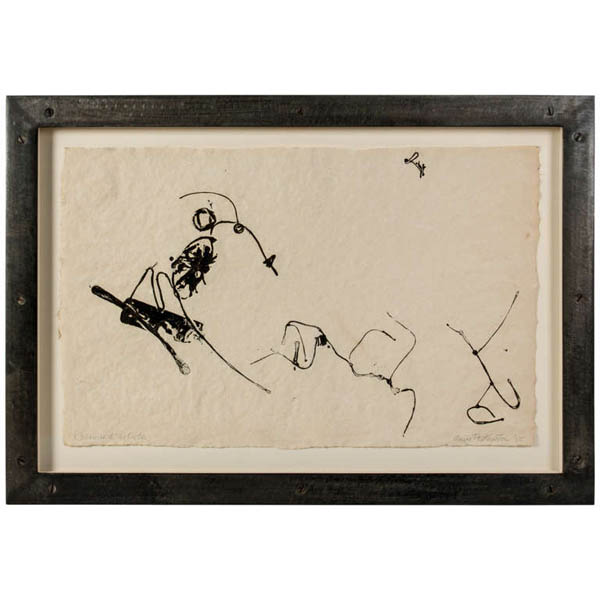
Claire McCarthy Falkenstein, Chase, Structure-graphic, unique impression of metal sculptural forms on handmade paper (artist’s proof) 1955
CLAIRE MCCARTHY FALKENSTEIN (1908-1997) Coos Bay, OR
“Chase” 1955
Structure-graphic, unique impression of metal sculptural forms on handmade paper (artist’s proof), steel frame.
Signed: “Claire Falkenstein ‘55” (on bottom right corner), “E prevue d’artiste” (on bottom left corner), #6, “Chase”, Structura grafica, Milano, Italy, Giorgo Unglio Shop (label on back)
*** A related structure-graphic from 1952-55 is in the collection of the Yale University Art Gallery.
Framed: H: 15 11/16” x 22 9/16”
SOLD
Falkenstein was born in the first decade of the century and was still hard at work in the last. Her life was precisely coincident with the 20th century, and she was a full participant in the tumultuous events in the art world. Her work incorporated modern technology, process, assemblage, chance, light, space, and what has been called “anti-form” as creative principles. Falkenstein was a contemporary of the Abstract Expressionists but, in fact, started sooner, lasted longer, and surpassed them in formal vocabulary, in the variety of materials she used and in her highly experimental techniques. Starting her career, (working, teaching and exhibiting} in San Francisco until 1950 when she moved to Paris for a dozen years to pursue her art career, where her association with critic Michel Tapié and his group Art Autre developed into many commissions including the gates at the home of her longtime friend Peggy Guggenheim in Venice, Italy. She returned to Venice, California in 1960. In other words, like a heat-seeking missile, she found and participated in the liveliest and most challenging art centers of the time. During her career she created over four thousand sculptures, paintings, and drawings, and became known for her innovative and often controversial abstract public art. Among major commissions were the windows for St. Basil’s Catholic Church, and fountains at California Federal Savings (now destroyed) and California State University. Putting her in the immediate milieu of many of the century’s greatest artists, she studied, worked, competed, collaborated and, in several cases, became close personal friends with several, including Alexander Archipenko, Clyfford Still, David Smith, Hans Arp, Mark Tobey, Antoni Tapies and Alberto Giacometti. Many years later, she said: “…there were marvelous things, marvelous people, but I took it all in stride. I was completely engrossed in what I was doing. There were people who were accustomed to being treated with deference and I guess I didn’t – and I guess that’s why they got interested.” (Falkenstein, Oral History, UCLA) Throughout Falkenstein’s career, she created a prodigious amount and variety of work, well beyond the traditional categories of painting and sculpture. She explored printmaking, ceramics, functional art, jewelry, and public monuments — ranging from the miniature (jewelry) to the colossal (50’ fountains and 100’ stained glass windows). And in each of these areas, her accomplishment has been consistently and unmistakably of historical significance.

 @hd_jewels