Product Description
Shreve & Co., Art Deco ring set with a trio of round cut diamonds (approx. 2 1/4 carats TW) set in platinum with caliber cut onyx surrounding the three diamonds, signed, c.1930

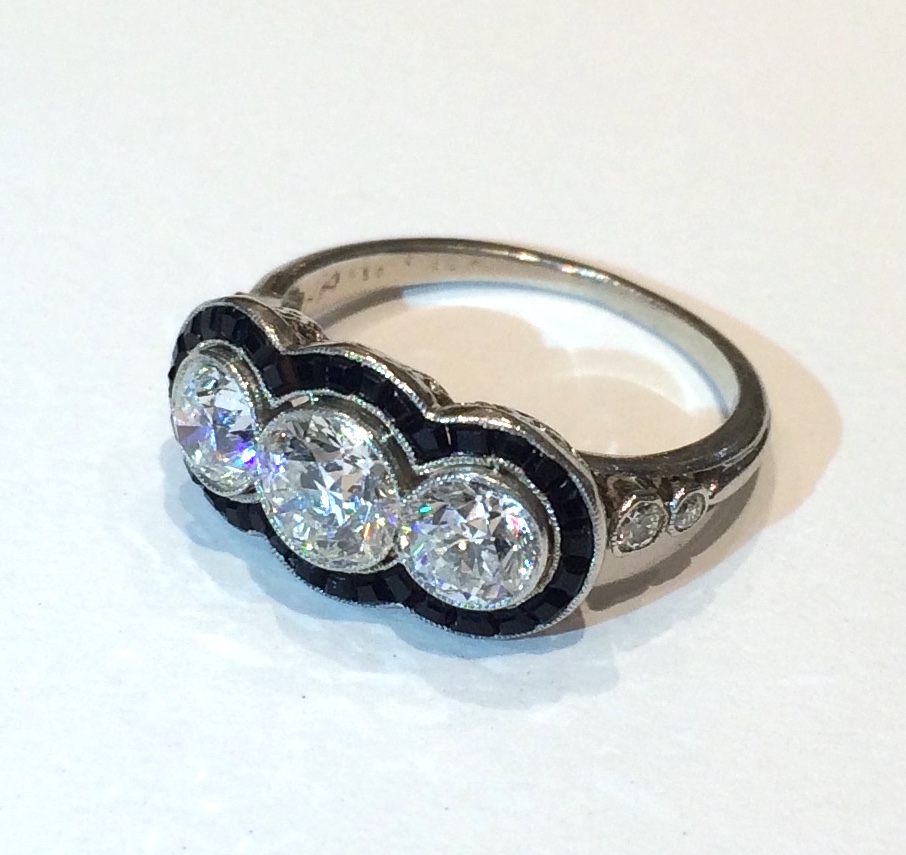
Shreve & Co., Art Deco ring set with a trio of round cut diamonds (approx. 2 1/4 carats TW) set in platinum with caliber cut onyx surrounding the three diamonds, signed, c.1930
SEVARD France (active 1920’s/1930’s)
Dinanderie vase with fish fins c. 1925
Hand wrought and hand hammered copper with a rich chocolate-brown
patination and bronze fin-like handles, gilt detailing
Marks: Sevard (inscribed signature), “France”
H: 7 7/8” x W: 8 3/4”
CHINESE ART DECO
Covered box c. 1930
Cloisonne enamel in a fantasy of archaic Chinese motifs in red, royal blue, black white and sand colored abstract designs on a bronze body with a turquoise enameled underside and interior.
H: 2 1/2″ x D: 6 1/4″ x W: 9″
TOMMI PARZINGER (1903-1981) Germany/USA
PARZINGER, INC. New York
Coffee table c.1939
Carved and ceruse oak with an incised diamond pattern pewter top
Illustrated: Arts and Decoration, June 1940
***This table was originally priced at $80 during the period, as it appears in the Arts and Decoration vintage illustration from 1940.
For other examples of Parzinger’s work see: Town & Country, Vol. 54, “Counter Points”, December 1939, p. 31; Town & Country, Vol. 95, “Counter Points”, June 1940, p. 19; The Studio, 1938, “For the Table”, p.107-09; The Studio, 1942, “Tommi Parzinger, Designer of Modern Interiors and Silver”, p.37; Decorative Art, Studio Yearbook (London & New York: The Studio Publications, 1952-53), p. 98; Craft in the Machine Age, ed. Janet Kardon (New York: American Craft Museum, 1995) p.128, 134, 183, 241.
H: 12” x L: 42” x D: 14”
Price: $34,500
This is a wonderful and rare coffee table by Tommi Parzinger in beautifully detailed ceruse oak with a diamond pattern pewter inset top. This table was
completely handmade and dates from 1940, shortly after Parzinger opened his first eponymous gallery on East 57th Street. It is low and lean with exquisite Neoclassical Revival carved details and a silhouette that calls to mind an American take on Jean Michel Frank’s sober and refined elegance of the same time period. The cross-hatch carving with tassels on the two long sides and the related top corner details also have a charm reminiscent of Parzinger’s affable personality and effervescent design sensibility.
WALTER BOSSE (1904 – 1979) Austria
Bookends c. 1930
Hand-painted and glazed earthenware
For more information see: Walter Bosse: Leben, Kunst, und Handwerk, 1904-1979, Cherica Schreyer-Hartmann, Hans Hagen & Johanna Hottenroth (Vienna: Verlag Christian Brandstätter, 2000), Wiener Keramik: Historismus, Jugendstil, Art Déco, Waltraud Neuwirth, (Braunschweig: Klinkhardt & Bierman, 1974), pp. 114-115.
H: 5″ x D: 4 1/2″ x W: 5 1/4″
Price: $2,250
Walter Bosse (November 13, 1904–December 13, 1979) was a Viennese artist, designer, ceramist, potter, metalworker, and craftsman noted for his modernist bronze animal figurines and grotesques.
Walter Bosse, born November 13, 1904, in Vienna, was the son of artists Luise and Julius Bosse. His father worked as a portrait painter at the imperial court. Walter Bosse attended the Wiener Kunstgewerbeschule (Vienna School of Applied Arts) from 1918 to 1921, where he studied ceramics under Michael Powolny, and ornament under Franz Cižek. He then attended the Münchner Kunstgewerbeschule (Munich School of Applied Arts). During his schooling he was given the opportunity to sell his work at the Wiener Werkstätte by Josef Hoffmann, who became a mentor to Bosse. Bosse opened his own shop in Kufstein in 1923.
Bosse’s work grew in popularity and a number of his pieces were shown at the International Exposition of Modern Industrial and Decorative Arts in 1925. He started designing for Augarten Porcelain Works (1924) as well as Goldscheider (1926) and Metzler and Ortloff (1927). In 1931, to meet increasing demand (especially in America), Bosse opened up a bigger shop in Kufstein, but by 1933 he started to feel the effects of the economic depression. By 1937, the Kufstein works were closed.
In 1938, now divorced, Bosse moved back to Vienna where he founded Bosse-Keramik (Bosse Ceramics), which expanded under the new name “Terra” to include glass, toys, textiles. and a variety of craft items for the gift market. In the late 1940s, Bosse began experimenting with brass by giving his ceramic figures a metal coating to protect them from breakage. In the early 1950s, Bosse began his “Black Golden” line of brass figurines. He transitioned all of his efforts to brass. The figures became popular worldwide.
Despite Bosse’s success with his brass figures, it was still a difficult time for him financially. In 1953, partly fleeing from financial troubles, he moved to Iserlohn where he set up a new shop and continued production. Bosse also collaborated with Karlsruhe State Majolika Works on a number of pottery animal figures. In 1958, he designed for Achatit Schirmer in Cologne. Bosse also turned his efforts to small, everyday items such as letter openers, keyrings, corkscrews, and pencil holders, all of which bear his distinctive “black and gold” look. A number of these Bosse designs began to gain widespread popularity internationally.