Product Description
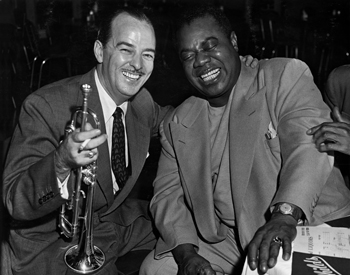
Stephen Longstreet “Jazz Festival Trio – Night Faces”, Paper cut-out, mixed media and paper collage, c. 1970’s

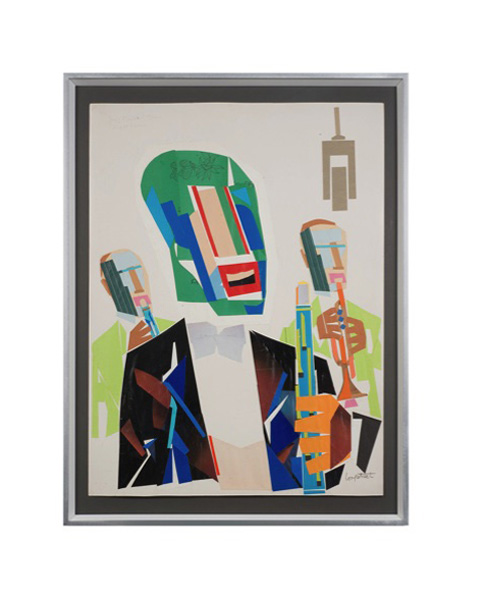
STEPHEN LONGSTREET (1907-2002)
“Jazz Festival Trio – Night Faces” c. 1970’s
Paper cut-out, mixed media and paper collage
Signed: Longstreet (lower right), titled in pencil (upper left)
Artist’s printed address label verso
H: 38″ x W: 28 3/8″
Stephen Longstreet was born on April 18, 1907 in New York City and attended Rutgers University (1926) and Harvard University (1927), and graduated from the New York School of Fine and Applied Art (1929); also studied in Paris with Matisse and Bonnard, as well as in Rome, London and Berlin; became painter, writer, art critic, and lecturer on art; literary critic for Reader’s Syndicate (1952-80) and for the Los Angeles Daily News; designed stage sets for RexRoth poetry jazz, 1952; president, Los Angeles Art Association. (1972-75); professor of modern writing, University of Southern California (1975-80); wrote radio plays, screenplays, and dozens of books ranging from novels to biography to travel, including: Decade, 1929-1939 (1940), The Pedlocks: A Family (1951), Gettysburg (1961), The World Revisited (1953), and The Real Jazz, Old and New (1956).
The world of jazz was a constant theme throughout Longstreet’s life.
Longstreet was introduced to ragtime and jazz by future singing legend Paul Robeson, then an All-American football player at Rutgers University. Their friendship began in 1918, when Robeson spotted the 11-year-old Longstreet sketching him as he practiced dropkicking. In his 1986 book “Storyville to Harlem: Fifty Years in the Jazz Scene,” Longstreet explained that Robeson made him “aware of the gap between the music taught on paper and the ‘razzmatazz’ sounds of the scratchy jazz recordings.” While studying at the School of Fine and Applied Arts in New York in the late ’20s, Longstreet drew the musical scenes in Greenwich Village, the speak-easies and the Cotton Club in Harlem. “I had hoped to capture with black marks on white paper, this music created by these people, and set down what they looked like, felt and did before they were gone,” he later wrote. By the late ’20s, Longstreet was furthering his artistic studies in Paris, where he met Picasso, Matisse and other artists. He also met and drew James Joyce, Gertrude Stein and the American “jazzmen” who were, he later wrote, “escaping from Judge Lynch and the back of the bus.” After returning to the United States in 1930, he traveled south to New Orleans, discovering the “strange and wonderful sounds” of jazzmen playing in Storyville, the city’s red light district, and capturing them in his work. He later drew and painted Count Basie, Sarah Vaughan, Billie Holiday, Duke Ellington and other jazz greats. Of Longstreet’s depictions of the century’s jazz scene, Louis Armstrong wrote in 1971: “You want to feel the smell–the color–the great ‘OH MY’ feeling of the jazzmen, and stomp around in the smoke and dusk of the joints … then you just go and locate some of the drawings and paintings of this cat Steve Longstreet and steal you a few.”
Over the years, Longstreet’s jazz-era works, including collages, watercolors and ink drawings, were exhibited in museums and galleries, including the National Portrait Gallery at the Smithsonian Institution. The University of Chicago Library, The Graphic Arts Collection and Department of Rare Books and Special Collections at Princeton University Library, as well as UCLA all have extensive collections of Longstreet’s artwork.
Stephen Longstreet “Jazz Festival Trio – Night Faces”, Paper cut-out, mixed media and paper collage, c. 1970’s
ARAM GESAR USA
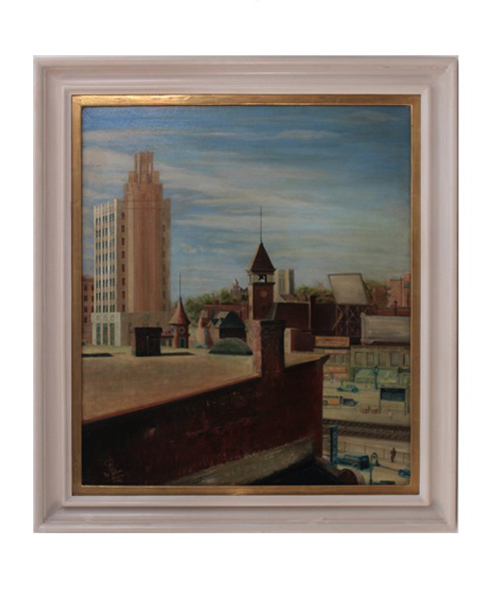
Venetian Blinds 1979
Ciba-chrome print, maple frame
Signed: 790069, LXXIX (on back)
Framed size: H: 17 9/16” x W: 23 ½”
Price: $24,000
Aram Gesar has been published internationally and has exhibited his photographic work in New York, San Francisco, Zurich and Geneva since 1977. As a producer, art director and photographer, Gesar created advertising campaigns for major corporations in the U.S. and Europe focusing on the fields of travel, banking, financial services, aerospace and motion pictures. He also created and produced documentaries on travel, aviation and yachting for national cable networks and the home video markets and television commercials and corporate programs for various U.S. and European corporations.
Gesar is currently one of the leading international experts on travel and air transport, and the founder and CEO of The Pyramid Media Group, which includes several magazines, newsletters, web sites, books, eBooks and other publications integrating a spectrum of business, travel and aviation content.
ARCHIBALD KNOX (1864-1933) UK
LIBERTY & CO. London, UK
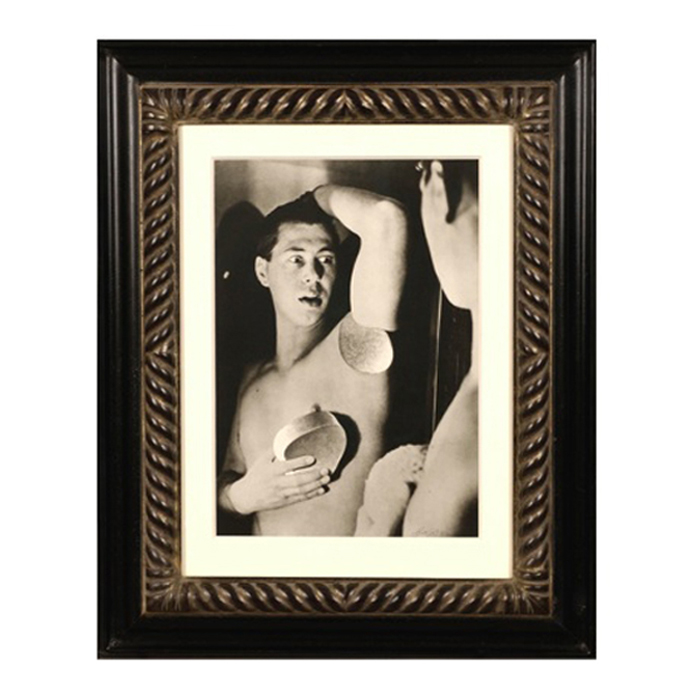
Hand mirror 1908
Sterling with large matrix cabochon turquoise
Marks: L & Co. cipher, Birmingham assay marks for 1908
Similar works with turquoise Illustrated: Archibald Knox, ed. by Stephen A. Martin (London: Academy Editions, 1995) ; Liberty Design 1874-1914, Barbara Morris (London: Pyramid Books, 1989) p. ; The Designs of Archibald Knox for Liberty & Co., A.J. Tilbrook (London: Ornament Press Ltd., 1976)
L: 11″
TIM LIDDY
“Who Can Beat Nixon” (1970) Presidential Sweepstakes 2006
Oil and enamel on copper, plywood back
Signed in script: Tim Liddy “circa 1970” 2006, red circular ring
Provenance: William Shearburn Gallery (St. Louis, MO)
H: 11 ¾” x W: 9” x D: 2”
With his recent paintings, Liddy has both reasserted the construct of hyperrealist painting and developed a thoroughly unique advancement of that mode by extending the cultural reality of the indexed original. Based on the illustrated box lids of vintage board games, Liddy has recontextualized a subject, which evokes the underlying rules of life. Painted on copper or steel in the precise dimensions of the original, the metal is then manipulated to demonstrate the exact rips and tears from years of usage and includes trompe-l’oeil renditions of the scotch tape that might be holding the cardboard box together, the assorted stains, or the various graffiti of time. Liddy leaves no possibility of ambivalence, these works speak to a concurrent understanding of their original object identity and to themselves as works of art engaged in historical and psychological dialogue.
KARL BENJAMIN (1925-2012) USA
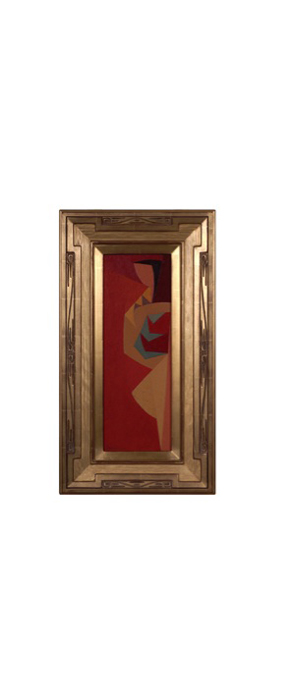
Geometricized figure 1954
Oil on canvas
Signed: Benjamin 54 (lower left)
For more information see: Dictionnaire des Peintres, Sculpteurs, Dessinateurs et Graveurs, Vol. 1 to 10, E. Bénézit (Paris: Librairie Gründ, 1976).
Canvas: H: 17″ x W: 6″
Framed: H: 24 1/2″ x W: 13 1/2″
Karl Benjamin was born in Chicago, IL in 1925. He received his BA from the University of Redlands, CA and his MFA at Claremont Graduate School, CA. Benjamin belonged to the Hard Edge group of West Coast painters led by John McLaughlin during the 1950s, 60s and early 70s. He was awarded the National Endowment for the Arts Grant for Visual Arts in both 1983 and 1989. His work has been featured in numerous museum exhibitions and is included in the public collections of the Los Angeles County Museum of Art; Museum of Contemporary Art, Los Angeles; Museum of Modern Art, Israel; Oakland Museum, Oakland, CA; San Francisco Museum of Modern Art, CA; Seattle Art Museum, WA; and the Whitney Museum of American Art, NY, among others. For many years, Benjamin taught painting at Pomona College and Claremont Graduate School, and currently is Professor Emeritus. He lived in Claremont, CA.