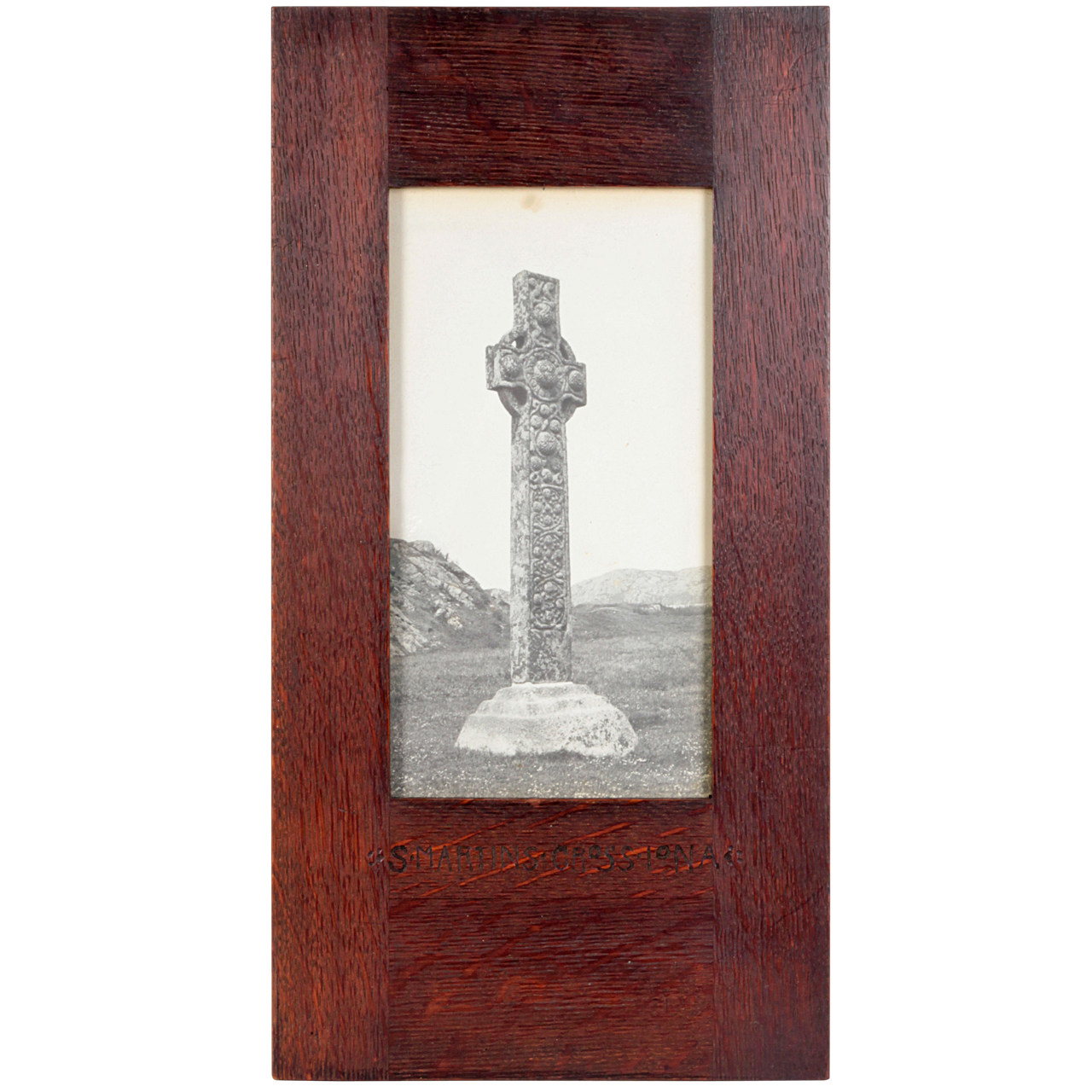
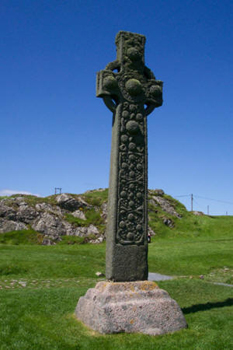
Sydney Pitcher "St. Martin's Cross Iona" Arts & Crafts photograph c. 1900
More Information
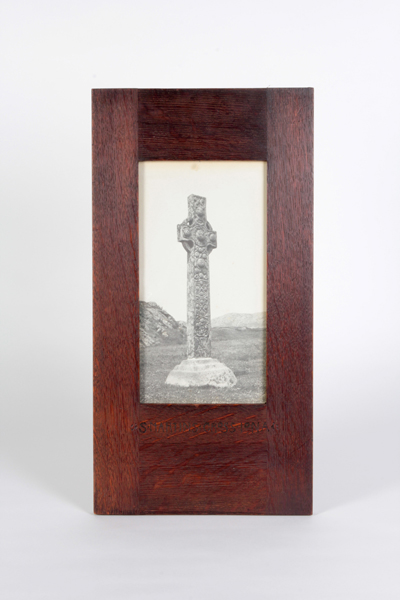
Sydney Pitcher “St. Martin’s Cross Iona” Arts & Crafts photograph c. 1900
SYDNEY PITCHER F.R.P.S. (d. 1950) England
ARTHUR H. PITCHER (Framer)
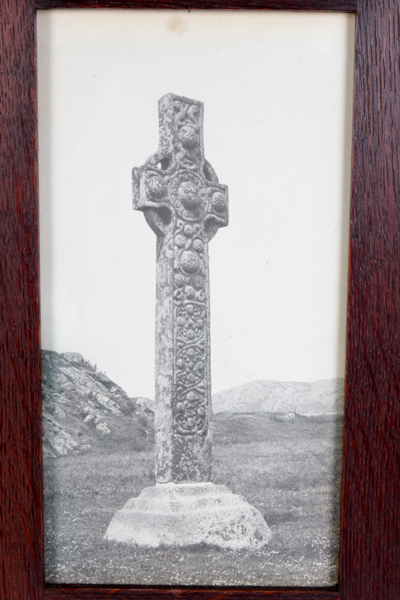
“St. Martin’s Cross Iona” c.1900
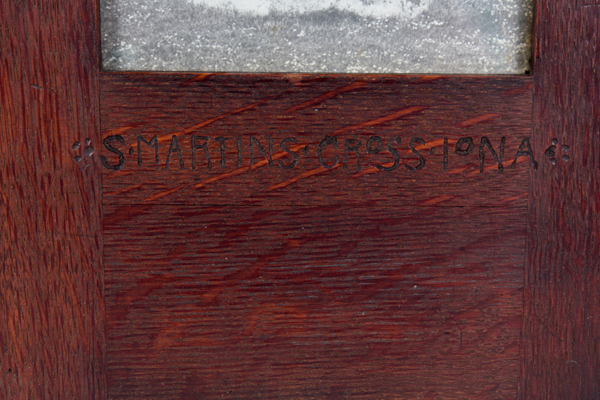
Carbon process photograph, hand carved oak frame with beautiful wood grain detail.
Marks: S MARTINS CROSS IONA (carved incised mark)
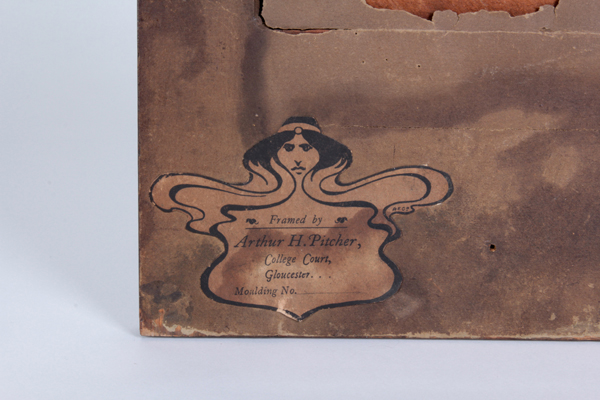
Art Nouveau paper label (on back): Framed by Arthur H. Pitcher, College Court, Gloucester, Moulding No…..
Photograph: H: 9 1/2″ x W: 5″
Frame: H: 16 3/4″ x W: 8 5/8″ D: 5/8″
Sydney A. Pitcher FRPS (active 1904-1939) was a photographer with an interest in monument and church architecture. He is listed in the 1927 Kelly’s Directory of the County of Gloucester as a commercial photographer, publisher and picture frame maker, operating from 5 & 7 College Court, Gloucester. Pitcher was involved primarily in the photography of Gloucestershire churches, but also took pictures of churches and cathedrals in neighbouring counties, and of medieval sculptures at Winchester College. He collaborated on the publication of Rushforth’s series of volumes The stained glass of Great Malvern Priory Church , Gloucester, 1916-1927.
He joined the Royal Photographic Society in 1904, was admitted as an Associate member in 1925, and became a Fellow in 1928.
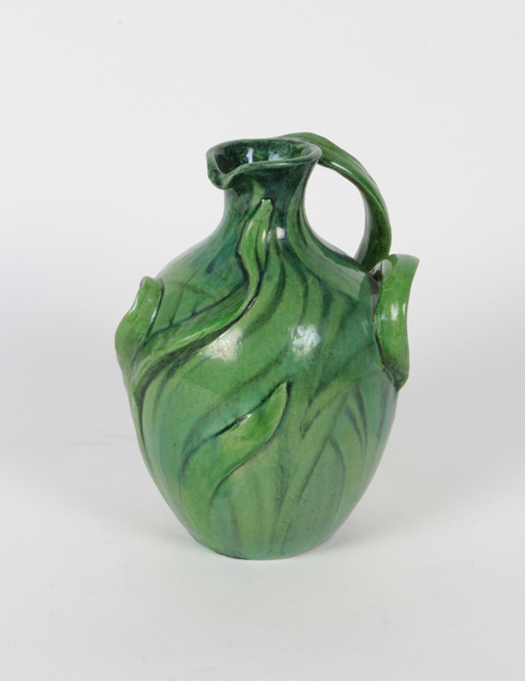
Edmond Lachenal French Art Nouveau Green glazed pitcher / vase form c. 1900
EDMOND LACHENAL (1855-1930) Paris, France
Green glazed pitcher / vase form c. 1900
Marks: E LACHENAL (impressed and glazed in a rectangle on base)
For information on Edmond Lachenal see:”Edmond Lachenal”, Fritz Minkus, Kunst und Kunsthandwerk, IV (1901) pp.390-98; La Céramique Art Nouveau, Edgar Pelichet and Michèle Duperrex (Lausanne: Les Éditions du Grand-Pont, Switzerland, 1976) pp. 66,71,74,78,83,112,115; “l’Atelier Lachenal à la galerie Georges Petit “ in Les Echoes d’Art” (1933), p. Vll; Art Nouveau: Belgium & France, exh. cat. Yvonne Brunhammer et al. (Houston, TX: Institute for the the Arts, Rice University, 1976), p. 48; Le Japonisme (Paris: Éditions de la Réunion des Musées Nationaux, 1988) cat no. 377, p. 321; Japonisme: the Japanese influence on western art in the 19th and 20th Centuries, Siegfried Wichmann (Parklane: New York, 1980) pp. 339, 349; cat. no. 920.
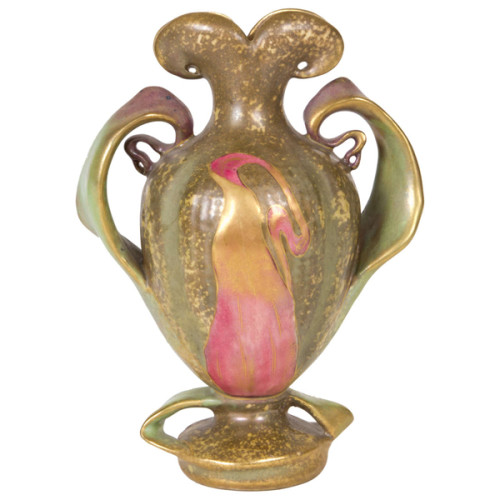
Amphora Art Pottery / Art Nouveau Organic vase c. 1900
AMPHORA ART POTTERY Turn-Teplitz, Austria
Organic vase c. 1900
Glazed earthenware
Marks: AMPHORA (in oval), AUSTRIA (in an oval), 8026, 41
For more information see: Deutsche Kunst und Dekoration, ( March 1901) pp. 346-349; Sammlung Bröhan: Kunsthandwerk, Glas, Holz, Keramik,Vol. 1 Band II (Berlin: Bröhan Museum, 1976), pp. 284-293.


 @hd_jewels