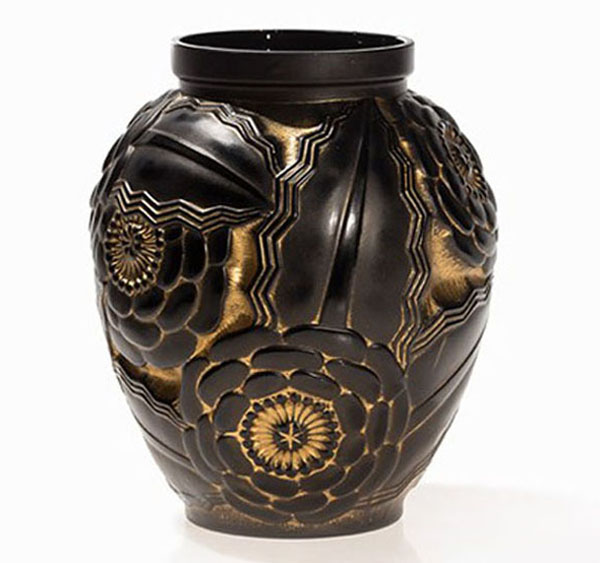
Overall matte finish art glass vase with an elaborate mosaic technique inset with red rectangular patchwork sections and blue murrina jewels all on a chocolate brown body with a black glass foot
Marks: Tsuchida Yasuhiko 99, 77
For more information see: Tsuchida Yasuhiko, exh. cat., Franco Schiavon (Murano, Italy: Palazzo del Vetro, 2000).
Provenance: Pauly & Co. Venice
H: 4 3/4″ x Dia: 5 1/8″
Price: $5,450
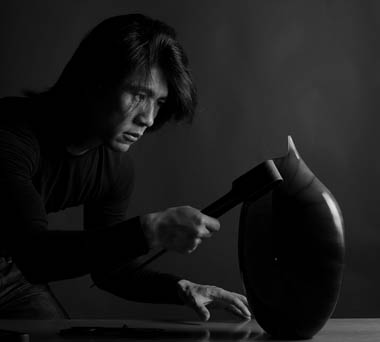
Yasuhiko Tsuchida was born in Osaka, Japan in 1969. In 1988, soon after graduating TSUJI Culinary Institute, he left Japan to explore food and art in Paris. Since 1992, he has lived in Venice, Italy. Tsuchida has been making glass work in Murano Island since 1995, and next year assumed the office of art director at Schiavone Glass Co. Ltd. In 1996 he presented a glass sculpture entitled “Bamboo Collection”
with Japanese motif of bamboo. The work was highly acclaimed, which gave him a chance to start to hold solo exhibitions around the world. In 2000, Tsuchida became a member of the board of directors at Venetian Glass Institute, and a chief director there in 2003. In 2004, he won Honorary Technique Prize in Düsseldorf, Germany, and in 2008, received Award of Contribution to Cultural
Promotion from Grosseto city, Toscana. In the same year, he
represented Japan at International Open Exhibition of Sculpture, and won the Grand-Prix. In 2010, Tsuchida was invited to the Issei Miyake “IM10” Project Competition, and held a solo exhibition at Lorusso Gallery, Andria, Italy. Tsuchida continues to exhibit in many solo shows around the world.
Exhibited: The Twenty One (Millenium) Exhibition, Arzenal Gallery, Prague, 2000
For more information see: Sípek, Philippe Louguet, Dagmar Sedlická (Paris: Éditions Dis Voir, 1999); Borek Sipek and Christian Tortu: Collection Twentyone 2001 (Prague: Arzenal Edition, 2001)
H: 13″ x Dia: 4″
Price: $1,050
The Czech architect, furniture designer, and glass artist Borek Sípek was born in Prague in 1949. From 1964 to 1968 Borek Sípek studied furniture design at the Prague School for the Applied Arts. In 1969 he began to study architecture at the Hochschule für bildende Künste in Hamburg. In 1973 he studied philosophy at Stuttgart University. From 1977 until 1979 he was an academic assistant at the Hannover University Institute of Industrial Design. Borek Sípek took his degree in architecture at Delft Technical University. Then he taught design theory at Essen University until 1983. In 1983 Borek Sípek also opened an architecture and design practice in Amsterdam. He founded Alterego, a design business, with David Palterer. In the 1980s, Borek Sípek designed Postmodern furniture and glass objects, which brought him international renown. Borek Sípek’s designs are formally distinctive, both ingeniously conceived and sumptuous, and are often executed in unconventional materials and combinations of materials. Borek Sípek views design as an interpretation of culture. For this reason, he rejects the functional and rational approach to design and does not want striving for technical perfection to lead to disregard of individuality. In 1983 Borek Sípek designed “Bambi”, a fragile-looking tubular steel chair with brass fittings and a back covered in silk. In 1991 Borek Sípek designed the “PCSS” table with blue glass legs and metal fittings. Borek Sípek’s superlative glass objects are executed by glassblowers in Murano and Novy Bor. Borek Sipek is also known worldwide as an architect and has received prestigious commissions. Between 1993-2002 Borek Sípek worked on the Het Kruithuis Museum in ‘s Hertogenbosch (the Netherlands). In 1994 Borek Sípek designed the Kyoto Opera Houseentsteht das Opernhaus in Kyoto. In 1995 Borek Sípek designed a Paris boutique for Karl Lagerfeld. In 1990 Borek Sípek became a professor of architecture at the Academy for the Applied Arts in Prague, where he taught until 1998. Since 1999 he has taught at the Universität for angewandte Kunst in Vienna.
His works are included in major international museum and private collections throughout the US and Europe including Museum of Modern Art, Stedelijjk Museum, Denver Art Museum, The Corning Museum of Art, The Hauge Municipal Museum, Kunstmuseum in Düsseldorf and Design Museum in London.
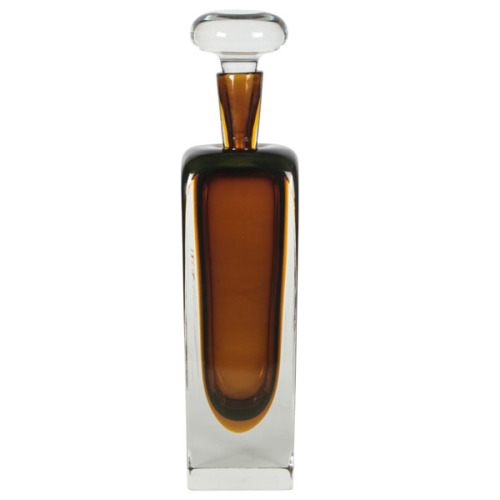
Flavio Poli for Seguso Large Murano Glass Bottle with Stopper c.1950’s
FLAVIO POLI (1900-1984) Italy
SEGUSO VETRI D’ARTE Italy
Bottle with stopper c. 1950’s
Spectacular large decanter or bottle with stopper with a golden cognac cased glass interior tear drop form suspended in a solid clear glass body by FLAVIO POLI (1900-1984) Italy for SEGUSO VETRI D’ARTE Italy
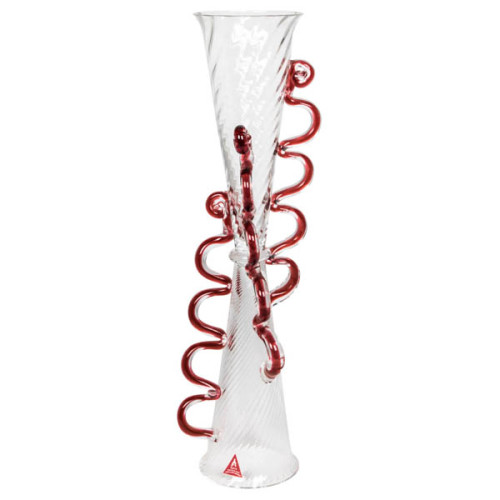
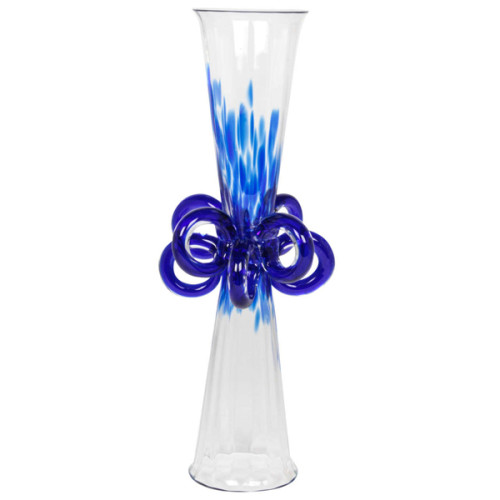
Borek Sipek Bagatti Valsecchi Art Glass Goblet c. 1994
BOŘEK ŠĺPEK (1949-2016) Prague, Czech Republic
Goblet “BAGATTI VALSECCHI” c. 1994
Blown clear glass with blue bow details
Exhibited: The Twenty One (Millenium) Exhibition, Arzenal Gallery, Prague, 2000
For more information see: Sípek, Philippe Louguet, Dagmar Sedlická (Paris: Éditions Dis Voir, 1999); Borek Sipek and Christian Tortu: Collection Twentyone 2001 (Prague: Arzenal Edition, 2001)
H: 12″ x Dia: 4 1/2″
Price: $1,150
The Czech architect, furniture designer, and glass artist Borek Sípek was born in Prague in 1949. From 1964 to 1968 Borek Sípek studied furniture design at the Prague School for the Applied Arts. In 1969 he began to study architecture at the Hochschule für bildende Künste in Hamburg. In 1973 he studied philosophy at Stuttgart University. From 1977 until 1979 he was an academic assistant at the Hannover University Institute of Industrial Design. Borek Sípek took his degree in architecture at Delft Technical University. Then he taught design theory at Essen University until 1983. In 1983 Borek Sípek also opened an architecture and design practice in Amsterdam. He founded Alterego, a design business, with David Palterer. In the 1980s, Borek Sípek designed Postmodern furniture and glass objects, which brought him international renown. Borek Sípek’s designs are formally distinctive, both ingeniously conceived and sumptuous, and are often executed in unconventional materials and combinations of materials. Borek Sípek views design as an interpretation of culture. For this reason, he rejects the functional and rational approach to design and does not want striving for technical perfection to lead to disregard of individuality. In 1983 Borek Sípek designed “Bambi”, a fragile-looking tubular steel chair with brass fittings and a back covered in silk. In 1991 Borek Sípek designed the “PCSS” table with blue glass legs and metal fittings. Borek Sípek’s superlative glass objects are executed by glassblowers in Murano and Novy Bor. Borek Sipek is also known worldwide as an architect and has received prestigious commissions. Between 1993-2002 Borek Sípek worked on the Het Kruithuis Museum in ‘s Hertogenbosch (the Netherlands). In 1994 Borek Sípek designed the Kyoto Opera Houseentsteht das Opernhaus in Kyoto. In 1995 Borek Sípek designed a Paris boutique for Karl Lagerfeld. In 1990 Borek Sípek became a professor of architecture at the Academy for the Applied Arts in Prague, where he taught until 1998. Since 1999 he has taught at the Universität for angewandte Kunst in Vienna.
His works are included in major international museum and private collections throughout the US and Europe including Museum of Modern Art, Stedelijjk Museum, Denver Art Museum, The Corning Museum of Art, The Hauge Municipal Museum, Kunstmuseum in Düsseldorf and Design Museum in London.




 @hd_jewels